

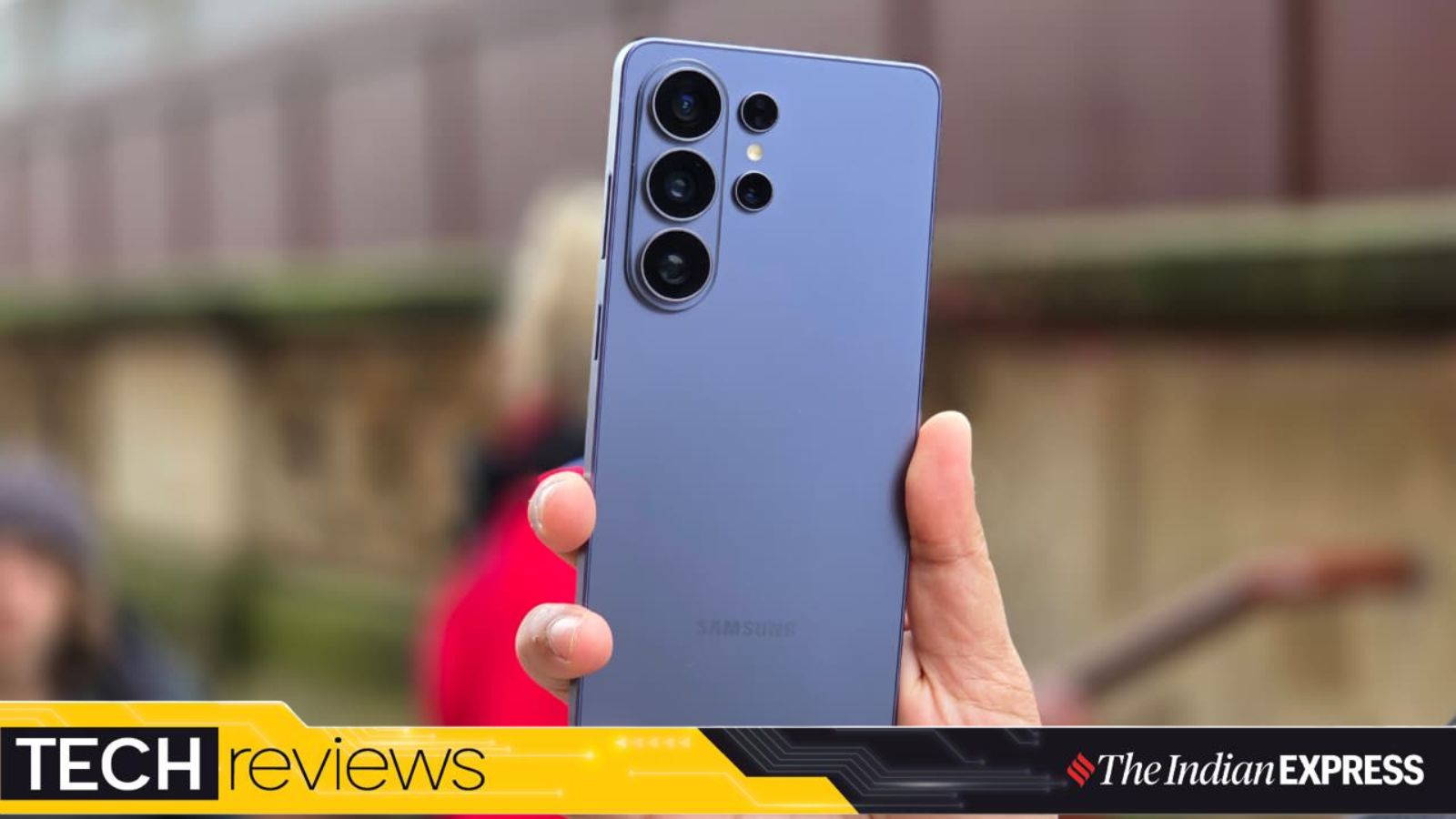
Post Content
There’s something different about Samsung’s flagship smartphone, the Galaxy S26 Ultra, this time—but the change feels internal rather than external. It offers a glimpse of what’s coming to smartphones, setting the record straight on how phones might evolve. The focus is less on physical changes and more on experience and artificial intelligence, with AI becoming a key part of the smartphone story going forward. The S26 Ultra is an interesting smartphone, a strange device in some ways, yet it still behaves like a phone, a device meant to be in your pocket.
Here’s my review of the Samsung Galaxy S26 Ultra.
What: Samsung Galaxy S26 Ultra| Price: Rs 1,39,999 onwards
Lighter and back to aluminium
When I first held the Galaxy S26 Ultra at Unpacked in San Francisco a few days ago, I found the phone’s design to be exactly the same as the S25 Ultra. In fact, for the past three generations, Samsung hasn’t changed its design language. Honestly, many average consumers decide whether to buy a phone based on how the device looks. Well, Samsung hasn’t changed the design of the S26 Ultra, though it swapped the titanium finish on the phone’s frame with Armor Aluminum 2 instead.
Samsung has shaved off a few millimetres of thickness. (Image: Anuj Bhatia/The Indian Express)
Samsung says that while titanium is technically stronger, aluminium increases durability. The company also claims that a new vapour chamber design for cooling results in better heat dissipation in the S26 Ultra. I have been using the S26 Ultra for quite some time, and the phone does feel lighter, as Samsung has shaved off a few millimetres of thickness and some weight (7.9mm and 214 grams), compared with last year’s S25 Ultra (8.2mm and 218 grams), though the difference is negligible on paper.
There is a built-in slot to store the S Pen. (Image: Anuj Bhatia/TheIndian Express)
The phone is more rounded, and there is a built-in slot to store the S Pen, which, until a few years ago, was seen as the defining identity of the Ultra. There are no changes to the S Pen this time around—it’s there, but without any new functional updates.
Privacy display is a game-changer
For me, the S26 Ultra’s 6.9-inch screen is an underrated gem. Sure, the display has more or less the same specs as the S25 Ultra’s: a 6.9-inch panel across the diagonal, up to 2,600 nits of peak brightness, a variable 120Hz refresh rate, and a maximum resolution of 3120×1440.
Also Read | Missed Samsung’s Galaxy S26 launch? Here’s a quick recap of every new announcement
But what’s fascinating about the display (and what made me a huge fan) is the secret Privacy Shield. Using an interlaced duo of wide-output and narrow-output pixels, one could deactivate the wide-output pixels to considerably narrow the field of vision. That’s what Samsung has done to the S26 Ultra—and why it is called Privacy Display. You won’t find it in any other smartphone, at present.
Story continues below this ad
What made me a huge fan is the secret Privacy Shield. (Image: Anuj Bhatia/The Indian Express)
The idea of a Privacy Display is deeply rooted in how we use our phones, and in my case, it works brilliantly. It literally stops people sitting next to you from spying on the conversations you are having on WhatsApp or accessing banking apps. I have had many encounters where people constantly look at my phone in the hope of reading my messages or seeing what I am watching.
When you turn on the Privacy Display and look at the phone from the side, everything fades into black (there’s an extra level called Maximum Privacy Protection that turns almost everything gray). You may still see parts of the UI or bright elements depending on the angle, but snoopers won’t be able to see anything on the screen. It is that effective.
You can always turn off the Privacy Display when it’s not needed. (Screenshot: Galaxy S26 Ultra)
The only downside to the Privacy Display on the S26 Ultra is that its viewing angles are not as wide as those of its predecessor, though this doesn’t impact image quality or brightness. That said, you can always turn off the Privacy Display when it’s not needed.
Stellar performance and lots of AI
The Galaxy S26 Ultra ships with Qualcomm’s Snapdragon 8 Elite Gen 5 (12GB or 16GB of RAM and up to 1TB of storage) but features a slightly tweaked, “for Galaxy” overclocked variant. In India and some other regions, however, the Ultra is the only model with Snapdragon; the S26 and S26 Plus come with Samsung’s 2-nanometer Exynos chip instead.
Story continues below this ad
Also Read | Samsung’s JB Park reveals the ‘secret sauce’ behind Galaxy S26: Why the new flagship is more Indian than you think
I have tried other premium Android phones with the Snapdragon 8 Elite Gen 5 chip, and it impressed me. The performance on the S26 Ultra is the same, though I feel that if you are a gamer, there’s a slight improvement; that’s where the tweaked chip and the new vapour chamber come in handy. This technique, used in many high-performing phones, extracts heat from the chip and disperses it into the rest of the phone’s body to cool it down, keeping it running at peak performance for longer.
The S26 Ultra’s 6.9-inch screen is an underrated gem. (Image: Anuj Bhatia/The Indian Express)
I have played Genshin Impact, and it works well, with the back staying cooler than previous Galaxy phones during extended gaming sessions, while producing better frame rates and being less sweaty to hold. I have had dozens of apps open in the background and even used my S26 Ultra like a laptop during a long-haul flight from Delhi to Los Angeles. The phone felt snappy—exactly what you expect when you pay a premium for a device.
The battery life is solid for a phone of this size, delivering about seven hours of active screen time on a mix of 5G and Wi-Fi. Initially, I feared the 5,000mAh cell wouldn’t be enough, but I was wrong. On heavy-use days, whether out and about, playing lots of games, or streaming Netflix, the S26 Ultra still managed to end the day with a healthy 20 per cent left in the tank. The 60W wired charging is effective and a welcome upgrade. However, I am still surprised to see the lack of a built-in magnetic ring for the Qi2 charging.
Also Read | I used Samsung’s Galaxy S26 Ultra at Unpacked in San Francisco: Here’s what I learnt
Coming to AI, Samsung has pitched the Galaxy S26 Ultra as an ‘AI agentic’ smartphone, a step up from the AI phone we have seen. I have previously explained in detail what that means and how it might change smartphones forever.
Story continues below this ad
I still feel that the Galaxy S26 Ultra is just the first step in how AI will change the phone experience, and the features currently being shipped are just a preview, not fully finished.
Although there are many AI features in the S26 Ultra, I particularly liked Photo Assistant, which doubles as a one-stop shop for your editing and creative needs. Then there’s Creative Studio, where you can easily create fun stickers and collections, including using your own photographs. I was especially eager to try the Agentic AI feature, where you can ask it to order an Uber, and it acts as an “agent” on your behalf via Automated App Actions. Unfortunately, that feature is limited to the US and South Korea at launch.
The Universal Search feature, for example, asking “show me pictures from Tokyo”, is really handy, and how Samsung has integrated cross-AI platforms is impressive, thanks to its partnership with Perplexity. However, the experience may vary depending on how much you actually use the Perplexity app.
There’s also an improved document scanner and a call screen that’s effective at blocking spam and robocalls. A notable feature as part of Galaxy AI is Now Nudge, which can surface relevant photos based on context at any time using the Samsung keyboard. The idea behind Now Nudge is similar to Google’s Magic Cue.
Story continues below this ad
A camera setup you can trust
I have noticed that the camera sensors on the S26 Ultra haven’t really changed from those on its predecessor, but there are some subtle upgrades. What has changed, however, is that the main and 5x telephoto cameras now have wider apertures for handling increased light input. Otherwise, the core specs remain the same, including the 50-megapixel 5x telephoto zoom, the ultra-resolution 200MP main camera, and the in-between 10-megapixel snapper with a 3x optical zoom.
The main and 5x telephoto cameras now have wider apertures. (Image: Anuj Bhatia/The Indian Express)
The main camera produces very good, well-balanced photos full of detail. In fact, it captures great shots across a range of lighting conditions and is particularly good for street photography, delivering solid detail. I roamed the streets of London and found the S26 Ultra’s camera produced true-to-life shots. I also liked Samsung’s automatic portrait mode, which is reliable and works with objects, not just people and pets. One thing I really appreciated about the S26 Ultra’s shots, however, was its performance at night.
Here are some camera samples I shot on the S26 Ultra:
Image resized for web.Image resized for web.Image resized for web.Image resized for web.Image resized for web.Image resized for web.Image resized for web.Image resized for web.Image resized for web.Image resized for web.
What’s also impressive is the video mode on the S26 Ultra. The Super Steady Video, for example, locks the horizon, stabilising the horizontal position regardless of your movement, and I would say it works really well. There are also pro features such as LOG shooting (with LUT application), but you need to be the type of user who cares about such features.
So, should you buy the Samsung Galaxy S26 Ultra?
By now, it is clear that the Galaxy S26 Ultra revisits the formula that made the ‘Ultra’ phones so good in the first place. Its superior camera, long battery life, powerful performance, and game-changing Privacy Screen make Samsung’s Galaxy S26 Ultra the king of Android flagships this year.
Story continues below this ad
However, the higher starting price of the S26 Ultra at Rs 1,39,999, compared with Rs 1,29,999 for the S25 Ultra, makes me question if AI has something to do with the rising cost of smartphones, especially when average wages are stagnant and not keeping up with inflation. If it is, then I am not a huge fan of the S26 Ultra’s higher price tag. I highly recommend the S26 Ultra if you are ready to pay a higher price, because the device is the best single-screen smartphone on the market.
