

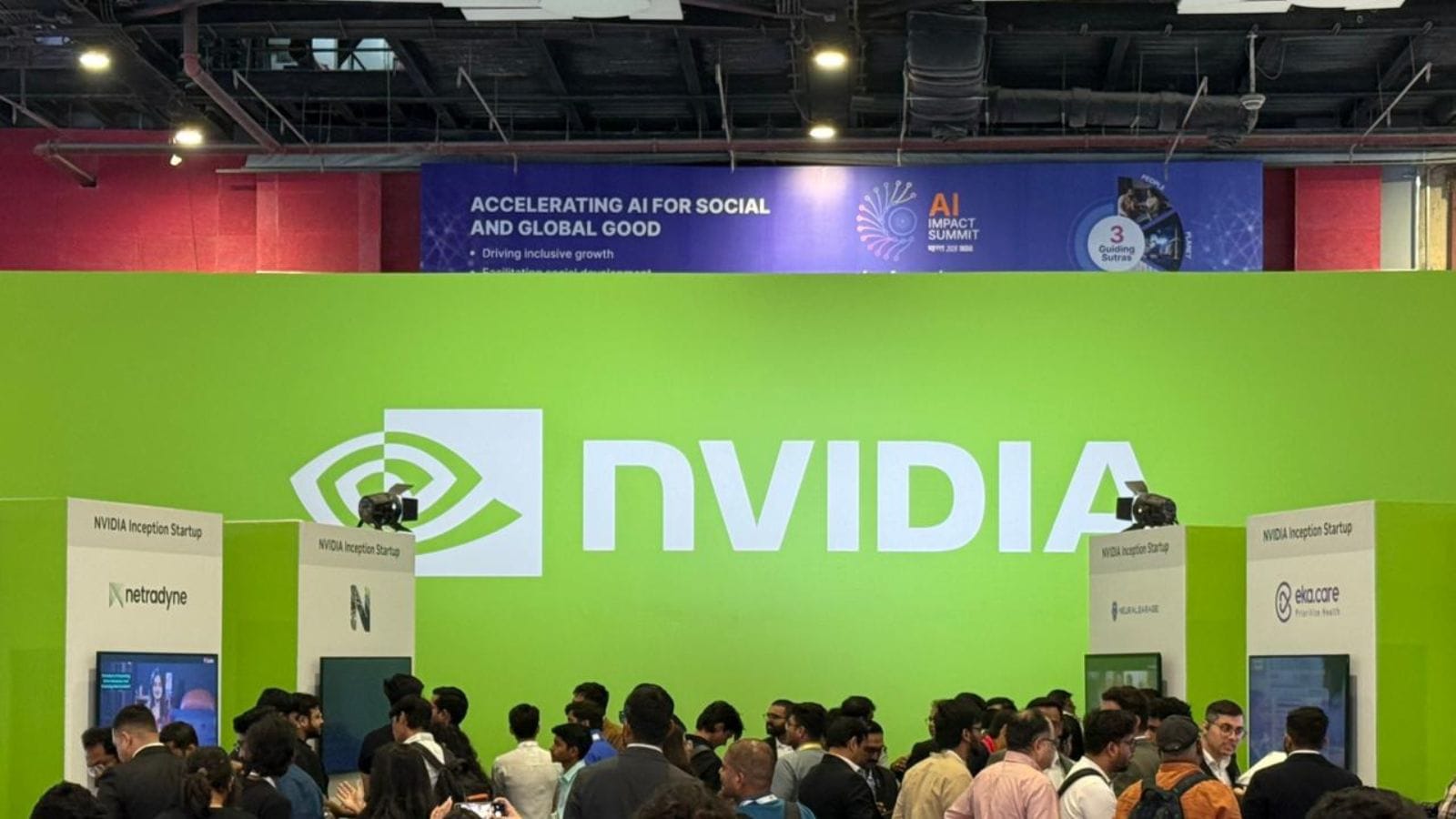
Post ContentThe Nvidia booth at the AI Impact Expo, Bharat Mandapam, New Delhi. (Express Image)
Nvidia GTC, one of Nvidia’s biggest conferences of the year, begins Monday, March 16, and runs till Friday. It is being held in San Jose, California, with CEO Jensen Huang set to deliver his highly-anticipated keynote speech onstage at the SAP Center.
Huang will likely reveal new chips, products, and partnerships geared toward keeping Nvidia in the lead amid a rapidly expanding field of competitors. The four-day GTC, short for GPU Technology Conference, has evolved into a major event for the chipmaker over the years, where it showcases its latest advances in chips, data centers, its chip programming software CUDA, digital assistants known as AI agents, and physical AI such as robots, etc.
This year’s conference, however, is closely watched by investors looking for signals that Nvidia’s strategy of putting back its profits into the AI ecosystem is actually paying off.
The event also comes at a time when the overall AI chip market is growing, with some analysts reportedly estimating that Nvidia’s slice might shrink as the AI industry’s focus moves beyond training AI models to inference, which can run on other kinds of chips, such as the TPUs (Tensor Processing Units) developed by Google and Amazon’s Trainium chips.
Here’s what we might likely see at Nvidia GTC 2026 in San Jose.
New AI chip
In December last year, Nvidia agreed to pay $20 billion to AI chip startup Groq to licence its AI inference hardware, while recruiting several of its employees, including its founder. The non-exclusive licensing deal is reportedly Nvidia’s largest purchase of any technology so far.
Also Read | NVIDIA CEO Jensen Huang’s GTC 2025 keynote: Physical AI, Rubin chips, and more
Now, reports suggest that Nvidia will likely introduce a new chip that has been developed by harnessing Groq’s inference technology. Inference is one of the steps involved in developing large language models (LLMs), where the model is made to generate outputs on previously unseen data. It is gradually becoming a larger and more competitive part of the AI computing process, even as AI adoption goes mainstream and customers seek out cost-effective ways to meet the booming demand.
Story continues below this ad
Groq integrations
In an earnings call last month, Huang said that Nvidia will showcase at this year’s GTC, how it can plug Groq’s ultra-fast inference technology into the company’s existing CUDA platform.
Analysts also expect Nvidia to roll out a new line of servers that will combine Groq’s specialised chips with Nvidia’s networking technologies to create a speedy and cost-efficient product, as per a report by Reuters.
CPU-only servers
While CPUs (central processor units) have taken a backseat to Nvidia’s GPUs in recent years, analysts said that Nvidia is likely to show off CPU-only servers at this year’s GTC. In the recent earnings call, Huang reportedly talked up CPUs, signalling that the chip could be back in focus.
Next-gen GPUs
Nvidia is expected to provide an updated roadmap of its next-gen GPUs, including the latest Vera Rubin family of chips which is due to ship in the second half of 2026. In last year’s GTC keynote, Huang had also shared a few details about Feynman GPUs, named after American theoretical physicist Richard Feynman, which it plans to bring to market sometime in the next two years.
Story continues below this ad
Also Read | GTC 2025: Nvidia unveils Groot N1, an AI model to power next-gen humanoid robots
Chip equipment
Earlier this month, Nvidia announced it is investing $2 billion each in Lumentum and Coherent, both of which make lasers for sending information between chips in the form of beams of light. Analysts expect Nvidia to showcase how the use of these lasers within co-packaged optics could help speed up the connections among its chips housed inside huge data centres.
Nemo Claw
Recent reports suggest that Nvidia is planning to introduce an open-source platform for AI agents called ‘NemoClaw’ to rival the popular OpenClaw, which has come under scrutiny for security threats. NemoClaw will reportedly be designed with enterprise-grade security, privacy protection, and scalable task automation. It will likely be deeply integrated with Nvidia’s NeMo framework, the Nemotron model series, and Nvidia Inference Microservices. The platform is also said to be hardware-agnostic, meaning it can run on any device and be powered by Nvidia, Intel, AMD, or other processors.
Physical AI
At last year’s GTC, one of the key moments onstage was Huang’s interaction with a Star Wars-like robot powered by Newton, a physics engine that can simulate robotic movements in real-world settings. Newton has been developed in collaboration with Disney and Google DeepMind. The company also unveiled an AI foundation model for humanoid robots called Groot N1 at GTC 2025.
This year, too, robotics is expected to feature prominently in Huang’s keynote with analysts predicting that physical AI could be a multi-trillion-dollar industry in the coming decades.
