

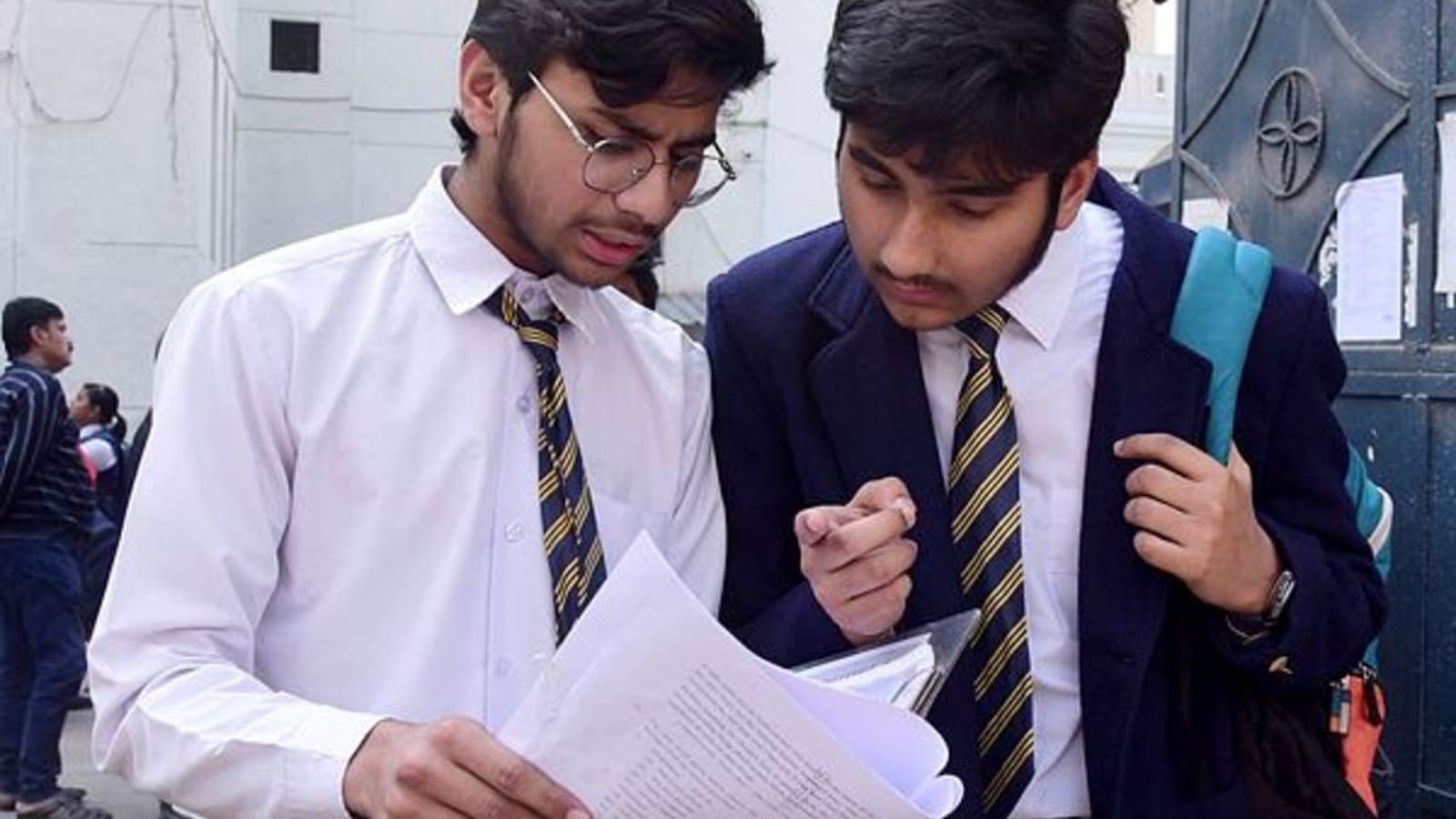
CBSE Class 12 political science paper on March 23 (Express Photo by Vishal Srivastav/ representative)
By Diljeet Kaur
The Class 12 Political Science CBSE paper is mostly NCERT-based and designed to test conceptual understanding with application-based, tricky queries, as seen in the 2025 examinations. Covering Contemporary World Politics and Indian Politics since Independence, the exam is meticulously designed to fathom the depth of students ‘understanding by employing a wide range of question types and evaluative techniques.
Chapter wise weightage is as under:
PART A – CONTEMPORARY WORLD POLITICS
Chapter No.
Chapter Name
Marks Allotted
1
The End of Bipolarity
6
2
Contemporary Centres of Power
6
3
Contemporary South Asia
6
4
International Organizations
6
5
Security in the Contemporary World
6
6
Environment and Natural Resources
6
7
Globalisation
4
Total
40
PART B – POLITICS IN INDIA SINCE INDEPENDENCE
Chapter No.
Chapter Name
Marks Allotted
1
Challenges of Nation-Building
6
2
Era of One-Party Dominance
4
3
Politics of Planned Development
2
4
India’s External Relations
6
5
Challenges to and Restoration of the Congress System
4
6
The Crisis of Democratic Order
4
7
Regional Aspirations
6
8
Recent Developments in Indian Politics
8
Total
40
As per the CBSE Board Instructions 50% paper will be competency based.
The most important topics are:
– Contemporary Centres of Power– International Organizations– Challenges of Nation Building– Environment and Natural Resources– Recent Developments in the Indian Politics
Read More | CBSE introduces online remote invigilation exam for school counsellors
Though Political Science is a theoretical subject but using memory techniques really help. I am providing some examples to create Mnemonics:
PANCHSHEEL-
P-Peaceful Coexistence
A-Aggression Non-use
N-Non-interference
C-Cooperation
H-Human Equality
S-Sovereignty
E-Equality
L-Legal Equality
Features of Globalization:
`TIDE`
T-Technology
I-Interdependence
D-Deregulation
E-Expansion of Markets
India`s Challenges:
`DID`
D-Development
I-Integration
D-Democracy
Causes of Disintegration of USSR:
SOVIET FAIL
S-Stagnant Economy
O-Over Centralization
V-Violation of people freedom
I-Inefficient Political System
E-Economic burden of arms race
T-Trade Restriction with West
F- Failure of Reforms
A- Administrative Corruption
I-Ideological Decline
L-Lack of trust in leadership
2. Do not just read your notes; instead, summarize key points in your own words and create mind maps to truly understand complex topics These are great help for last minute revision.
Story continues below this ad
3. Allocate specific time blocks for each chapter, ensuring your toughest topics are covered when your mind is freshest, such as in the morning.
4. Break answers into Introduction-Body-Conclusion. Begin the answer with clear definition and use sub headings. Write answers in points.
5. Be sure to block out time for breaks and relaxation in your schedule; a well-rested mind is essential for effective studying
6. Turn off distractions like social media. Identify your weak areas during your first revision, and allocate extra time in your schedule to focus on those topics.
Story continues below this ad
Most Important– Solve Maximum Sample Papers. Revise Previous Year Question Paper
Attempt Paper in a sequence -Section Wise
Remember, the hard work you put in today is the most valuable investment you can make in yourself.
Good Luck for your exams!
The author is PGT Political Science, HOD Social Science, Manav Rachna International School, Ludhiana
