

No payments are being made for the safe transit of Indian tankers out of the Persian Gulf through the Strait of Hormuz, and no permission is required from Iran either for the passage, although given the prevailing situation in West Asia, movements are being made based on safety assessments, a senior government official said on Tuesday. There has been considerable speculation that for ships to transit the fraught waters of the Strait of Hormuz—a critical maritime chokepoint between Iran and Oman—they are being required to seek specific permissions from Tehran. There was also speculation that certain vessels have had to pay millions of dollars to the Iranian authorities to cross the strait; Iran on its part has dismissed such claims.
“No permission is required to sail through the strait…There is freedom for navigation through the strait. Since the strait is narrow, only the entry and exit lanes are demarked which need to be followed by shipping lines…it is the decision of the charterer and shipping company when to sail or when not to sail,” said Shipping Ministry Special Secretary Rajesh Kumar Sinha, adding that the narrow waterway is an international strait and is free for international vessel movements.
“Since these are special circumstances, they assess the situation with regard to safety, etc., before deciding. No permission is required,” Sinha said, adding that no fees or protection money is being paid for the safe passage of the ships. Two India-flagged LPG tankers—Pine Gas and Jag Vasant—crossed the strait on Monday, and are on their way to India. There are now 20 India-flagged vessels with 540 Indian seafarers in the Persian Gulf, waiting to cross the strait. Of these, there are five LPG tankers with 2.3 lakh tonnes of LPG, while another empty LPG tanker has begun loading the fuel. Other vessels stuck in the Persian Gulf include four crude oil tankers, one LNG tanker, one chemical products, three container ships, two bulk carriers, and three vessels undergoing routine maintenance.
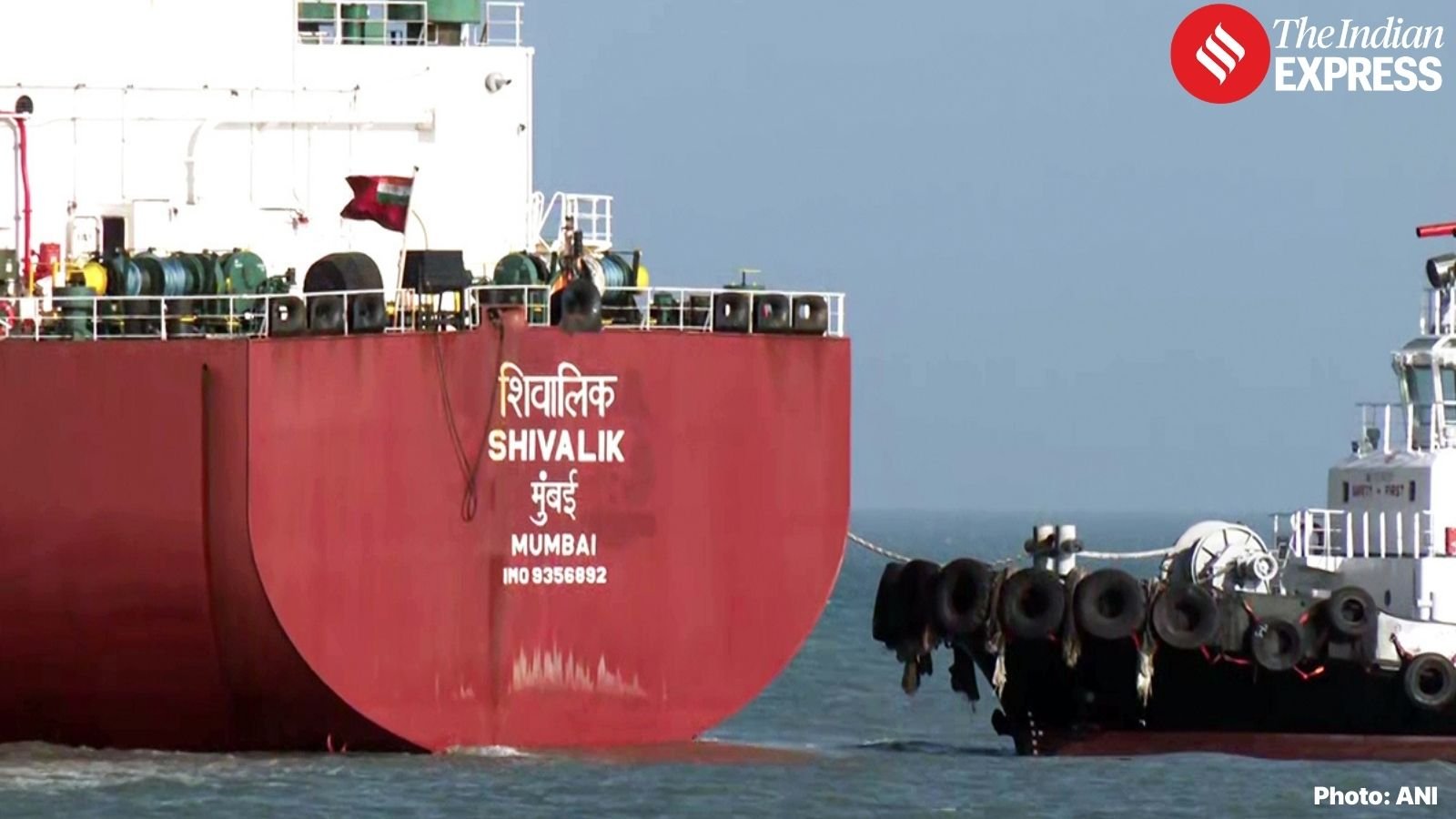
India has been engaged with Iran at the diplomatic level for safe passage of Indian ships through the Strait of Hormuz, which earlier helped two LPG tankers—Shvalik and Nanda Devi—to transit the strait a few days back. In an interview to the Financial Times last week, Foreign Minister S Jaishankar said that there was no “blanket arrangement” with Iran for India-flagged ships, “every ship movement is an individual happening”, he added, while saying that he remained engaged in talks with Tehran. Iran’s Foreign Minister Seyed Abbas Araghchi had told CBS that Iran was “open” to countries that want to discuss “safe passage of their vessels”. Notably, as was the case with Shivalik and Nanda Devi, the transit of Jag Vasant and Pine Gas came close on the heels of a conversation between Prime Minister Narendra Modi and Iran’s President Masoud Pezeshkian.
Jag Vasant and Pine Gas crossed the Strait of Hormuz using a route—through Iran’s territorial waters—that industry experts believe allows Tehran to run a checkpoint and regulate vessel movements through the chokepoint. According to ship tracking data, the two LPG tankers sailed through the waters between Iran’s Larak and Qeshm islands on Monday afternoon. Jag Vasant is expected to reach the Kandla port on March 26, while Pine Gas is likely to arrive at the New Mangalore port the next day. The two tankers are cumulatively carrying around 92,600 tonnes of LPG; India’s daily LPG demand under normal circumstances is around 90,000 tonnes.
Various other vessels that have managed to safely trickle out of the Persian Gulf over the past few days took a similar longer and circuitous path before crossing the Strait of Hormuz, as against the shorter and straighter conventional path through the middle of the strait, ship tracking data shows. Nanda Devi and Shivalik were also estimated to have taken the same route, as did vessels from other countries including Pakistan, Turkey, and Greece. According to observers, this type of an unusual routing through Iran’s territorial waters suggests that the vessels are being verified by Iran before they exit the Persian Gulf.
While Iran has been claiming that the strait is closed only for vessels linked to the US, Israel, and their allies, a few vessels of evidently neutral countries had also come under attack. This led to most trading houses, insurers, and vessels becoming loath to transit the Strait in the extremely high-risk environment. The strait accounts for one-fifth of global oil and LNG flows. As for India, around 40% of the country’s crude oil imports, over 55-60% of its LNG imports, and a whopping 90% of its LPG imports flow through the strait, making the chokepoint critical for India’s energy imports, particularly LPG supplies.
Story continues below this ad
Iran’s Ministry of Foreign Affairs said Monday that the country has adopted a “responsible approach” by implementing “a series of precautionary measures” to prevent the “additional risks on ships and seafarers in the Persian Gulf, the Strait of Hormuz, and the Sea of Oman”, and the strait remains open to vessels, except for those linked to the US, Israel, and their allies. “Accordingly, and as repeatedly emphasized, the Strait of Hormuz is not closed, and maritime traffic through it has not been suspended. Navigation in the Strait continues, subject to compliance with the aforementioned necessary measures and considerations arising from the wartime situation,” it said in a statement.
“Non-hostile vessels, or those belonging to or affiliated with other countries, provided that they do not participate in or cooperate with acts of aggression against Iran and comply with the declared safety and security regulations and measures, may, in coordination with the competent Iranian authorities, benefit from safe passage through the Strait of Hormuz,” it added, while maintaining that vessels linked to the US, Israel, and their allies “do not qualify as engaging in normal and non-hostile passage”.
“The Ministry of Foreign Affairs of the Islamic Republic of Iran once again emphasizes that any arrangements, initiatives, or mechanisms related to the safety and security of navigation in the Persian Gulf, the Strait of Hormuz, and the Sea of Oman must be undertaken with full respect for the rights and interests of the Islamic Republic of Iran, in coordination with its competent authorities, and with due regard to the realities arising from the aggression and the situation of conflict,” the statement read.
Furthermore, the Iranian Embassy in Delhi dismissed claims that payments were being made by vessels to Iran in order to transit the strait. “In response to certain claims regarding the alleged receipt of a sum of 2 million dollars by the Islamic Republic of Iran from vessels transiting the Strait of Hormuz, it is emphasized that such claims are unfounded. The statements made in this regard merely reflect the personal views of individuals and do not, in any way, represent the official position of the Islamic Republic of Iran,” the Iranian embassy posted on social media platform X.
