

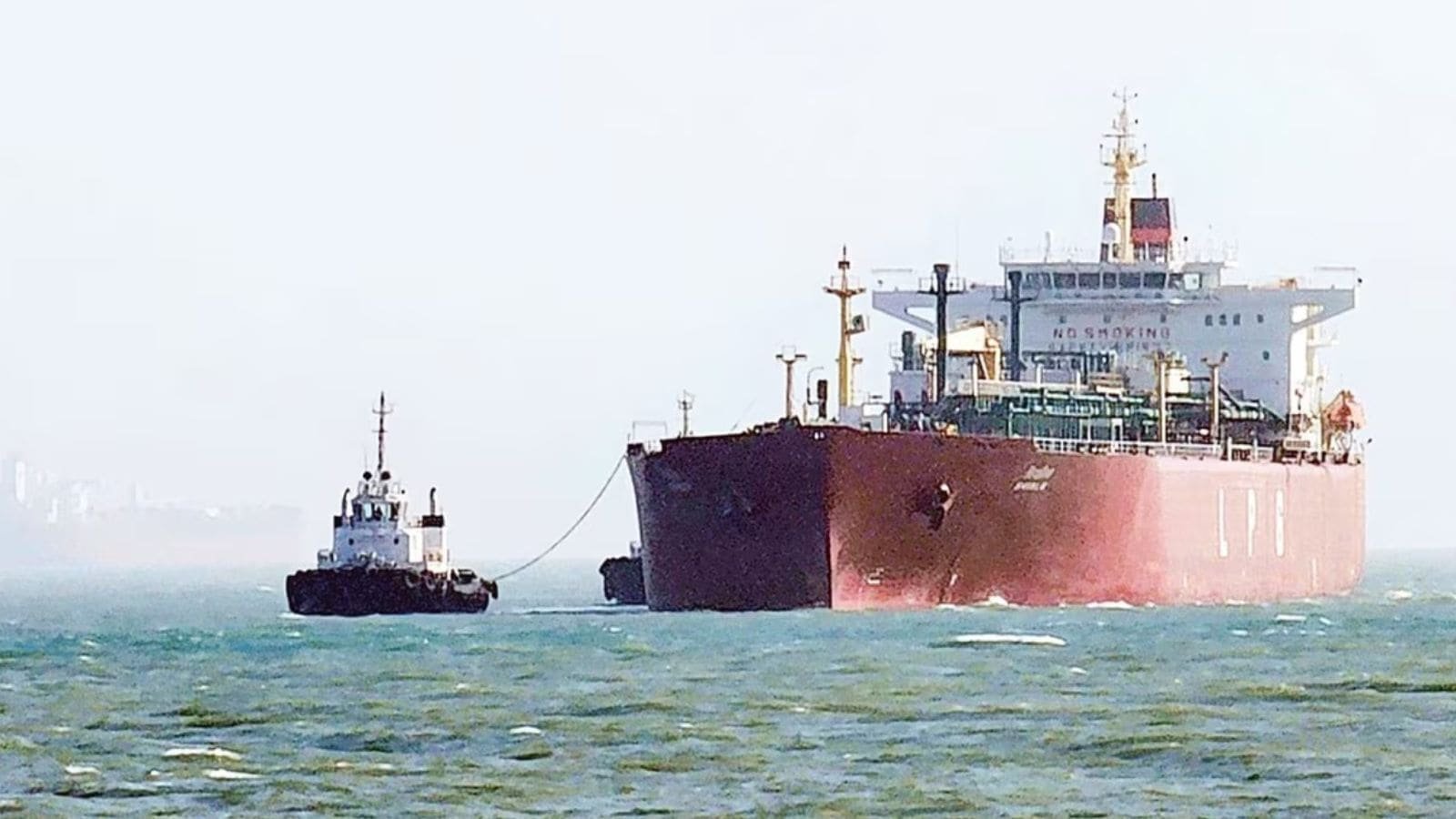
Two days after the last India-flagged vessel crossed the Strait of Hormuz, another Indian ship—liquefied petroleum gas (LPG) tanker Green Asha—crossed the fraught waters of the Strait on Sunday, vessel tracking data shows. As of 3:30 pm India time on Sunday, Green Asha had crossed over to the east of the Strait, after transiting through Iranian waters between Iran’s Larak, Qeshm, and Hormuz islands, according to ship tracking data. Green Asha is estimated to be carrying around 20,000 tonnes of LPG, according to trade sources, and is the eighth Indian India-flagged merchant ship to transit the Strait since the West Asia war began; all the eight have been LPG tankers.
ARTICLE CONTINUES BELOW VIDEO
[embedded content]
Green Asha is a mid-sized gas carrier (MGC) owned by MOL India, according to shipping databases. MOL India is the Indian arm of Japan-based global shipping giant Mitsui OSK Lines. The tanker has a deadweight capacity of over 26,000 tonnes. Deadweight tonnage is the total weight a vessel can carry, including cargo, fuel, fresh water, ballast water, provisions, and crew. The seven other Indian LPG tankers that crossed the Strait of Hormuz over the past few weeks were very large gas carriers (VLGCs), with more than double the LPG carrying capacity than an MGC.
On Friday, The Indian Express had reported that India-flagged LPG tanker Green Sanvi had crossed the Strait, and two more Indian LPG carriers—Green Asha and Jag Vikram—were expected to follow suit in a matter of days. After Green Asha’s departure from the region, there will be 16 India-flagged vessels in the Persian Gulf, which is to the west of the Strait of Hormuz. These include at least two more LPG tankers, four crude oil tankers, one liquefied natural gas (LNG) tanker, one chemical products tanker, three container ships, two bulk carriers, and a few vessels undergoing routine maintenance.
Image Credit: MarineTraffic
While transiting the Strait of Hormuz, Green Asha was signalling that it was an Indian ship with Indian crew on board. Such identity broadcasts have become a standard of sorts among vessels crossing the Strait in coordination with Iranian authorities, which are regulating vessel movements. The Strait of Hormuz is a narrow waterway between Iran and Oman that connects the Persian Gulf with the Arabian Sea and is a critical maritime chokepoint for global energy flows. Around one-fifth of global oil and gas flows transited the Strait before the war began.
India is among the countries that have been engaged with Iran at the diplomatic level for safe passage of their ships through the Strait of Hormuz, where Tehran has brought vessel movements to an effective halt amid the ongoing West Asia war. Last week, Iran said that non-hostile vessels linked to countries other than the US, Israel, and their allies can cross the strait in coordination with Iranian authorities. Iran’s Foreign Minister Abbas Araghchi had said the strait remains operational for nations that have engaged with Tehran and are considered friendly, adding that vessels from China, Russia, India, Iraq, and Pakistan had been allowed to move their vessels from through the maritime chokepoint, according to Iranian State TV.
The effective closure of the Strait of Hormuz has hit energy supplies to India, which depends on imports to meet a bulk of its energy needs. Around 40% of India’s crude oil imports, over 50% of its LNG imports, and a whopping 90% of its LPG imports came from West Asia through the Strait, making the chokepoint particularly critical for India’s LPG supplies. India’s annual LPG consumption stands at a little over 33 million tonnes, or about 90,000 tonnes a day, with an import dependency level of 60%. With 90% of India’s LPG imports coming from West Asia, the Strait of Hormuz effectively sees the movement of around 54% of India’s LPG consumption.
Scores of vessels have been stranded in the Persian Gulf since the war began, with only a few being able to safely transit the Strait, and that, too, in coordination with Iran. Like most other vessels that have been able to cross the Strait, Green Asha also sailed through Iranian waters between the country’s Larak and Qeshm islands, instead of taking the shorter and straighter conventional path through the middle of the strait, ship tracking data shows. The rather unusual routes through Iran’s territorial waters taken by vessels that recently transited the Strait of Hormuz are a major signal of Tehran running a checkpoint of sorts and regulating the flow of maritime traffic through the Strait.
Story continues below this ad
Also Read | How an Indian LPG tanker escaped Hormuz via an unusual route
Last week, Iran’s Ministry of Foreign Affairs said that the country has adopted a “responsible approach” by implementing “a series of precautionary measures” to prevent the “additional risks on ships and seafarers in the Persian Gulf, the Strait of Hormuz, and the Sea of Oman”. “Accordingly, and as repeatedly emphasized, the Strait of Hormuz is not closed, and maritime traffic through it has not been suspended. Navigation in the Strait continues, subject to compliance with the aforementioned necessary measures and considerations arising from the wartime situation,” it said in a statement.
“Non-hostile vessels, or those belonging to or affiliated with other countries, provided that they do not participate in or cooperate with acts of aggression against Iran and comply with the declared safety and security regulations and measures, may, in coordination with the competent Iranian authorities, benefit from safe passage through the Strait of Hormuz,” it added, while maintaining that vessels linked to the US, Israel, and their allies “do not qualify as engaging in normal and non-hostile passage”.
“The Ministry of Foreign Affairs of the Islamic Republic of Iran once again emphasizes that any arrangements, initiatives, or mechanisms related to the safety and security of navigation in the Persian Gulf, the Strait of Hormuz, and the Sea of Oman must be undertaken with full respect for the rights and interests of the Islamic Republic of Iran, in coordination with its competent authorities, and with due regard to the realities arising from the aggression and the situation of conflict,” the statement read.
