

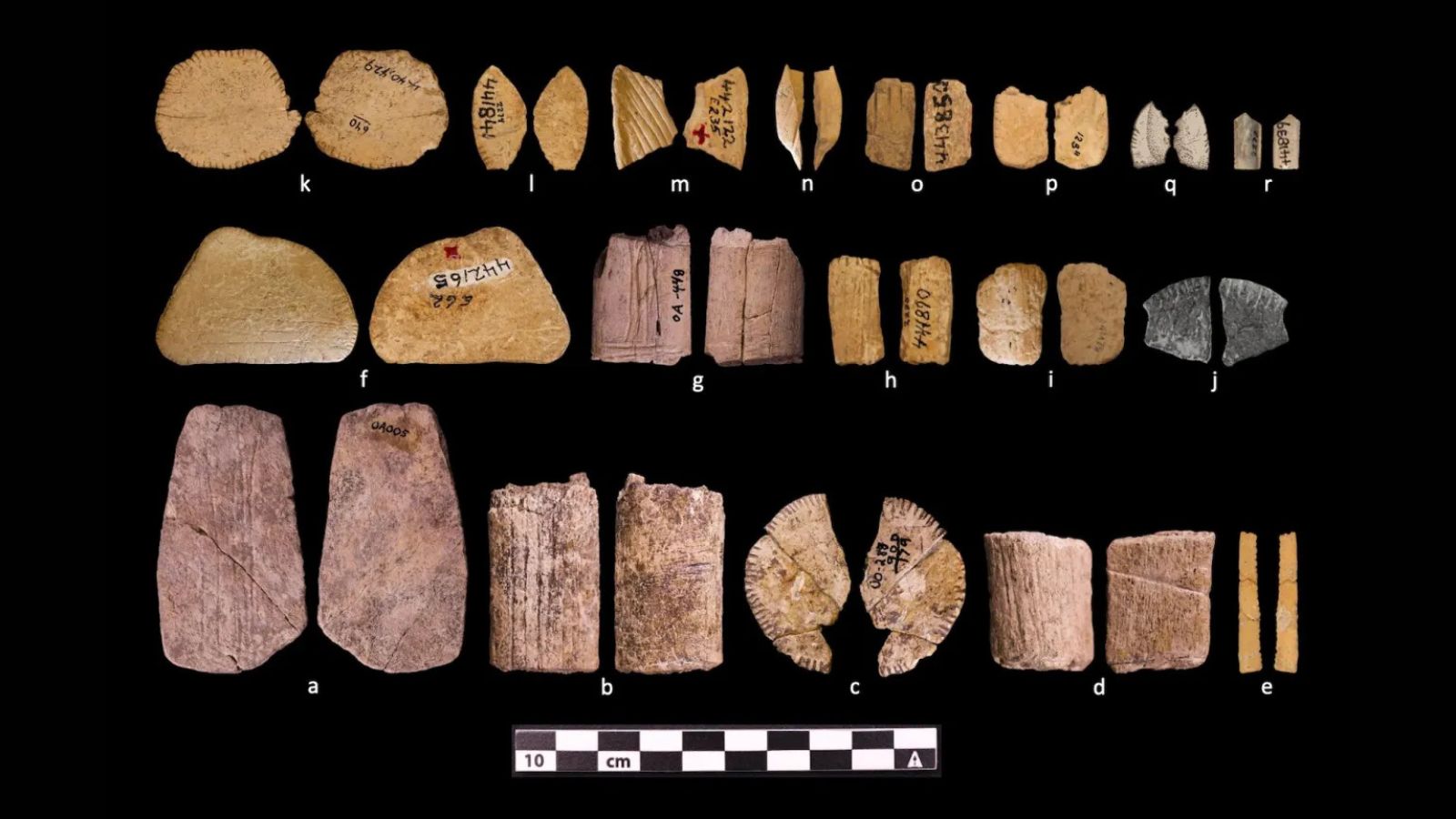
Post Content These artefacts date back roughly 12,800 to 12,200 years, making them more than 6,000 years older than previously known dice from other parts of the world. (Image: American Antiquity)
A recent archaeological study has brought to light fresh insight into the history of gambling and the playing of dice. The study has revealed that the earliest form of dice was used by Native American hunters as far back as 12,000 years ago.
The findings, published in the journal American Antiquity on April 2, suggest that structured games of chance existed in North America thousands of years before similar objects appeared in Bronze Age societies in the Old World.
Ancient origins of dice
The research led by Robert J Madden, a PhD student at Colorado State University, shows that dice and gambling were already part of life during the Late Pleistocene, near the end of the last Ice Age.
The oldest examples were discovered at Folsom-period sites across present-day Wyoming, Colorado, and New Mexico. These artefacts date back roughly 12,800 to 12,200 years, making them more than 6,000 years older than previously known dice from other parts of the world.
“Historians have traditionally treated dice and probability as Old World innovations,” Madden told SciTechDaily. “What the archaeological record shows is that ancient Native American groups were deliberately making objects designed to produce random outcomes, and using those outcomes in structured games, thousands of years earlier than previously recognised.”
‘Binary lots’
Unlike modern cube-shaped dice, these early objects were much simpler in form. They were small pieces of bone, carefully shaped and designed to fit comfortably in the hand.
Also Read | Shroud of Turin, linked by believers to Jesus Christ, has Indian DNA traces: Study
The items were known as ‘binary lots.’ They had two different faces, like a coin. These faces were differentiated by some means, making it easy to tell them apart. Tossing these produced only two outcomes. Players would often throw multiple pieces at once, and the outcome depended on how many landed on the designated counting side.
Story continues below this ad
“They’re simple, elegant tools,” Madden said. “But they’re also unmistakably purposeful. These are not casual byproducts of bone working. They were made to generate random outcomes.”
New methods of identification
One of the challenges in studying these objects has been correctly identifying them. Many had previously been labelled as general ‘gaming pieces’ or overlooked entirely.
To address this, the study introduced a new method based on measurable physical features. This approach was built using comparisons with 293 sets of historic Native American dice documented in earlier ethnographic research.
Using this system, Madden reviewed older collections and identified more than 600 likely dice across archaeological sites spanning thousands of years. These sites span 12 US states and encompass multiple cultural periods, from early hunter-gatherers to later societies.
Story continues below this ad
“In most cases, these objects had already been excavated and published,” Madden said. “What was missing wasn’t the evidence, it was a clear, continent-wide standard for recognising what we were looking at.”
Many of the earliest examples were also examined directly in museum collections, including those held by the Smithsonian Institution and other research centres.
More than just games
Until now, scholars believed that games involving randomness — and the early ideas behind probability — first appeared around 5,500 years ago in more complex Old World societies.
Also Read: Mystery deepens: could a second Sphinx lie beneath Giza?
This study challenges that view by showing that much earlier communities were already using tools designed to produce random outcomes in consistent, rule-based ways.
Story continues below this ad
“These findings don’t claim that Ice Age hunter-gatherers were doing formal probability theory,” Madden said. “But they were intentionally creating, observing, and relying on random outcomes in repeatable, rule-based ways that leveraged probabilistic regularities, such as the law of large numbers. That matters for how we understand the global history of probabilistic thinking.”
© IE Online Media Services Pvt Ltd
