

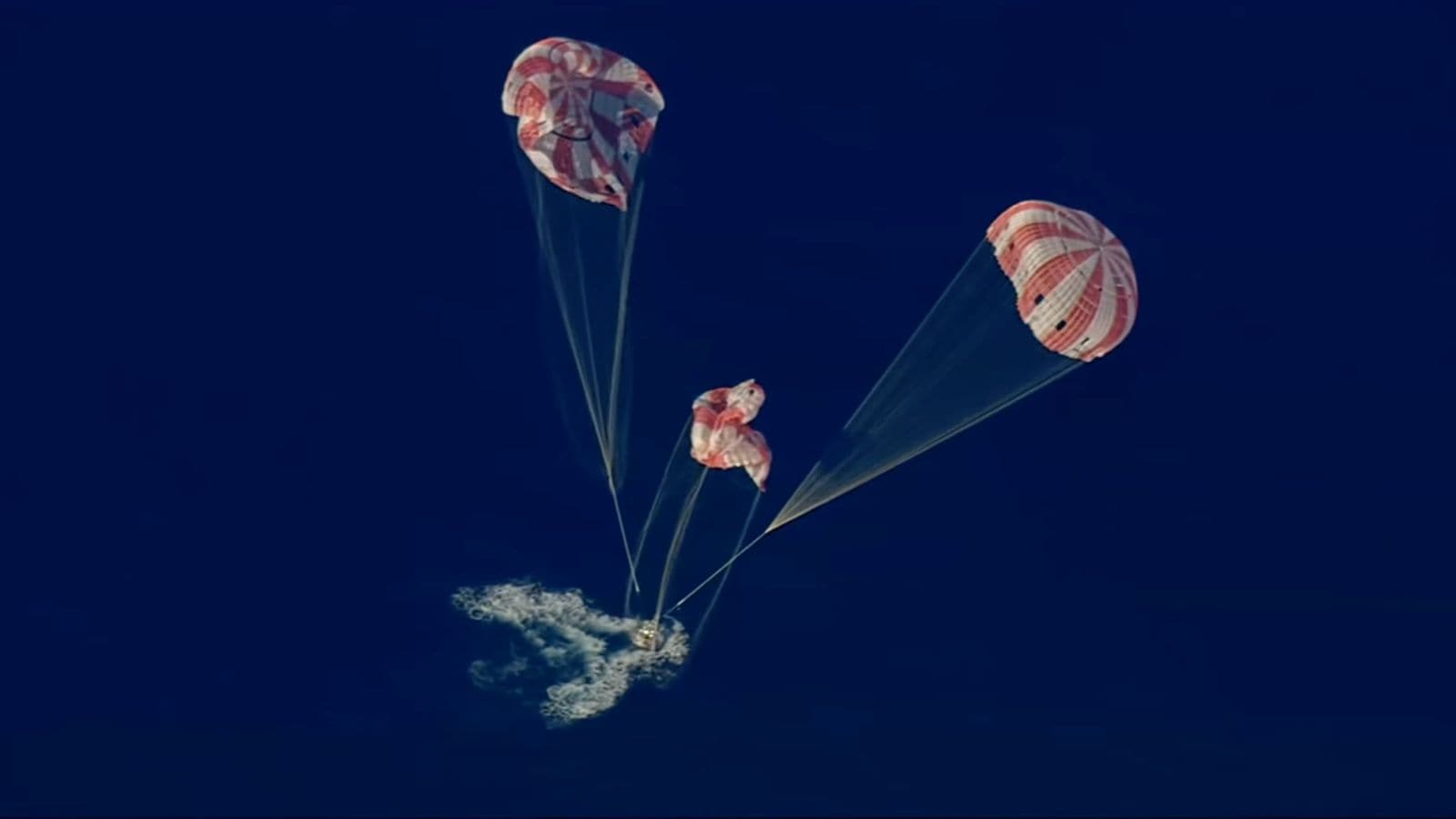
Post Content The Artemis II crew—NASA astronauts Reid Wiseman, Victor Glover, Christina Koch, and Jeremy Hansen from the Canadian Space Agency—are getting ready for re-entry aboard the Orion spacecraft. (Image: Nasa)
The four astronauts aboard the Orion spacecraft began the final phase of their journey home as they completed their third and final return trajectory correction burn and shifted into full re-entry and splashdown preparation.
Space enthusiasts have a chance to catch the rare sight of Artemis II as it races back toward Earth, with a live broadcast scheduled for tonight.
Story continues below this ad
The splashdown will take place at 8:07 pm EDT on April 10 ( 5:37 am IST on April 11) in the Pacific Ocean off the coast of San Diego, California. To watch the return of the Orion spacecraft, you can tune into Nasa’s official site. It will also be broadcast on Nasa’s official YouTube channel and on Netflix.
Launched on April 2, Artemis II marked a major milestone for , sending four astronauts on the first crewed mission beyond low Earth orbit since Apollo 17.
During their journey, the crew travelled thousands of miles past the moon and even witnessed a total solar eclipse from space.
For those waiting to follow the final moments of the mission, tonight’s livestream offers a unique window into one of the most exciting phases of Artemis II’s journey.
Artemis II will be Nasa’s first crewed flight using the Space Launch System (SLS) rocket and Orion spacecraft. During the mission, astronauts will test and assess these systems to support upcoming missions, including Artemis IV, which is targeting a Moon landing in 2028. The crew of four: Reid Wiseman, Victor Glover, Christina Koch, and Jeremy Hansen, carried out a lunar flyby but did not land on the Moon.
Designed as a 10-day journey around the Moon focused on evaluating critical systems for future lunar exploration and helping lay the groundwork for eventual human missions to Mars.
Stay tuned to this LIVE blog for continuous updates on the Artemis II mission.
Live Updates
Apr 11, 2026 05:32 AM IST
Orion’s position locked after signal returns
After emerging from the six-minute blackout, the Orion spacecraft on Artemis II enters a critical phase as NASA teams work to lock onto its exact position. As communication has been restored.
Officials must quickly regain GPS tracking to accurately determine the splashdown zone. Recovery teams then move to a pre-designated point, known as “waypoint Bravo,” a few miles from the landing site, allowing faster access once Orion touches down.
After splashdown, teams will assess the capsule’s position, ensuring it is stable and upright. If needed, systems are in place to correct its orientation before crew recovery begins.
Apr 11, 2026 05:26 AM IST
4G forces and blackout: Orion’s most intense phase
The Orion spacecraft on Artemis II reached Earth’s atmosphere at around 400,000 feet, travelling nearly 35 times the speed of sound and about 1,956 miles from the splashdown site—marking the entry interface where its guided descent begins.
Orion enters a planned six-minute communications blackout as superheated plasma forms around the capsule, blocking signals.
During this phase, travelling at around 11 km/s (40,000 km/h), astronauts experience up to 4G, feeling nearly four times heavier as the spacecraft rapidly slows. This is one of the most intense yet expected phases, with Orion designed to withstand it and safely return the crew.
Apr 11, 2026 05:08 AM IST
Raise burn completed
The Artemis II has successfully completed its crew module 19-second raise burn. The brief, precise manoeuvre by the Orion spacecraft fine-tuned its trajectory and angle of attack ahead of re-entry.
This adjustment ensures optimal alignment for atmospheric entry, helping protect the heat shield and setting the stage for a safe and controlled descent toward splashdown.
Apr 11, 2026 05:06 AM IST
Crew module and service module separation
During Artemis II, the Orion spacecraft undergoes a critical step as the crew module separates from the service module ahead of re-entry.
This separation discards the service module—responsible for propulsion, power, and life support during the mission—leaving the crew module to continue alone toward Earth. From this point, the heat shield is fully exposed to withstand extreme re-entry temperatures, marking the start of the spacecraft’s final descent toward splashdown.
Apr 11, 2026 04:56 AM IST
Orion transitions to near-Earth communications system
The Orion spacecraft has been relying on Nasa’s Deep Space Network to maintain contact during its journey. This network, made up of three powerful antennas located in California, Spain, and Australia, is built to communicate with spacecraft venturing far into space, like Voyager 1, now billions of miles from Earth.
As Artemis II nears home, Orion is transitioning to the Tracking and Data Relay Satellite System (TDRS) for its communications. This system is typically used for missions closer to Earth, including those aboard the International Space Station, which orbits just a few hundred miles above the planet.
Apr 11, 2026 04:43 AM IST
Why re-entry causes a communications blackout
During Artemis II, a brief loss of communication during re-entry is not a glitch but a predictable and well-understood physical effect. As the Orion spacecraft plunges into denser layers of Earth’s atmosphere at several kilometres per second, the air around it is heated to extreme temperatures, transforming into a plasma cloud of charged particles that envelops the heat shield.
For signals to reach Earth, radio waves from the spacecraft’s antennas must pass through this plasma layer. However, at certain frequencies, the ionised gas behaves like a high-pass filter, blocking or reflecting signals below a critical plasma frequency. As a result, transmissions cannot escape, and the spacecraft appears to go silent for several minutes.
Engineers at NASA use this knowledge to improve mission design, adjusting antenna placement, selecting higher-frequency communication links, and exploring methods to alter or thin the plasma sheath to reduce blackout duration and maintain more consistent contact in future missions.
Apr 11, 2026 04:36 AM IST
Orion set for upright splashdown
NASA expects the Orion spacecraft to land upright as Artemis II ends in the Pacific. During re-entry, Orion will travel at extreme speeds, surrounded by plasma that causes a brief communications blackout.
While an upright landing is the goal, Orion is equipped for any scenario. Its Crew Module Uprighting System (CMUS)—a set of large airbags—can automatically flip the capsule if it lands upside down or is destabilised by waves. The system can right the spacecraft in under four minutes and keep it stable for extended periods, ensuring crew safety and proper recovery operations.
Apr 11, 2026 04:23 AM IST
From separation to splashdown: 34 defining minutes
For Artemis II, everything comes down to a dramatic 34-minute window—from separation to splashdown. At 7:33 p.m. EDT (5:03 a.m. IST), the Orion spacecraft crew module separates, exposing its heat shield. Four minutes later, Orion performs its final raise burn to refine trajectory and reduce stress on re-entry.
By 7:53 p.m. EDT (5:23 a.m. IST), Orion reaches 400,000 feet, travelling at nearly 35 times the speed of sound, with astronauts experiencing up to 3.9 Gs. A planned communications blackout follows due to plasma buildup.
At 8:03 p.m. EDT (5:33 a.m. IST), parachutes deploy at 22,000 feet, rapidly slowing the capsule. Finally, at 8:07 p.m. EDT (5:37 a.m. IST), Orion splashes down in the Pacific, marking the successful end of the mission.
Apr 11, 2026 04:16 AM IST
Artemis II re-entry: Astronauts brace for intense 4G forces on the ride back
As Artemis II returns to Earth, astronauts aboard the Orion spacecraft are expected to experience up to 3.9 Gs—nearly four times Earth’s gravity. According to NASA, Orion will slow dramatically from about 24,000 mph to just 19 mph in roughly 14 minutes.
This intense deceleration will make the crew feel significantly heavier, with movement and even breathing becoming more difficult after days in weightlessness. The shorter, steeper descent helps reduce stress on the heat shield, even as it increases the physical strain on astronauts during re-entry.
Apr 11, 2026 04:10 AM IST
Entry, descent & landing
As Artemis II enters its final phase, NASA outlines a precise sequence of critical events for the Orion spacecraft. Around 37 minutes before splashdown, the crew module separates from the service module, followed by a crew module raise burn to fine-tune re-entry. Orion then hits the entry interface at about 400,000 feet, roughly 13 minutes before landing.
As descent continues, the forward bay cover is jettisoned, allowing parachute deployment, drogues, pilot chutes, and main chutes to slow the capsule. After splashdown, parachutes are released, the capsule uprighting system activates, and recovery teams move in to secure the crew.
Apr 11, 2026 04:05 AM IST
Artemis II splashdown zone mapped
Apr 11, 2026 03:53 AM IST
Orion performs well, minor fixes ahead
NASA officials say Orion spacecraft performed strongly during Artemis II, despite a few “minor anomalies.” Associate administrator Amit Kshatriya noted these issues have relatively straightforward fixes and will help refine future missions.
Engineers are analysing data from the 10-day mission to better understand how Orion and its crew operate in deep space. The findings will feed into upcoming missions like Artemis III and Artemis IV, as NASA continues improving systems and crew operations for future lunar exploration.
Apr 11, 2026 03:51 AM IST
Just short of the record, Re-entry speed of Orion spaceraft
As Artemis II returns to Earth, the Orion spacecraft is expected to hit a peak re-entry speed of about 24,661 mph, according to NASA.
While blisteringly fast, it will fall just short of the record set by Apollo 10, missing it by around 130 mph. The figure remains unofficial until post-mission analysis, but it still highlights the extreme conditions Orion must withstand during its high-speed return through Earth’s atmosphere.
Apr 11, 2026 03:19 AM IST
Suit leak check complete
Another key milestone cleared for Artemis II as astronauts aboard the Orion spacecraft successfully completed suit leak checks. NASA confirmed all suits are fully sealed with no leaks detected, ensuring crew safety ahead of re-entry.
With this step complete, systems continue to perform as expected, keeping the mission on track for a smooth and controlled splashdown.
Apr 11, 2026 03:05 AM IST
What’s next after the splashdown?
Even as Artemis II nears splashdown, the mission’s work is far from over. NASA will spend months analysing data gathered during the flight to refine future missions.
Focus will soon shift to upcoming launches. Artemis III, now targeted for 2027, will test docking between Orion and a lunar lander in Earth orbit. Originally planned as a Moon landing, that milestone has moved to Artemis IV and Artemis V in 2028. Artemis V is also expected to help lay the groundwork for a long-term human presence on the Moon.
Apr 11, 2026 02:44 AM IST
less than 3 Hours to Splashdown
With just hours to go, Artemis II is on track for splashdown at 8:07 p.m. EDT (5:37 am IST) off the coast of San Diego. The four-member crew—Reid Wiseman, Victor Glover, Christina Koch, and Jeremy Hansen—have completed key re-entry preparations, including cabin configuration and a final trajectory correction burn to refine their path home.
The day began with a wake-up message from Zac Brown Band, boosting morale. The crew also wrapped up final checks, captured Earth images, and secured equipment, including shutting down the malfunctioning onboard toilet, as they prepare for a safe return.
Apr 11, 2026 02:33 AM IST
Artemis II to make final trajectory tweaks
During the splashdown, the Orion spacecraft will carry out a precise 19-second crew module raise burn, boosting its velocity by about 9.9 ft/s. This controlled manoeuvre fine-tunes the spacecraft’s angle of attack, ensuring the correct orientation for safe atmospheric re-entry and optimal heat shield performance. Non-essential systems, including the onboard washroom, are shut down during this phase to prioritise critical operations.
Meanwhile, NASA confirms weather remains “go” for splashdown. Despite cloudy skies, ocean conditions are stable, keeping recovery operations on track for a safe return.
Apr 11, 2026 02:06 AM IST
Fist bump before astronauts prepare for reentry
https://platform.twitter.com/widgets.js
Apr 11, 2026 01:54 AM IST
What happens after Artemis II splashes down
After Orion splashes down in the Pacific, teams from NASA and the U.S. military will extract the crew from the spacecraft and fly them via helicopter to the USS John P. Murtha.
All this will happen within two hours after splashdown. The recovery teams will retrieve the crew, assist them onto an inflatable raft, and then use helicopters to deliver them to the ship.
Once aboard, the astronauts will undergo post‑mission medical evaluations. After that they will return to shore, where awaiting aircraft will take them to NASA’s Johnson Space Center in Houston.
Apr 11, 2026 01:34 AM IST
Artemis II splashdown timeline
A carefully timed sequence will guide Orion through the final stages of descent:
7:33 pm EDT( 5:03 am IST on April 11): Orion’s crew module will separate from the service module, exposing its heat shield for the spacecraft’s return through Earth’s atmosphere, where it will encounter temperatures of about 3,000 degrees Fahrenheit.
7:37 pm EDT ( 5:07 am IST on April 11): Following separation, Orion will perform an 18 second crew module raise burn beginning to set the proper entry angle and align the heat shield for atmospheric interface.
7:53 pm EDT ( 5:23 am IST on April 11): When Orion reaches 400,000 feet above Earth’s surface while traveling nearly 35 times the speed of sound. The crew is expected to experience up to 3.9 Gs in the planned entry profile. This moment marks the spacecraft’s first contact with the upper atmosphere and the start of a planned six-minute communications blackout as plasma builds around the capsule.
8:03 pm EDT ( 5: 33 am IST on April 11): Around 22,000 feet in altitude, the drogue parachutes will deploy, slowing and stabilising the capsule as Orion nears splashdown.
8:04 pm EDT ( 5:34 am IST on April 11): At around 6,000 feet, the drogues will release, and the three main parachutes will deploy, reducing Orion’s speed to less than 136 mph.
8:07 pm EDT ( 5: 37 am IST on April 11): Slowing to 20 mph, Orion will splash down in the Pacific Ocean off the coast of San Diego, completing the Artemis II crew’s return to Earth and a 694,481-mile journey.
Apr 11, 2026 01:12 AM IST
What will Orion’s re-entry speed be?
During re-entry, the Orion spacecraft from Artemis II will descend at around 24,000 mph (about 38,600 km/h), according to NASA. That’s roughly 32 times the speed of sound and nearly 400 miles per minute. At this speed, Orion could cross the continental United States in about 7 minutes or circle Earth in just over an hour. This extreme velocity highlights the challenges of re-entry, with the spacecraft relying on its heat shield and parachutes to slow safely before splashdown.
Apr 11, 2026 12:52 AM IST
NASA Artemis 2 LIVE Updates: Orion completes final burn before splashdown
A few minutes ago the Orion spacecraft ignited its thrusters for 8 seconds. This produced a change in velocity of 4.2 feet-per-second and pushed Artemis II toward Earth. NASA astronauts Reid Wiseman, Victor Glover, Christina Koch and CSA (Canadian Space Agency) astronaut Jeremy Hansen reviewed procedures and monitored the spacecraft’s configuration and navigation data, NASA said.
The crew is now wrapping up cabin configuration for re-entry. Splashdown is in less than five hours.
Apr 11, 2026 12:45 AM IST
NASA Artemis 2 LIVE Updates: Final return burn to nudge Orion home
The third return burn is set to happen now, refining Orion’s path for entry in Earth’s atmosphere atmospheric entry and splashdown. During the maneuver, the spacecraft will make precise adjustments to stay on its targeted course home. It’s under five hours now for splashdown.
Apr 10, 2026 10:10 PM IST
NASA Artemis 2 LIVE Updates: Artemis II – Why space junk isn’t in any photo
Despite concerns about orbital debris, Artemis II images show no “space junk” because it’s extremely hard to capture. Most debris is tiny and moves at very high speeds—often faster than 28,000 km/h—making it nearly invisible to cameras. Additionally, the highest concentration of debris lies in low Earth orbit, while Artemis II quickly travels beyond this region during its journey. Even larger objects are difficult to spot due to motion and distance. While debris remains a real concern monitored by NASA, space is vast, and the chances of photographing it are extremely low.
Apr 10, 2026 09:11 PM IST
NASA Artemis 2 LIVE Updates: Artemis ‘Earthset’ photo
During Artemis II, astronauts captured a striking view of Earth appearing to “set” behind the Moon’s horizon—often referred to as an Earthset. The term mirrors the famous Earthrise image taken during Apollo 8, when Earth seemed to rise above the Moon. (Credit:NASA)
Apr 10, 2026 08:27 PM IST
NASA Artemis 2 LIVE Updates: How did NASA fix the Orion capsule’s heat shield problem?
The reentry of the Orion capsule carrying the crew of the Artemis II mission will be the most dangerous hurdle yet. The capsule’s reentry will occur at over 25,000 mph (40,000 km/h), one of the fastest in history.
The heat shield at the bottom of the capsule is almost exactly the same as the one used for Artemis I, which cracked upon reentry. To address this issue, NASA hasn’t replaced the heat shield, but tweaked the flight path instead.
Apr 10, 2026 08:18 PM IST
NASA Artemis 2 LIVE Updates: Day 5 – Record-breaking distance
On Day 5 of Artemis II, the Orion spacecraft reached its farthest distance from Earth, setting a new record for a crewed mission. Traveling beyond the Moon’s far side, the crew moved farther than any humans since the Apollo era, surpassing the benchmark set by Apollo 13. This milestone highlights the spacecraft’s deep-space capabilities as NASA prepares for future lunar landings. The moment also marked a symbolic return of humans to deep space exploration after more than five decades.
Apr 10, 2026 07:34 PM IST
NASA Artemis 2 LIVE Updates: Artemis II Moon mission
NASA’s Artemis II is the first crewed mission of the Artemis programme, sending four astronauts around the Moon and back without landing. Launched aboard the Space Launch System (SLS) rocket, the Orion spacecraft will travel thousands of kilometres beyond the lunar far side, testing critical systems for future deep space missions.
The crew consist of three Americans and one Canadian: Reid Wiseman, Victor Glover, Christina Koch, and Jeremy Hansen, who will evaluate navigation, life support, and communication systems. Artemis II is a key step toward future Moon landings under Artemis, including long-term human exploration.
Apr 10, 2026 07:06 PM IST
NASA Artemis 2 LIVE Updates: Artemis II crew
The Artemis II crew includes four astronauts representing international collaboration under NASA. Commander Reid Wiseman leads the mission, joined by pilot Victor Glover. Mission specialists include Christina Koch and Jeremy Hansen, the first Canadian assigned to a lunar mission. Together, they will travel around the Moon aboard Orion, testing systems and operations essential for future crewed lunar landings under NASA’s Artemis programme.
Apr 10, 2026 06:09 PM IST
NASA Artemis 2 LIVE Updates: Artemis II splashdown
NASA’s Artemis II is set to conclude with a splashdown in the Pacific Ocean off the coast of San Diego. The Orion spacecraft will re-enter Earth’s atmosphere at high speed, using a heat shield to withstand temperatures of nearly 2,800°C before deploying parachutes for a controlled descent.
Recovery teams, including U.S. Navy personnel, will secure the capsule and assist the four-member crew after landing. Final timing may shift based on mission progress, with updates expected in the hours leading up to splashdown.
