

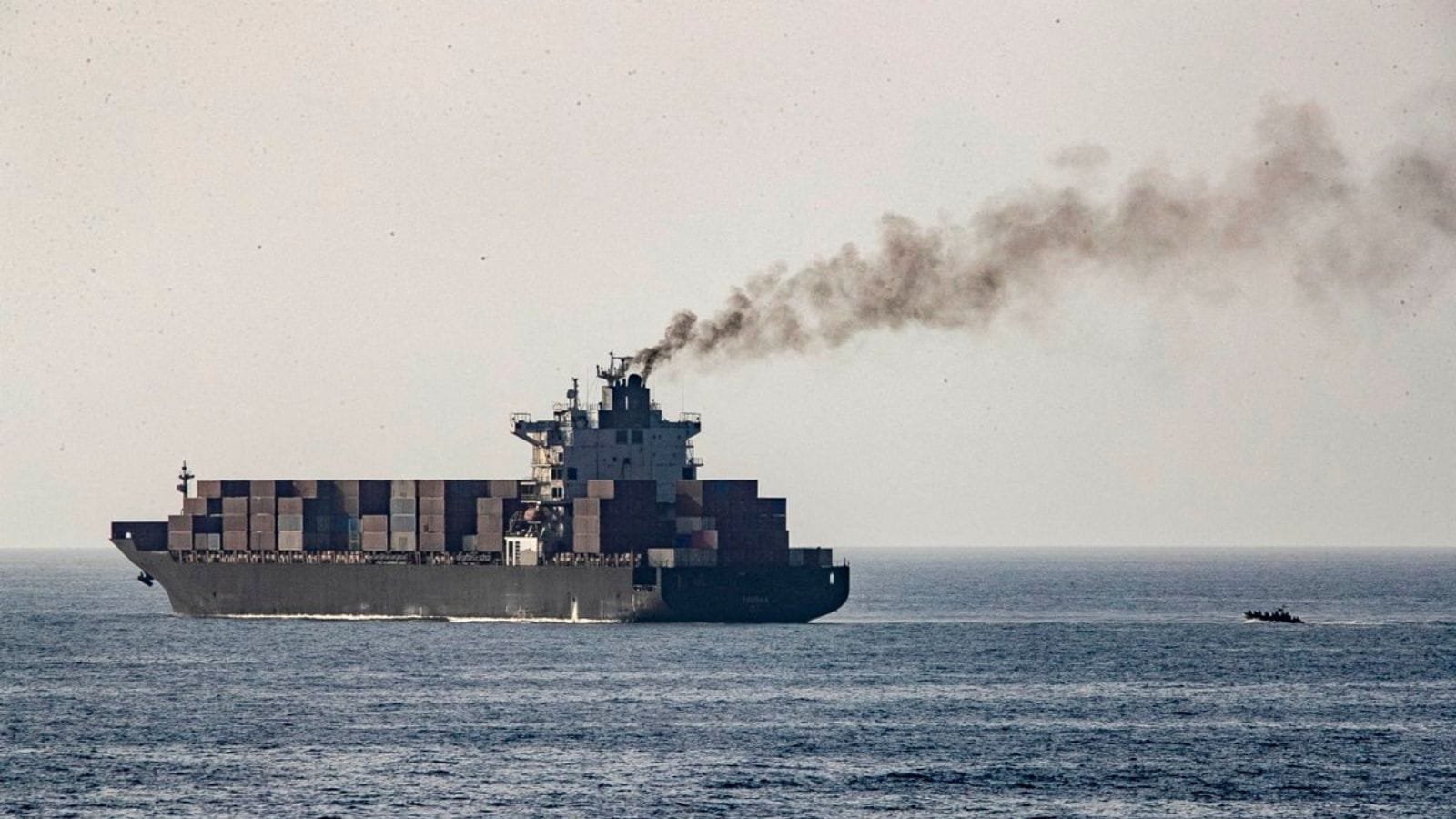
Even as US President Donald Trump announced that the ceasefire with Iran, which was due to expire on Wednesday, will continue for the time being, Iranian forces fired on three merchant vessels in the Strait of Hormuz, according to Iranian media outlets. One of the ships that came under attack–container ship Epaminondas–on Wednesday was indicating Mundra port in Gujarat as its destination, while another container ship–MSC Francesca–was signalling that it was headed to the Sri Lankan port of Hambantota, according to vessel tracking data from maritime data and intelligence firm MarineTraffic. The third vessel–container ship Euphoria–was indicating Jeddah as its destination.
Indicative destination ports that ships broadcast may not be the final or the actual intended destinations, and can change mid-voyage. Liberia-flagged Epaminondas and Panama-flagged MSC Francesca were in the custody of the Islamic Revolutionary Guard Corps (IRGC), and were being taken to Iran, the Associated Press reported quoting Iranian state television. Panama-flagged Euphoria is reportedly stranded following the attack.
The attacks come close on the heels of US forces seizing a few Iranian oil tankers that were attempting to slip through its blockade over the past few days. the US has also claimed that it’s forces in the region have forced the diversion around 30 ships attempting to either leave or enter Iranian ports. Iran has condemned the US blockade, calling it “armed piracy” and a breach of the ceasefire between Washington and Tehran.
Details about the the volume and nature of cargo on seemingly Mundra-bound Epaminondas were not immediately available. MarineTraffic data indicated that the ship had departed from the UAE’s Jabel Ali port on March 4, but had been stuck since in the Persian Gulf as the West Asia war led to the effective closure of the critical maritime chokepoint of the Strait of Hormuz.
According to international shipping databases, the container ship is managed and operated by Greece-based companies. Epaminondas, a Post-Panamax container ship, has a deadweight tonnage (DWT) of about 95,000 tonnes. Deadweight tonnage is the total weight a vessel can carry, including cargo, fuel, fresh water, ballast water, provisions, and crew.
Wednesday’s attacks by Iran against merchant vessels also follow the incident of Iranian gunboats firing at two India-flagged ships on Saturday as they tried to exit the fraught waters of the Strait of Hormuz. The vessels–oil tanker Sanmar Herald and bulk carrier Jag Arnav–turned back into the Persian Gulf after coming under fire.
Just a day earlier, Iran had announced that the Strait of Hormuz was completely open for commercial shipping, but by Saturday afternoon, the IRGC announced that the Strait was closed for all vessels. Iran said that the reversal was due to the US refusing to end the blockade of Iranian ports even as a fragile ceasefire was in place. The sudden U-turn by Iran on the status of the Strait led to confusion among ships that had lined up to cross the maritime chokepoint, which could have played a role in the incident of firing upon Indian ships.
Story continues below this ad
Scores of commercial vessels with thousands of seafarers have been stuck in the Persian Gulf since the West Asia war began on February 28 as vessel movements through the Strait of Hormuz ground to a halt after warnings from Iran; a few ships had also come under attack. The Strait of Hormuz is among the world’s most critical chokepoints for energy supplies, and accounts for a fifth of global oil and liquefied natural gas (LNG) flows.
For Iran, its ability to disrupt global trade and energy flows by effectively closing the Strait has proven to be its most potent weapon and bargaining chip in the West Asia war. The halt in traffic through the Strait have sent energy prices soaring, caused shortages in various parts of the world, and forced some countries to ration fuel supplies amid the global supply crunch and price shock.
Over the past few weeks, only a few ships a day have been able to cross the waterway, that too in coordination with the Iranian forces. Even with the fragile ceasefire between the US and Iran in place, vessel movements through the Strait hardly picked up as confusion over the status of navigation through the critical waterway persisted.
