

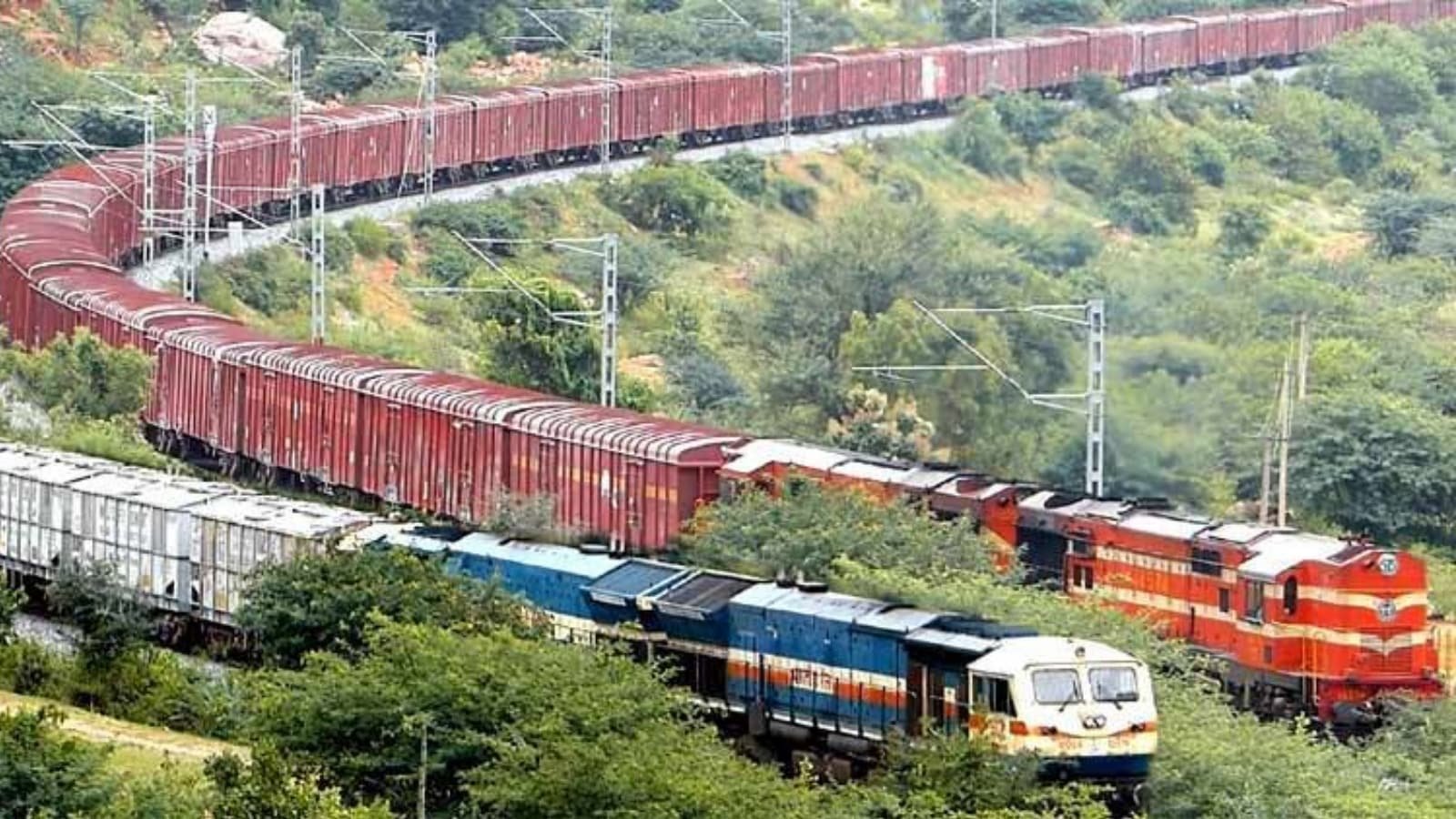
After slowing down in winter, cargo movement regains momentum.
On April 22, milk became the latest commodity to be transported to Anantnag over the railway link to the Valley opened in July last year, arriving from Linch Railway Station in Ahmedabad Division.
Data shows that between August 2025 and March 2026, during the time Kashmir has been part of the Railway network, cement accounted for the largest inbound freight into Kashmir, and apples the largest commodity transported out. Apart from that, cars, foodgrains, and even military consignments have been transported on rakes.
Freight operations began modestly, with 13 rakes in August 2025 and 20 in September, but rose sharply to 46 rakes — the highest — in October, largely driven by construction activity, with 41 rakes of cement entering the Valley that month.
Movement slowed in winter, dropping to 34 rakes in November, 22 in December, and 16 in January, before regaining momentum with 22 rakes in February and 30 in March 2026.
One of the first rakes carrying cement travelled to Kashmir on August 9, with 21 wagons loaded in Punjab’s Rupnagar. By March 2026, 203 rakes had travelled to Anantnag, carrying 3,514 wagons in all, of which 76% or 155 rakes were loaded with cement.
Vehicles are the next in-bound commodity, having been transported over 18 special New Modified Goods rakes. Maruti Suzuki India was the first to do so in October 2025, with automobile transportation among the Railways’ key initiatives to diversify its freight basket.
Foodgrains come third at 17 rakes, from the Food Corporation of India. In December 2025, a mini foodgrain freight train carrying 1,384 tonnes, dispatched from Ajitwal Railway Station in Punjab, reached the Anantnag goods terminal — the first bulk food grains supply by rail to Kashmir.
Story continues below this ad
Other cargo includes fertilisers, two rakes of military consignments, and one rake each of apple crates and salt.
Recently, Amazon extended its operations to the Valley through a door-to-door parcel delivery service by Indian Railways and India Post.
With freight movement expected to generate revenue and stabilise supply chains — especially in remote areas — the Railways is giving it a significant push. “More than 65% of the national carrier’s revenue comes from this segment. We are exploring new areas of freight supply to Kashmir,” a senior Railway official said.
“Daily vehicle parcel-based cargo movement has commenced between Adarsh Nagar and the Budgam rail terminal. This service will ensure forward loading from the National Capital Region to the Valley and return loading of Valley produce back to the capital. It will be a two-way supply chain with a 30-hour train,” he said.
Story continues below this ad
With Kashmir the country’s leading apple producer, it is hardly a surprise that it is the leading produce transported out. A total of 278 apple-loaded bogie covered wagons — designed to protect goods from the weather — were dispatched from Anantnag during the period.
The 272-km Udhampur–Srinagar–Baramula Rail Link (USBRL), or Kashmir line, became fully operational on June 6, 2025, when Prime Minister Narendra Modi inaugurated the 63-km Katra–Sangaldan section, marking the completion of a project to link Kashmir to the rest of the country that was first initiated 42 years ago.
While different stretches of the project were operationalised earlier in phases, the most challenging was the 111-km Katra–Banihal section. It includes India’s longest operational transportation tunnel, T-50 (12.77 km); the world’s highest railway arch bridge, the Chenab Bridge (359 metres above the riverbed); and the Railways’ first cable-stayed bridge, the Anji Bridge.
