

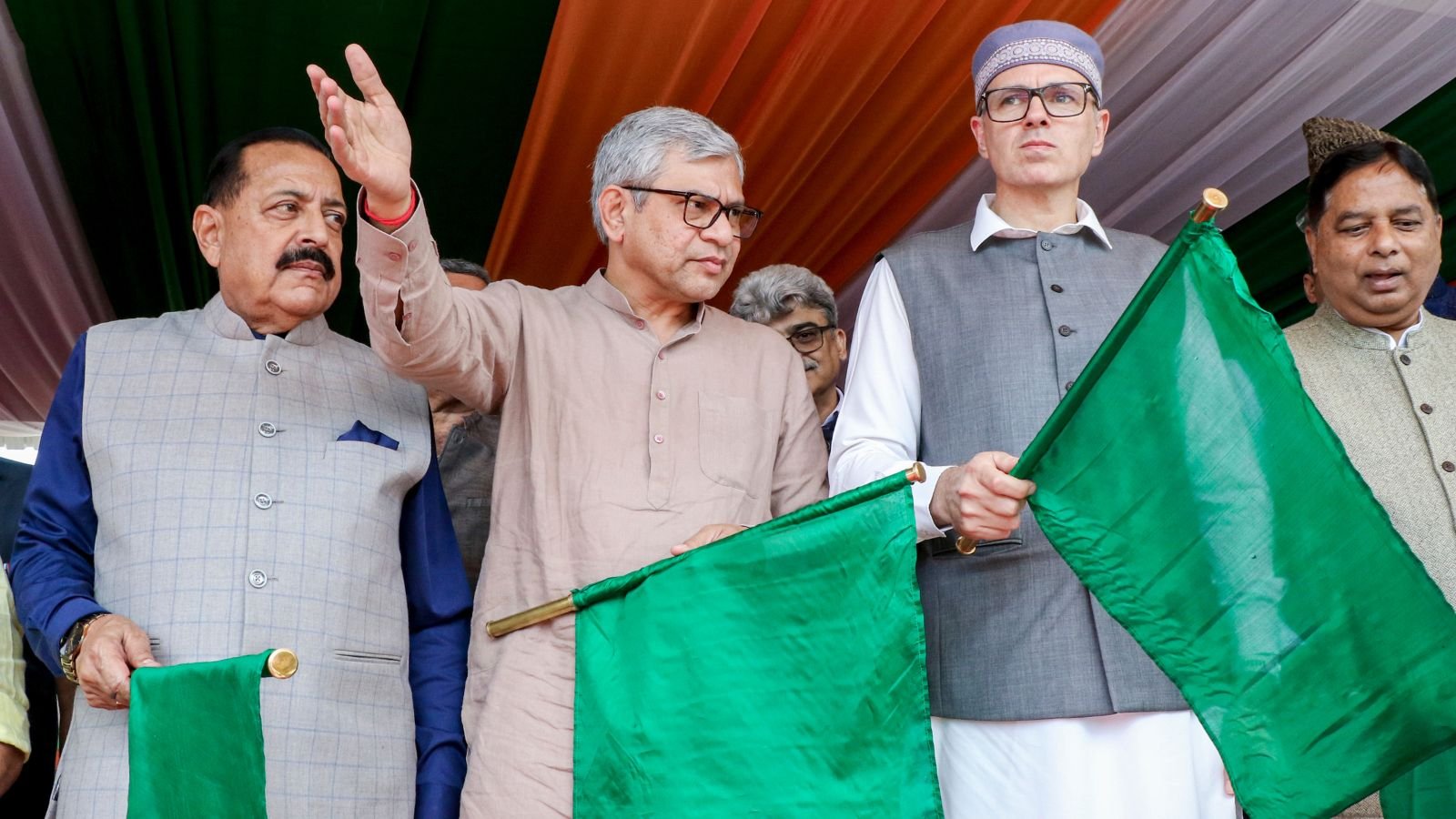
Union Railways Minister Ashwini Vaishnaw along with Union MoS Jitendra Singh, Jammu and Kashmir Chief Minister Omar Abdullah, flag off the extended Srinagar-Katra Vande Bharat Express from Jammu Tawi Railway Station (JAT) in Jammu district (PTI).
Union Railway Minister Ashwini Vaishnaw, in what may be described as a historic moment, on Thursday flagged off the first direct Vande Bharat Express between Jammu and Srinagar, providing not only all-weather connectivity between the two capital cities of Jammu and Kashmir, but also reducing the travel time between them to less than five hours.
The train, with 20 coaches, which will operate six days a week from May 2 except Tuesdays, will cover approximately 266 km.
It will leave Jammu Tawi railway station at 6.20 am and reach Srinagar at 11.10 am in a record travel time of 4 hours and 50 minutes. From Srinagar, the train will depart at 8 am and reach Jammu Tawi by 12.40 pm. It will relieve thousands of commuters travelling on the Jammu-Srinagar national highway of the problem of frequent road closures during the rainy season and winter.
It will have brief halts at Katra, Reasi and Banihal railway stations.
Vaishnaw was accompanied by Union Minister Dr Jitendra Singh and Chief Minister Omar Abdullah, among others.
This is the extended Vande Bharat service as the train with eight coaches is already running on the Katra-Srinagar stretch, which was flagged off by Prime Minister Narendra Modi.
The decision to increase the number of coaches to 20 was taken keeping in view the overwhelming response from passengers to the already operational train service between Katra and Srinagar. This will also ease pressure on reservations and reduce the waiting list, especially during the peak tourist season and the upcoming Amarnath Yatra.
Story continues below this ad
With the Vande Bharat Express now operating between Jammu and Srinagar, people across the country intending to visit Kashmir by rail need not travel to Katra, as they can board it at Jammu Tawi railway station itself.
The Jammu-Srinagar Vande Bharat is part of the 324-km Jammu-Baramulla rail line, which has been completed in phases since 1983, when Prime Minister Indira Gandhi laid the foundation stone for the Jammu-Udhampur railway line. However, when the line was under construction, the then Prime Minister PV Narasimha Rao announced its extension to Baramulla in 1994.
After a delay of nearly 21 years, Prime Minister Manmohan Singh inaugurated the Jammu-Udhampur railway line in 2005, besides the Anantnag-Qazigund and Anantnag-Baramulla sections in phases between 2008 and 2013.
The railway line entails several engineering achievements, including the world’s highest railway bridge over the Chenab river, India’s first cable-stayed railway bridge over Anji Khad, and India’s longest railway tunnel in Pir Panjal.
Story continues below this ad
Speaking on the occasion, Vaishnaw said that while strengthening maintenance practices remains key to safety and security, the next major focus of the Central government is increasing capacity on the Jammu-Srinagar rail corridor through track doubling to enable more train operations. He talked about doubling the Qazigund-Srinagar railway line so that more trains can be run on it.
Pointing out that the Vande Bharat Express on the Jammu-Katra-Srinagar route has emerged as a major success, he said two crore kg of apples have been transported from Kashmir to Delhi. Thirty-two bogies have been booked for cherry, he added.
More than five lakh people have travelled on the Vande Bharat between Katra and Srinagar since its inauguration by Prime Minister Narendra Modi, he said. The world’s highest railway bridge over the Chenab and the country’s first cable-stayed railway bridge over Anji Khad have also been a big hit, he said.
“We are serving Dogri and Kashmiri foods in this Vande Bharat,” he said, adding that the train can operate even in minus-10-degree temperatures and its piping is such that water cannot freeze. “In the last snow season, we tried this train, and accordingly, the new 20-bogie train was modified.”
Story continues below this ad
He also talked about the use of higher-specification electronics and the installation of 3,000 microchips in the Jammu-Srinagar Vande Bharat.
