

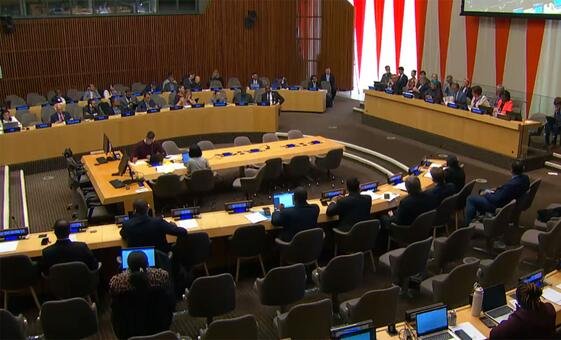
The details of the guide were presented at the latest General Assembly briefing on the UN80 proposals – the fourth such meeting so far this year – held at United Nations headquarters. Guy Ryder, the UN head of policy, explained that the new document serves as a navigational tool which clarifies when, and through which organs of the organisation, decisions are expected to be taken for each work package of the initiative.
The guide outlines the objectives and actions being undertaken to achieve it, the progress made to date on those actions and the work planned for the coming months (as well as whether an intergovernmental process is envisaged).
“We are engaging on some of the most complex issues facing the UN system,” said Mr. Ryder, “and I believe we are making real progress, both in how we understand these challenges and in how we are shaping solutions together.”
‘Step forward and step up’
Mr. Ryder’s presentation was followed by updates, delivered by senior UN officials, on three of the work packages in the UN80 Action Plan (the Shared Platform Initiative, the Regional Reset and the Joint Knowledge Hubs).
Amina Mohammed, the Deputy Secretary-General, explained that the Shared Platform Initiative – which aims to improve collaboration between humanitarian and development functions and to simplify the work of Resident Coordinators and Humanitarian Coordinators – is about “cutting through complexity and building collaboration between humanitarian and development action.”
Internationally coordinated humanitarian response, Ms. Mohammed added, is transitioning to national coordination. She called on the development response to “step forward and step up.”
Tom Fletcher, the UN humanitarian chief, spoke via video link from Baidoa, Somalia, a place that, he said, illustrates the importance of ensuring that the humanitarian and development pillars of the UN work together much more closely and effectively. “The people I’m meeting today,” he said, “are worried about the combination of flash floods and droughts. We can meet those humanitarian needs as much as we can, but without that development investment into water storage, water tracking, dams, water infrastructure, we won’t be able to properly turn that situation around.”
Better results on the ground
Ms. Mohammed also reported on the progress of the Regional Reset, an attempt to improve the current, fragmented regional architecture of the UN, which has over 240 regional offices and multiple entities working in parallel, at times out of step with country needs.
This drives up costs, weakens coordination with governments, partners and country teams and limits the system’s ability to tackle regional and national challenges.
The reform process, she said, is not about creating new structures, but making existing systems “work as one, and better.” The success of the Regional Reset, she continued, will depend on “whether we can translate these proposals into more timely support to countries, more coherent responses to regional challenges, and ultimately more tangible results on the ground.”
Pooling UN knowledge and expertise
The third area under discussion at the briefing was Joint Knowledge Hubs, a response to a core challenge: the fact that knowledge across the UN development system remains dispersed across entities, with overlapping mandates, fragmented products and insufficiently integrated policy support.
The hubs are intended to pool knowledge on priority issues, reduce duplication, strengthen coherence and make knowledge more accessible to Member States. Currently in pilot phase, the expectation is that, by September 2026, they will be fully functioning and delivering coherent and effective UN-wide support by integrating data, knowledge and expertise.
“By pulling existing knowledge across the entities around the shared priority issues, these hubs reduce duplication, strengthen the system-wide coherence and ensure that the wealth of the UN knowledge is more easily available to support the needs and priorities of the Member States,” Li Junhua, the head of the UN Department of Economic and Social Affairs (DESA) told the delegates.
Pedro Manuel Moreno, the acting chief of the UN trade and development agency (UNCTAD) explained that the hubs under development will focus on three main areas: trade and regional integration, productive transformation and strategic foresight.
The hubs, said Mr. Moreno, will mean “more harmonised data, statistics and analysis” for UN Member States, and “more coherent policy support, drawing on the strengths of every entity rather than duplicating them.”
Progress under the UN80 Initiative can be tracked through a public dashboard, which provides an overview of actions, timelines and implementation across the system.
UN80 Initiative: Real progress made on tackling complex issues facing the UN system
0
