

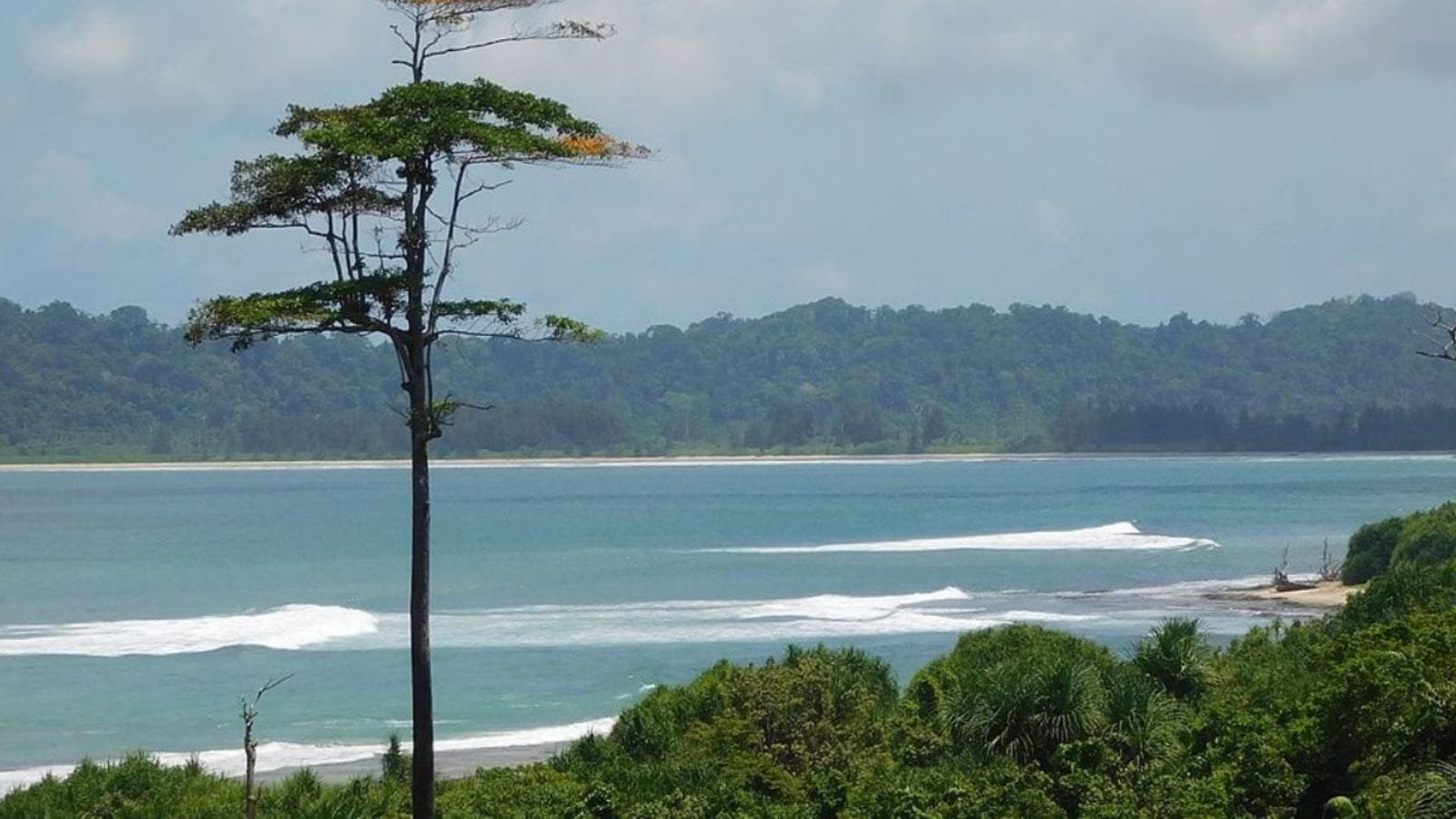
The Nicobarese community, though, has written to the Centre, the National Commission of Scheduled Tribes on multiple occasions, pointing out that it had revoked their no-objection certificate to the denotification of the tribal reserve. The Nicobarese community, though, has written to the Centre, the National Commission of Scheduled Tribes on multiple occasions, pointing out that it had revoked their no-objection certificate to the denotification of the tribal reserve.The Nicobarese community, though, has written to the Centre, the National Commission of Scheduled Tribes on multiple occasions, pointing out that it had revoked their no-objection certificate to the denotification of the tribal reserve.(Wikimedia Commons)
Two days after Rahul Gandhi, the Leader of Opposition in Lok Sabha, called the Rs 81,000-crore Great Nicobar mega infrastructure project as “one of the biggest scams” and “gravest crime” against India’s natural and tribal heritage, the Union Government on Friday issued a lengthy factsheet on ‘environmental impact assessment’, tribal welfare, while laying out the project’s ‘strategic maritime’ and ‘defence’ purpose.
The government also claimed that Nicobarese and Shompen habitations on the island will not be displaced, and ‘no relocation’ of the communities is proposed.
The government fact-sheet, while not explicitly defending the project against Gandhi’s charge, sought to underline that the project has been granted prior environmental clearance after a detailed process, and includes 42 specific conditions on environmental protection.
It said that the project leverages the island’s strategic location “to strengthen India’s national security, maritime and defence presence in the Indo-Pacific, while simultaneously embedding environmental safeguards and tribal welfare mechanisms.”
The mega project will see the construction of a transshipment port, an integrated township, a civil and military use airport, and a 450-MVA gas and solar power-based plant. It requires a total area of 166.10 sq km, including 35.35 sq km of revenue land and 130.75 sq km of forest land, including felling of a million trees in the tropical evergreen and semi-evergreen forests.
The government release said that the estimated number of trees in this (project) area is 18.65 lakh, though the maximum number expected to be felled is 7.11 lakh within 49.86 sq km of forest. “The tree felling will be carried out in a phased manner in line with the proposed phase-wise development of the key projects. Importantly, 65.99 sq km of land will be preserved as green zones with no tree felling, ensuring ecological balance,” the government stated.
Also Read | As NGT clears Great Nicobar project, a look at its strategic importance and ecological fallout
‘Millions of trees are marked for the axe’: Rahul Gandhi
Story continues below this ad
Gandhi was on a three-day visit to the Andaman and Nicobar Islands, and on the third day, April 28, he visited the Great Nicobar Island, and interacted with leaders from the indigenous Nicobarese community and settlers who belong to the ex-servicemen community.
After visiting forests on the Island, Gandhi said in an X post that “Millions of trees are marked for the axe.” He added, “This is not development. This is destruction dressed in development’s language. So I will say it plainly, and I will keep saying it, what is being done in Great Nicobar is one of the biggest scams and gravest crimes against this country’s natural and tribal heritage in our lifetime. It must be stopped. And it can be stopped – if Indians choose to see what I have seen.”
On tribal welfare, the government release said that the project has been “carefully designed” to ensure that the Nicobarese and Shompen tribes are not displaced.
‘11.032 sqkm already used as revenue land since 1972’
“Out of the 166.10 sq km that is proposed for development projects, 84.10 sq km overlaps with the Tribal Reserve. However, within this portion, 11.032 sq km has already been settled and used as revenue land since 1972. Consequently, the effectively remaining area measuring 73.07 sq. km is being de-notified for project purposes. To compensate, 76.98 sq km is being re-notified as a tribal reserve, resulting in a net addition of 3.912 sq. km to the tribal reserve,” the government claimed.
Story continues below this ad
The Nicobarese community, though, has written to the Centre, the National Commission of Scheduled Tribes on multiple occasions, pointing out that it had revoked their no-objection certificate to the denotification of the tribal reserve. The Nicobarese community faced casualties in the 2004 tsunami and has repeatedly made demands to the Andaman and Nicobar Island administration to relocate them to their ancestral villages. Following the tsunami, they were relocated to a settlement in Rajiv Nagar and New Chingenh, towards the eastern coast.
In January, the tribal council of the Great Nicobar Island had alleged that officials from the Nicobar district administration asked them to sign “surrender” certificates, writing off their claims over their ancestral land. Last year, the community wrote to the Ministry of Tribal Affairs, alleging that their rights under the Forest Rights Act were not settled, and that the process of recognition of rights had not begun.
