

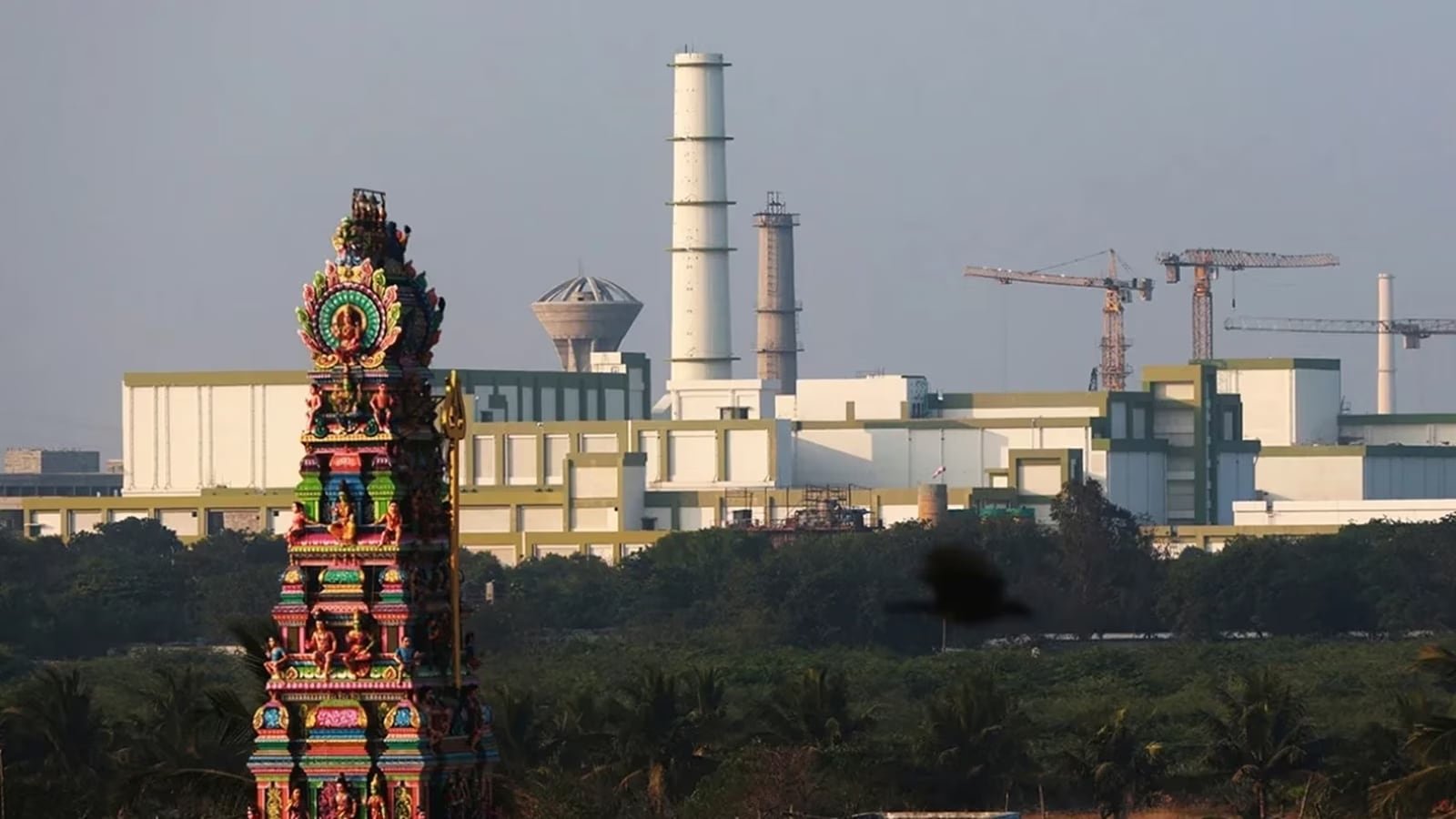
SHANTI Act paves way for private players to enter civil nuclear power sector.
As India moves to expand the civil nuclear power sector by allowing private participation through the recently passed SHANTI Act, there are two divergent views within the top levels of the government over the jurisdictional administration of this strategic sector.
The question is this: whether to continue with the Department of Atomic Energy’s (DAE) overall control over the nuclear sector or tangentially allow the Ministry of Power the authority to supervise certain types of new civil nuclear projects.
Currently, the DAE, under the Prime Minister’s Office, is the administrative authority for matters that are related to nuclear power.
However, there is an emerging view that new civil nuclear projects developed by private players should be brought within the ambit of the Ministry of Power, even as legacy nuclear power projects will continue to remain under the administrative control of DAE, The Indian Express has learnt.
The view to entrust administration of private nuclear power projects to a separate ministry emerged from rising concern over potential conflict of interest due to DAE’s full control over the entire nuclear power supply chain — from research and development to fuel supply and spent fuel management.
Even the Atomic Energy Regulatory Board (AERB), responsible for carrying out all regulatory functions, was dependent on DAE for its budget and administration until it was accorded a statutory status under the SHANTI Act.
In 2012, the Comptroller and Auditor General of India (CAG) had also pointed out a conflict of responsibilities and interest as the chairperson of AERB was subordinated to the chairperson of the Atomic Energy Commission, who is also the secretary of the DAE.
Story continues below this ad
As the SHANTI Act fixes this, AERB is expected to play a larger role in regulating nuclear power plants developed and operated by both DAE — through Nuclear Power Corporation of India Ltd (NPCIL) — and other private players.
According to senior officials aware of the matter, private players who would develop nuclear power based on imported technology, such as light water reactors (LWR) or pressurised water reactors (PWR), could likely come under the administrative control of the Ministry of Power, while the ones built using the legacy pressurised heavy water reactors (PHWRs) technology could remain under DAE, as the latter has technological expertise on this type of reactor.
A senior DAE official said the role of DAE has been clearly mentioned in the SHANTI Act, which says DAE will be the nodal agency.
“Nuclear power is not like a thermal power plant. It requires technical institutional knowledge… DAE and its other bodies have that expertise and the technical know-how,” the official added.
Story continues below this ad
Queries emailed to the Ministry of Power and the DAE remained unanswered till the time of filing this story.
India aims to achieve 100 GW of nuclear power by 2047, with more than of this capacity to be developed by NPCIL.
Of the rest, around 30% is expected to be developed by NTPC, a public sector enterprise under the Ministry of Power, and the rest would be developed by private players.
In December, the parliament passed the SHANTI Act, paving way for private players to enter the strictly regulated civil nuclear power sector.
Story continues below this ad
The Act also omitted a key liability clause which had previously exposed nuclear equipment vendors to long-term and uncertain liability risk in the event of a nuclear accident.
However, it retains exclusive central government control over certain critical and sensitive activities, including the enrichment and isotopic separation of radioactive substances, the management and reprocessing of spent fuel and high-level radioactive waste, and the production and upgradation of heavy water, among others.
Currently, India’s installed nuclear power capacity stands at 8.7 gigawatt electrical (GWe), constituting merely 1.65% of total installed capacity. In 2025-26, it added 700 megawatt electric (MWe) nuclear power till January this year.
Meanwhile, 6,600 MWe of Nuclear Capacity is presently under construction and is targeted to be completed by 2031-32.
Story continues below this ad
Additionally, 7,000 MWe of Nuclear Capacity is under various stages of planning and approval.
