

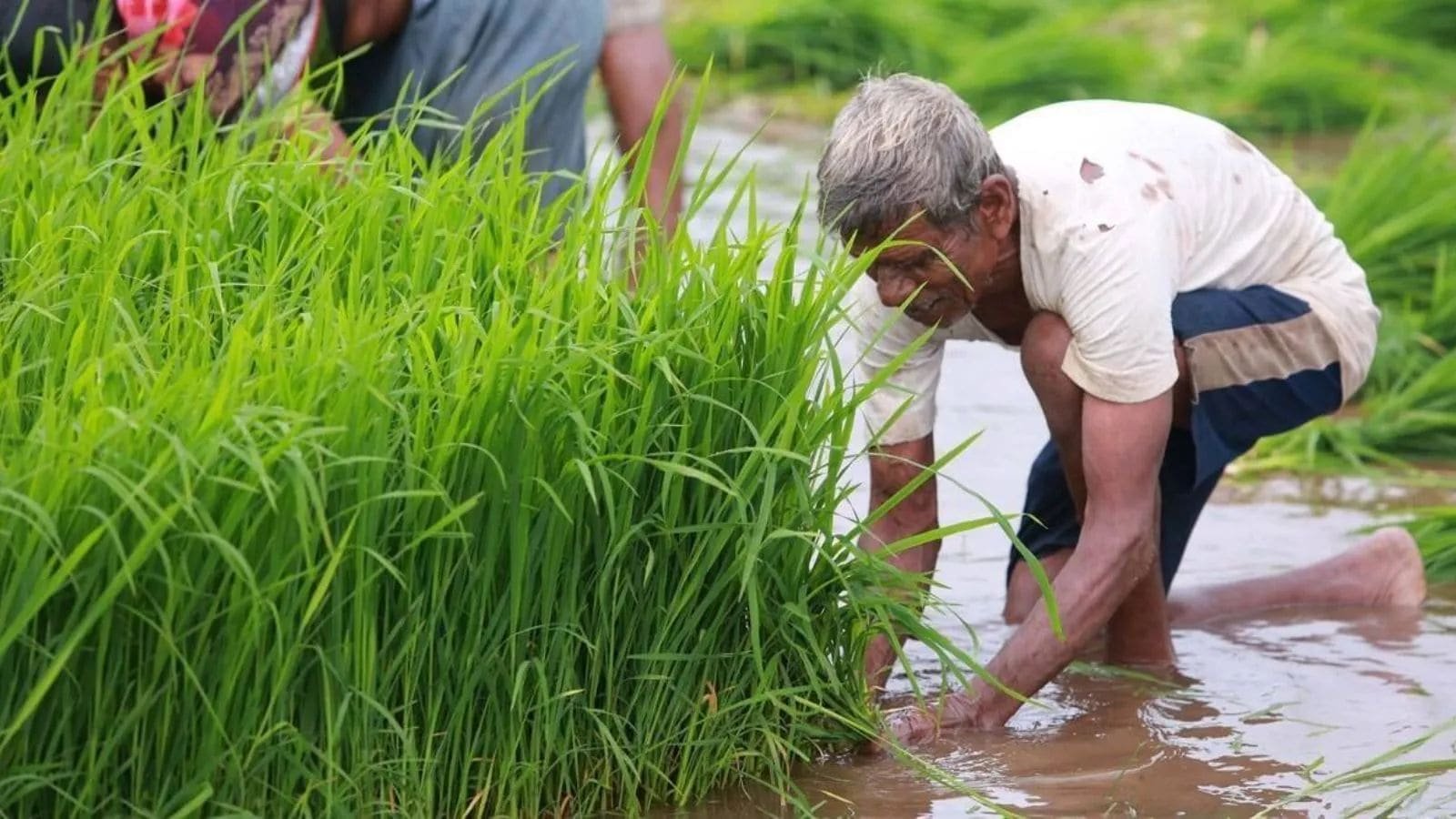
Weather scientists said that the newly developed products will significantly help manage and plan agriculture, water resource management,
The India Meteorological Department (IMD) on Tuesday launched two advanced, Artificial Intelligence-based weather forecasting products for the core monsoon areas, which practice rain-fed agriculture.
This is the first time that the IMD has heavily incorporated AI-based guidance in its forecasting services, which will commence this monsoon season.
Developed by the National Centre for Medium Range Weather Forecasting (NCMRWF), one forecasting product has been specifically developed for Uttar Pradesh. This product incorporates AI and offers a spatial resolution of up to 1 km, meaning rainfall forecasts can now be provided for every 1 km geographical area, making it a highly localised and specific forecast.
“The pilot project has been launched for Uttar Pradesh, which has a dense network of Automatic Rain Gauges (ARG) and Automatic Weather Stations (AWS). Rainfall data from these, combined with the rainfall data gathered from satellites and Doppler weather radars, will be used. Then the AI-based downscaling to 1km resolution can be provided up to 10 days lead time,” said M Ravichandran, Secretary, Ministry of Earth Sciences (MoES).
Speaking at the product launch in New Delhi, MoES Minister, Dr Jitendra Singh said, “Farmers can now take informed decisions regarding sowing of which crop seeds, irrigation, plan crop protection, and harvest locally. We have started the pilot project from UP, but it will be expanded to other regions, given the increasing weather vagaries and extreme events.”
Another AI-driven rainfall forecasting product has been developed by Pune-based Indian Institute of Tropical Meteorology (IITM). This forecasting system closely tracks how the monsoon will progress into various parts of the country, more specifically, every district. It is capable of generating district-level rainfall forecasts well in advance, and the updates will be made available every Wednesday.
“Earlier, the IMD shared monsoon advances over a larger geographical area, but now on, we will be able to provide monsoon advancements at the district level, so that the farmers can be better prepared and ready. So, both spatially and temporally, the rainfall forecast has been improved,” explained Ravichandran.
Story continues below this ad
There are over 750 districts in India, and this micro-level rainfall tracking will be, in this phase, available for 3,196 blocks/sub-districts across 16 states and one UT. These regions were chosen primarily because they are heavily rain-fed areas, whose requirement for rainfall forecasts is more urgent.
Weather scientists said that the newly developed products will significantly help manage and plan agriculture, water resource management, and disaster management, among a host of others.
