

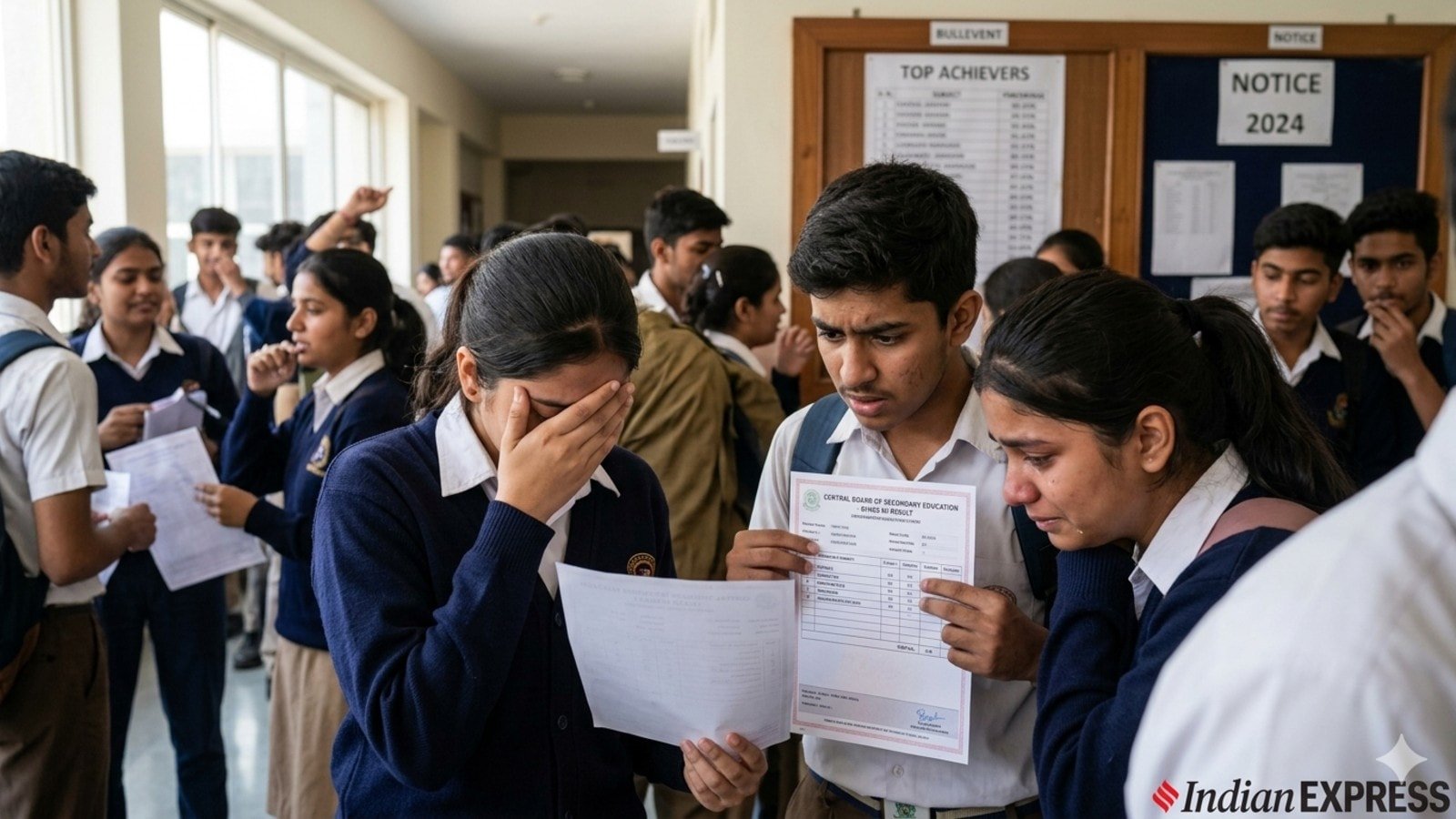
For two years, students organised their lives around board examinations — coaching classes, mock tests, sample papers, and endless revision schedules, all with the hope of securing strong Class 12 scores and opening the door to reputed colleges. But for some students, the CBSE results declared this week have instead left futures uncertain. A student from Assam said the board marks have now jeopardised eligibility for the Joint Entrance Examination (JEE) despite strong entrance preparation.
“I scored well in JEE Main, but because my aggregate dropped below 75 per cent, I am now not eligible for JEE Advanced,” the student said. “That is the hardest part to process. One evaluation outcome has suddenly changed the direction of everything I worked towards for two years.”
The student also questioned the disconnect between entrance examination performance and board results. “It feels strange that an entrance exam score says one thing about my preparation, while the board marks highlight something completely different. Right now, I don’t know which version colleges are supposed to believe,” the student added.
Across schools in the country, students who have consistently scored above 90 per cent through school exams, pre-boards, and coaching assessments said this year’s Class 12 board marks have left them shocked, confused, and emotionally shaken.
Also Read | CBSE Class 12 results: 16% fall in students scoring 90% or above; on-screen marking in focus
First year of On-Screen Marking
This is also the first year CBSE introduced On-Screen Marking (OSM) for Class 12 evaluation – a system under which scanned answer sheets are checked digitally instead of physical copies being manually evaluated.
Story continues below this ad
While no student or teacher indianexpress.com spoke to alleged wrongdoing, many questioned whether the transition to digital evaluation may have affected consistency in marking, especially in step-based papers such as mathematics, physics, chemistry, biology, and English.
And increasingly, the concerns are not coming from weak students.
“These are not students who underperformed or were unprepared,” said Nandini Sharma, an educator. “These are consistent achievers who came back confused, not angry. They are not asking, ‘Why did I fail?’ They are asking, ‘Why does this not match anything I have experienced in the last two years?’ That confusion is what concerns me most as an educator.”
According to Sharma, schools across cities have noticed similar patterns.
Story continues below this ad
“The dip is visible, and it is not random,” she said. “Physics, chemistry, and mathematics have been flagged across multiple schools. In Delhi, schools that have reliably produced large cohorts of 95-plus scorers year after year have reported notable drops this year. When the pattern cuts across schools, across cities, and concentrates in specific subjects, that is not individual underperformance. That is a systemic shift that requires a systemic explanation.”
One student who expected around 90 in both mathematics and chemistry based on pre-board performance ended up with 63 and 68, respectively.
“Those were realistic targets based on how my pre-boards and sample papers had gone,” the student said. “Maths surprised me the most because it was also the subject I had worked hardest on.” The student said teachers, too, had expected significantly higher scores.
“My preparation was visible to my teachers,” the student said. “These were not subjects where I was struggling or scraping through.”
Comparisons with classmates made the confusion worse.
Story continues below this ad
“Students who prepared at a similar level – or in some cases less – ended up with marks that were closer to what we had both expected,” the student said. “There was no logical pattern connecting effort to outcome this year.”
The student said the board’s result has now placed future academic opportunities in doubt.
“College admissions are percentage-driven,” the student said. “Scoring 63 in maths when you expected 90 does not just affect one number – it brings down your aggregate and closes doors that were well within reach two weeks ago.”
For another student, the biggest shock was physical education.
“That was my strongest subject, genuinely the one I was most confident about going into the exam,” the student said. “Scoring below 50 in it was something I did not see coming at all.”
Story continues below this ad
The student said some classmates who had prepared less rigorously scored significantly higher.
“That inconsistency is difficult to process,” the student said. “It suggests the difference was not in the preparation – it was somewhere in how the papers were evaluated.”
Another student, who had consistently scored above 95 per cent in school and secured a 99.76 percentile in JEE, said the board results have now complicated college plans. This student has obtained an overall percentage of 89.8 per cent.
“I was expecting around 95 per cent overall,” the student said. “Maths surprised me the most. I was expecting 91 or 92, and I got 79. English was also a shock. I have never scored below 95 in English before, and this time I got 88.”
The student described months of intense preparation.
Story continues below this ad
“I stopped eating on time. I solved RD Sharma cover to cover, every NCERT question, 10 years of past papers,” the student said. “When you put that much into one subject, and the result comes back 12 marks below what you expected, it doesn’t just feel disappointing, it feels wrong. Like something didn’t get counted.”
The student added, “Two years of work, and a number that doesn’t reflect any of it is now the first thing colleges will see.”
Teachers said what makes this year stand out is not merely the number of complaints, but the profile of students filing them. “Yes, and not just one or two,” educator Ekta Soni said. “Multiple students came to me with results that simply did not add up. These are children I have personally taught and assessed. I know their capability.”
Soni recalled one student who consistently scored above 95 in English but received 68 in the board examination.
Story continues below this ad
“When a student who consistently scored above 95 in English comes back with 68, she doesn’t just come to me confused, she comes broken,” Soni said. “That is not a one-off. That is a signal.”
According to Soni, unusual score drops have appeared in mathematics, biology, and English.
“A biology student who got only three to four MCQs wrong received 62,” she said. “A maths student who had prepared exhaustively – past papers, NCERT, everything – received 79 when she expected 91. English scores have dropped in students who have never dipped below 95. These are not random fluctuations. There is something systemic here.”
The transition to On-Screen Marking has become central to many of these discussions.
Story continues below this ad
“Reading a handwritten answer on a screen is a fundamentally different experience from checking a physical paper,” Soni said. “When you are evaluating step-by-step solutions in Maths or detailed diagrams in biology through a zoomed-in screen interface, you are working harder to see the same information. That additional cognitive load has consequences – especially when evaluators are doing this at scale for the first time.”
Sharma echoed similar concerns.
“A lightly written answer, a margin note, a diagram with fine lines, a multi-step solution that spans two pages – all of these depend on scan quality and screen legibility in ways they never depended on before,” she said.
According to Sharma, the key issue is whether the transition was adequately prepared for.
“Any change in the medium of evaluation changes the experience of evaluation,” she said. “The question CBSE needs to answer is: was that change accounted for? Were evaluators given adequate time to recalibrate? Was there a parallel run to compare outcomes between physical and digital marking before rolling this out at full scale?”
On evaluator training, Sharma said: “Standardisation only works when three things are in place: examiner training is standardised, interpretation of marking schemes is standardised, and quality audits are transparent. If any one of those is missing, you are not digitising accuracy. You are digitising inconsistencies.”
Educators also questioned whether screen-based evaluation may affect subjective papers differently.
“In a long-form subjective paper, an essay, a derivation, a detailed analytical response – the evaluator needs to follow the architecture of the answer,” Sharma said. “That kind of reading demands sustained, uninterrupted attention. A screen – with its zooming, scrolling, and interface navigation – interrupts that flow in ways a physical paper does not.”
Soni added, “Objective answers with fixed responses are more forgiving of the medium. Subjective assessment requires a different kind of attention, and screens interrupt that.”
Many students indianexpress.com has spoken to said they are now applying for verification, photocopies of answer sheets, and re-evaluation despite the financial burden.
“Scoring below 50 in your strongest subject leaves you with no choice but to question it formally,” one student said. “I want to see the answer sheet. I want to understand what happened.”
Teachers said the growing volume of rechecking requests is itself significant.
“When students who have never questioned their results before – students with strong, consistent academic histories – are filing for rechecking across multiple subjects, that is a pattern worth documenting,” Sharma said. Soni pointed to the financial aspect as well.
“These are toppers,” she said. “Students who have never needed to apply for rechecking before are now spending Rs 500 per subject, money that many families cannot easily spare.”
“In today’s system, even a difference of five to 10 marks can decide admissions, scholarships, eligibility criteria, and career pathways,” Soni added. “That is why students are reacting so strongly this year. For them, these are not just numbers on a marksheet.”
Cautionary note
Education experts, however, cautioned against attributing the decline entirely to OSM.
Prashant Jain, CEO, Oswaal Books, called the 85.20 per cent Class 12 pass percentage “a course correction.” According to Jain, three converging factors explain the decline: the first-year transition to OSM, tougher physics and mathematics papers, and the lingering impact of COVID-era learning loss among students who were in middle school during the pandemic years.
“This is the first year of On-Screen Marking for Class 12, and any system transition of this scale reflects in the numbers, especially for borderline students, where light handwriting, faint diagrams, and marginal annotations are harder to read on a screen than on paper,” Jain said.
“The removal of informal totalling cushions under OSM has also tightened the margin,” he added.
Jain further argued that the 2020-22 board results had been “inflated by alternative assessment models” and that current numbers indicate a “normalisation” closer to pre-pandemic trends.
At the same time, he acknowledged that digital evaluation changes examination expectations. “Under OSM, presentation is not secondary,” Jain said. “Clear handwriting, dark ink, labelled diagrams, and structured working are now examination skills.”
For students waiting to access photocopies of evaluated answer sheets, the issue has now moved beyond marks. “It has been really hard,” one student said. “I have been a topper since childhood. Finishing Class 12 with a strong score was a dream I had worked towards for two full years.”
Among those seeking re-evaluation is a Class 12 student of Amity International School, Saket, who said he was surprised by his English score despite scoring 99, 98, and 97 in other subjects.
“Considering the difficulty of the paper, my overall academic consistency and expectations from the examination, I believe there may have been an inadvertent discrepancy during the evaluation process, including the possibility of an issue during OSM or totalling,” he said, adding that he would apply for revaluation.
