

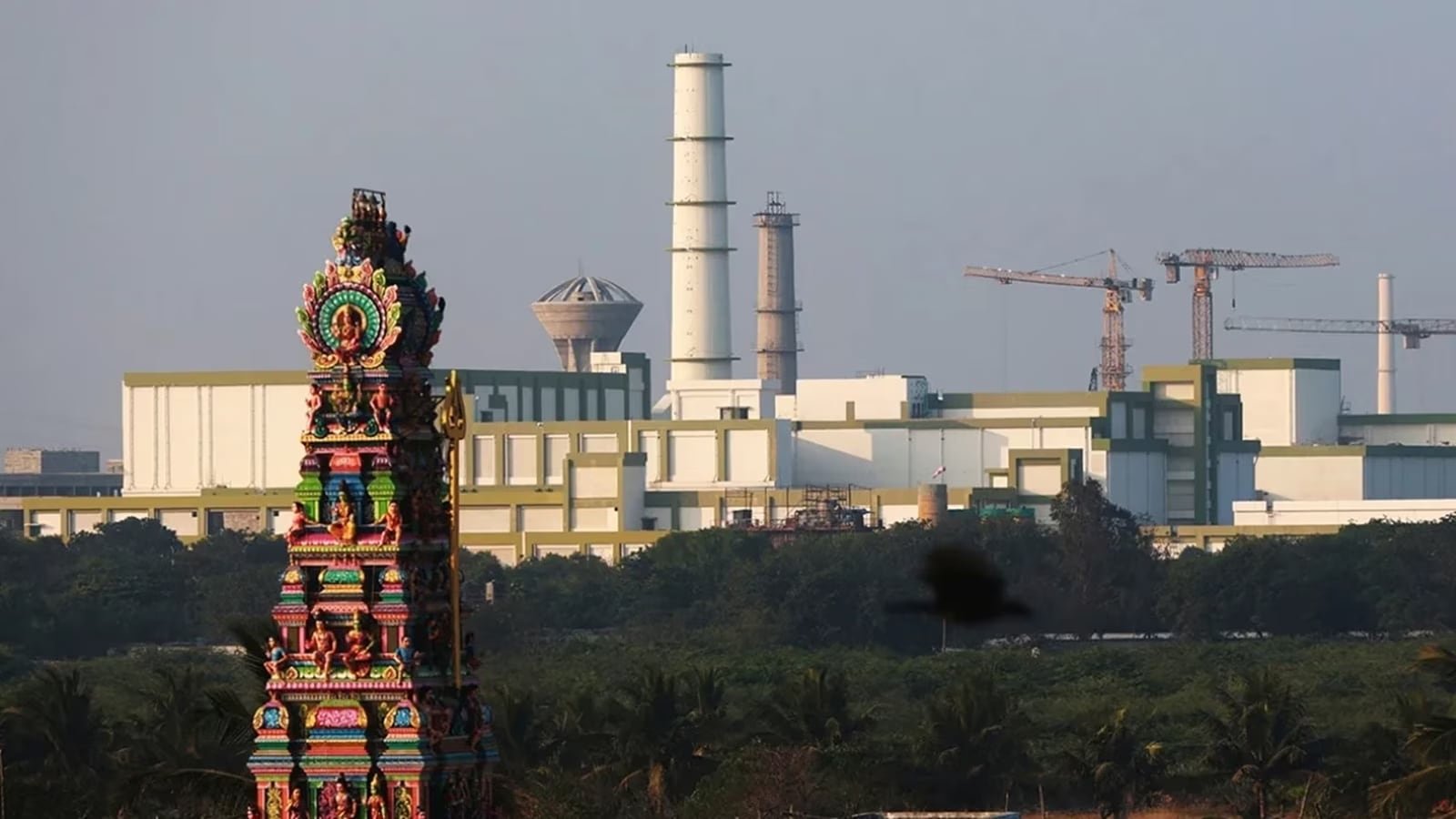
Alongside a stepped-up role for the private sector in nuclear plant operations, India is doubling down on its domestic civil nuclear programme based on its mainstay, pressurised heavy water reactors (PHWRs), and remains open to collaborating with external players to scale up projects built on this technology.
Less than six months after the landmark legislation opened up India’s nuclear sector, a visiting high-powered American nuclear delegation has been informed, in meetings with top government functionaries, of New Delhi’s two clear objectives following the legal changes: scale up nuclear power to step up base-load capacity, and progressively enter the manufacturing value chain of small modular reactors (SMRs).
Based on heavy water and natural uranium, PHWRs are a technology India’s nuclear establishment has mastered — but one that is increasingly out of sync with the light water reactors (LWRs), or pressurised water reactors, that are now the most dominant type worldwide. The Americans, Russians and French are among the leaders in LWR technology.
The problem with LWRs, from an Indian perspective, is high project costs, which translate into a high per-unit cost of power. As a result, there is a sense in policy circles that PHWRs will remain the main focus, with the government willing to explore possibilities on the fuel front, including the potential for thorium fuel. Any foreign collaboration could largely be limited to SMRs for now, given cost concerns linked to LWRs, an executive who is part of the US delegation told The Indian Express after the first leg of visits concluded in Delhi.
Read | Ahead of India visit, US-based nuclear firms tapped for inputs on investment potential
The executive said the Indian side communicated a general openness to private participation, alongside the need for funding from foreign sources. SMRs are an area where foreign expertise and funding are being actively sought. India’s dominant nuclear technology — PHWRs spanning 220 MWe (megawatt electric) reactors up to newer 700 MWe reactors — has a largely unblemished operational record but has suffered from scalability issues.
India’s external outreach for nuclear collaborations is driven more by the need for capital than technology, a top government official had indicated at the time of the nuclear Amendments’ passage.
The import of LWRs at higher cost raises two important concerns: such projects should not end up stunting the growth of indigenous reactor design and production capacities; and higher capital expenditure results in higher tariffs, which must be absorbed under Indian market conditions. The setting up of nuclear reactors at the Jaitapur site in Maharashtra, for instance, has been in limbo because of high tariff concerns, alongside liability concerns flagged earlier by French atomic power major Areva, which also faced its own financial troubles. The liability concerns have been addressed in the new nuclear amendments.
Story continues below this ad
Explained
America’s mission
The US nuclear ‘executive mission’ has a twin-pronged brief: take stock of India’s nuclear energy landscape after a landmark legislation opened up this sector; communicate the US industry’s interest, as well as coordinate US government messaging, on emerging opportunities.
It is learnt that foreign funds, including sovereign funds from West Asia, have expressed early interest in part-financing India’s stated objectives to scale up nuclear power, including entering the manufacturing value chain of SMRs. SMRs are increasingly seen as important for nuclear energy to remain a commercially competitive option in the future.
Organised by the Washington DC-based Nuclear Energy Institute — a lobby group of America’s commercial nuclear energy industry — and the US-India Strategic Partnership Forum, the industry delegation held meetings with Union Power Minister Manohar Lal and Finance Minister Nirmala Sitharaman, as well as top representatives from states such as Andhra Pradesh and Maharashtra.
Over the past 15 months, a handful of American nuclear companies have secured “specific authorisations” from the US government with respect to a restrictive American regulation referred to as “10CFR810” (Part 810 of Title 10, Code of Federal Regulations of the US Atomic Energy Act of 1954). This authorisation permits these companies, subject to conditions, to transfer technology to Indian entities, which is otherwise barred under 810 regulations. Most of the companies that have received this clearance are part of the visiting delegation.
The delegation is currently in Mumbai for two days, with meetings scheduled with India’s private sector energy players, including Reliance Industries, Adani Group, Tata Power Company, JSW Energy, Vedanta, Larsen & Toubro, Tata Consulting Engineers and Hindalco Industries.
Story continues below this ad
In December last year, Parliament passed the Sustainable Harnessing and Advancement of Nuclear Energy for Transforming India (SHANTI) Act, 2025, marking a major shift in how India’s tightly-controlled nuclear power sector will be governed. For the first time, the Act enabled private players to enter the operations side of the sector, as well as areas such as fuel management, which had remained under tight public-sector control for decades.
The SHANTI Act was passed amid Opposition concerns over private participation and changes to the liability regime — particularly the dilution of provisions fixing responsibility on equipment suppliers in the event of a nuclear accident. The Act replaced two earlier legislations — Atomic Energy Act, 1962, and Civil Liability for Nuclear Damage Act, 2010 — and effectively redrew the rules governing India’s nuclear power sector, covering who can build and operate plants, how accident liability is capped, the role of the safety regulator, and mechanisms for dispute resolution and compensation.
