

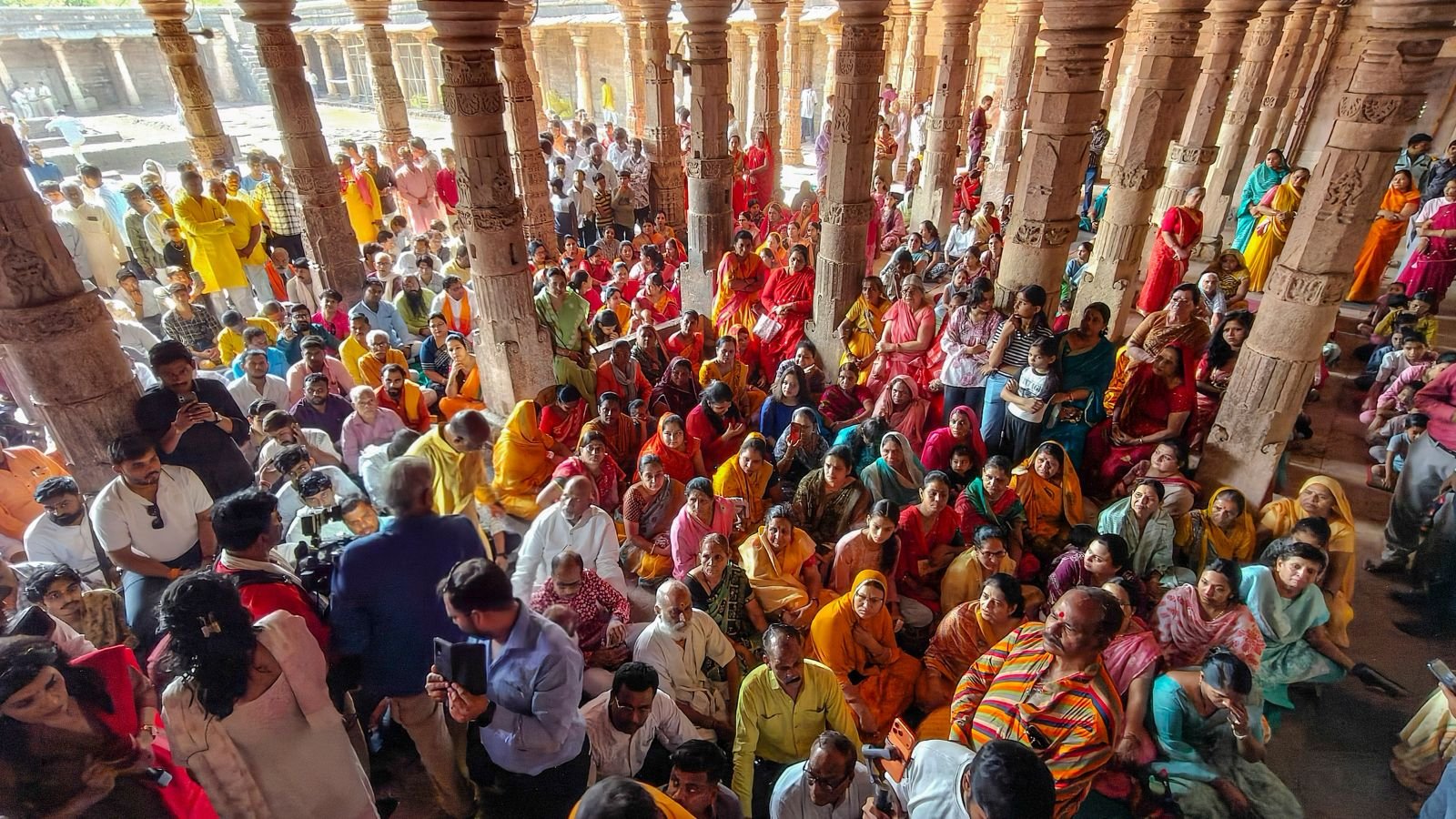
Under the watch of nearly 1,800 security personnel deployed across Dhar, the Bhojshala-Kamal Maula complex witnessed its first ‘maha aarti’ by Hindu groups, while Muslims who say their right to offer namaaz at the structure still stands chose to offer prayers in the confines of their homes as a sign of protest.
Barricades ringed the approach roads to the complex from early morning Friday, while RAF, QRF and STF personnel patrolled sensitive areas across the town. Police conducted flag marches through Dhar Thursday night ahead of the prayers and ceremonies, with officers monitoring social media and maintaining additional pickets in Muslim-majority localities. The Maha aarti comes after the Archaeological Survey of India (ASI) has granted the Hindus unrestricted access to the monument at the Bhojshala complex in Dhar district of Madhya Pradesh for worship and other purposes, police said.
Dhar Superintendent of Police said the administration would permit only those rituals allowed under the Madhya Pradesh High Court order.
“Only puja that has been permitted following the orders and directions of the honourable High Court will be conducted here. Apart from this, we have made adequate security arrangements within the premises, around the area, and across the entire city,” Sharma said. He added that discussions had been held with community representatives and that all sides had agreed to follow the court’s directions.
Also Read | Why Madhya Pradesh High Court ruled that Bhojshala was a temple
The atmosphere inside the complex sharply contrasted with the tension outside. Hindu devotees queued barefoot beneath the carved stone arches of the ASI-protected monument, reciting Hanuman Chalisa and offering prayers to Goddess Saraswati, whom they refer to as “Ma Vagdevi”.
Hindu organisations described Friday’s ceremony as historically significant, claiming it was the first Friday ‘maha aarti’ held at Bhojshala in 721 years. The Bhoj Utsav Samiti had earlier announced that devotees would take out a procession and conduct a “Vagdevi Maha Aarti” after the High Court ruling altered the religious status of the site.
Until the Madhya Pradesh High Court judgment on May 15, worship at the monument operated under a 2003 ASI arrangement that allowed Hindus to offer prayers on Tuesdays and Basant Panchami, while Muslims offered namaz on Fridays. The arrangement had often led to tension when Basant Panchami coincided with Friday prayers.
Story continues below this ad
The high court, however, held last week that the religious character of the disputed structure was that of Bhojshala — a temple dedicated to Goddess Saraswati. The court also said the site remained a protected monument whose preservation was the constitutional responsibility of the state.
Inside the complex on Friday, petitioner offered prayers and called the verdict part of a wider resurgence of Hindu assertion.
“Today, with the resurgence of Hindus, we are winning the fight to reclaim symbols of Hindu faith and pride,” Tiwari said. Referring to the legal challenge mounted by the Muslim side, he added that the matter could not be considered fully settled until the Supreme Court pronounced its final verdict.
Tiwari also demanded unrestricted access for Hindu devotees to the site, saying entry fees should no longer be charged now that Bhojshala had been declared a temple.
Story continues below this ad
The ruling has also triggered fresh demands from Hindu litigants over the physical structure of the monument. The petitioner, associated with the Hindu Front for Justice, has written to the Archaeological Survey of India seeking the immediate opening of a locked room in the south-eastern section of the complex, claiming it formed part of the original temple structure.
Also Read | Bhojshala verdict: What the Hindu and Muslim sides argued in the High Court
In his application, Goyal also demanded the removal of what he termed “unauthorised Islamic symbols” from the premises in view of the High Court ruling.
Even as Hindu groups celebrated the verdict, Muslim petitioners announced symbolic protests against the order while emphasising they would remain within constitutional limits.
Maulana Kamal Welfare Society president Abdul Samad, one of the petitioners from the Muslim side, said members of the community would offer namaz inside their homes and courtyards instead of gathering at the complex. He said Muslims would wear black bands, shut shops and upload photographs and videos of prayers on social media to protest what they viewed as the loss of a mosque.
Story continues below this ad
“We want to send this message that our mosques are being snatched from us,” Samad said. “The Constitution guarantees us the right to worship. We will follow the Constitution and not play with other people’s religious sentiments.”
The protests came as the Muslim side formally moved the Supreme Court against the High Court verdict. One Qazi Moinuddin has filed an appeal challenging the May 15 judgment that declared the religious character of the Bhojshala-Kamal Maula complex to be that of a Hindu temple.
Friday’s developments marked the latest chapter in a dispute that has shaped communal and political mobilisation in Dhar for decades. Earlier this week, Hindu groups had celebrated the court verdict with havans, Hanuman Chalisa recitations and fireworks at the site. On Thursday night, police carried out large-scale flag marches through the city in an attempt to project readiness and reassure residents amid fears of unrest.
By Friday evening, the city remained tense but calm, with security forces continuing deployment across sensitive zones as both sides prepared for what is expected to be a prolonged legal battle before the Supreme Court.
