
African and Caribbean leaders are demanding financial compensation, debt cancellation and formal apologies from countries that benefited from the transatlantic slave trade after adopting a sweeping reparations plan at a conference in Ghana.
The 19-point framework calls for financial compensation, debt relief, a Global Reparations Fund and the return of looted cultural artifacts and ancestral remains. It also seeks reforms to international financial institutions that supporters say disadvantage Third World countries.
The proposal is expected to be presented at the next UN General Assembly as African and Caribbean nations step up a coordinated push for slavery reparations.
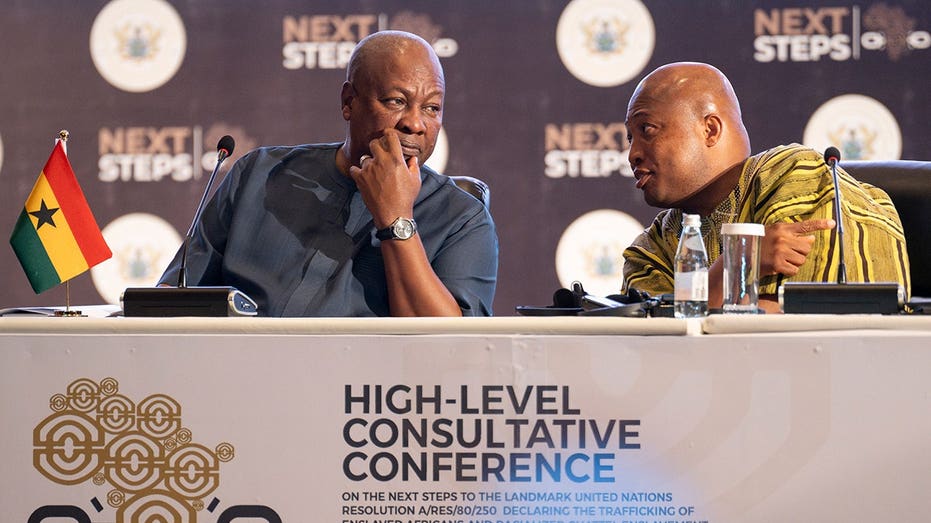
The plan was adopted Friday by the African Union and the Caribbean Community (CARICOM) Commission on Reparatory Justice at the end of a three-day conference.
REPARATIONS ADVOCATES PUSH FOR PAYMENTS TO BLACK AMERICANS DESPITE BUDGET AND LEGAL CHALLENGES
"None of us gathered in this hall today can be held personally responsible for the atrocities of the transatlantic slave trade," Ghanaian President John Dramani Mahama told delegates.
"History does not ask us to inherit guilt, but it asks us to inherit responsibility," Mahama added.
The proposal does not identify specific countries that should provide compensation or issue formal apologies.
TULSA MAYOR PROPOSES $100M REPARATIONS PLAN FOR DESCENDANTS OF 1921 TULSA RACE MASSACRE
It does call for debt cancellation, climate justice financing, expanded citizenship pathways for Africans in the diaspora and what organizers describe as a "right of return" for descendants of enslaved Africans.
The plan also urges African countries to preserve former slave forts and castles as memorial sites.
According to advocates, at least 12.5 million Africans were kidnapped and transported aboard European ships between the 15th and 19th centuries. Supporters of reparations argue the effects of slavery continue to be felt across Africa and the Caribbean generations later.
UN COURT RULES WEALTHY NATIONS PAY UP FOR CLIMATE CHANGE DAMAGES IN CONTROVERSIAL GLOBAL RULING
The conference follows a UN vote in March recognizing transatlantic slavery as the "gravest crime against humanity."
The resolution passed with 123 votes in favor, but the U.S., Israel and 52 other countries either voted against it or abstained.
According to Reuters, the United States and European Union raised concerns that the resolution could be interpreted as creating a hierarchy among crimes against humanity by treating some atrocities as more serious than others.
MACRON TAKES THE STAGE UNINVITED AT AFRICA SUMMIT TO SCOLD CROWD FOR 'TOTAL LACK OF RESPECT'
Heads of state from Namibia, Liberia, Senegal, Barbados and Sao Tome and Principe attended the conference, along with senior officials from several other countries.
French President Emmanuel Macron addressed the gathering virtually from the Élysée Palace, where he acknowledged the suffering caused by slavery.
Enslaved people were "torn from their homelands, deported, dehumanised, and treated as goods," Macron said.
Macron also said reparations should not be viewed "as an end point, or a cheque written to bring the story to a close."
The conference in Ghana brought together separate reparations efforts previously pursued by African and Caribbean nations into a single document that organizers plan to take before the United Nations.
Reuters contributed to this report.