

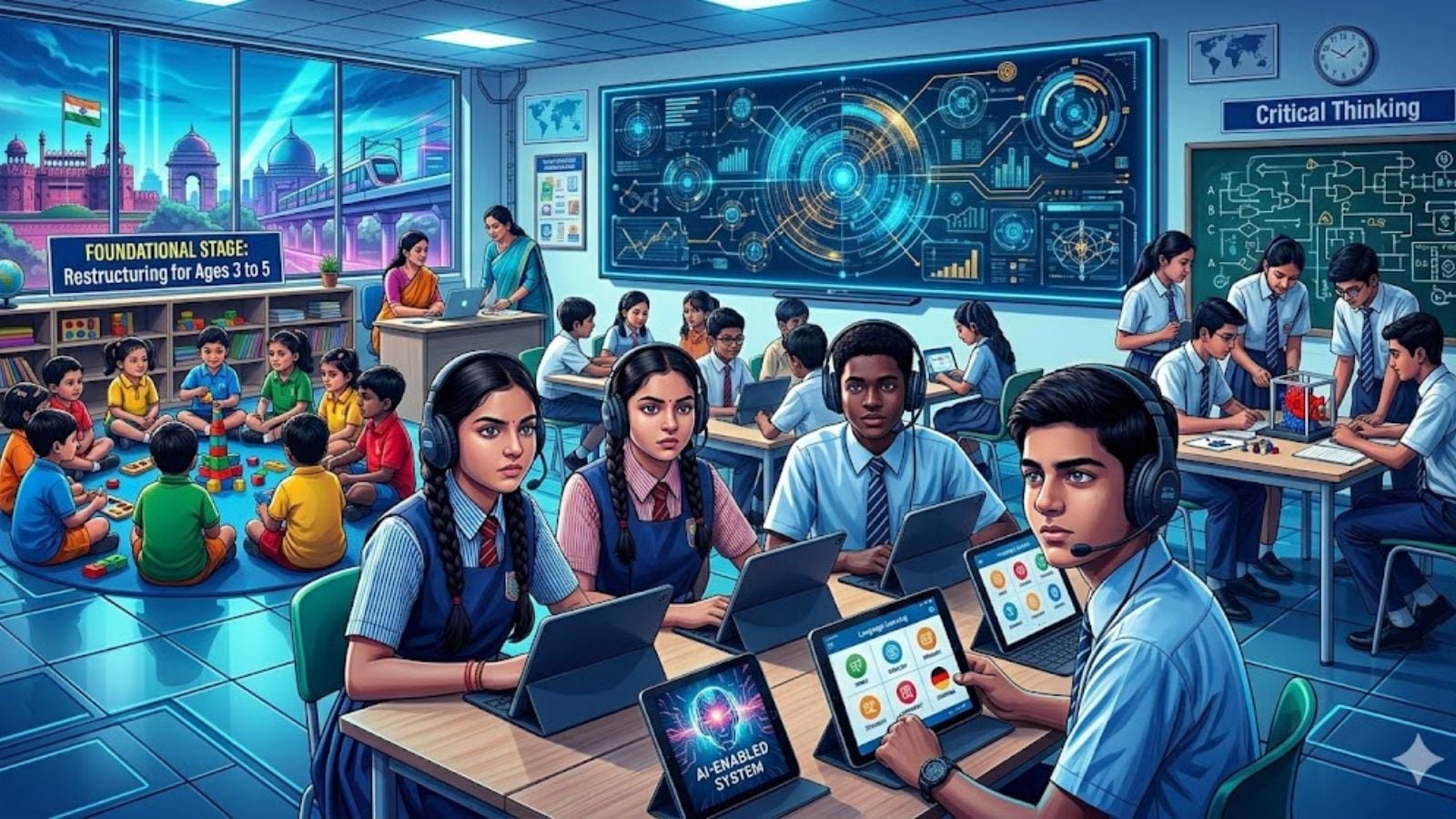
Beginning 2026-27, the Directorate of Education will restructure the foundational stage to include three years of pre-primary education, covering ages 3 to 5 years, before entry into Class 1. (Image generated using AI)
Language labs powered by artificial intelligence (AI), a restructuring of early childhood education, and a fresh push to make classrooms less about memorisation and more about thinking — these are some of the new initiatives in the education sector announced by Chief Minister Rekha Gupta in the Delhi Budget on Tuesday (March 24).
At the centre of the new initiatives is the Dr A P J Abdul Kalam Language Labs program, an AI-enabled system designed to strengthen students’ listening, speaking, reading, and writing skills. Piloted in 100 government schools in 2025-26, the program is expected to reach nearly 60,000 students in Classes 6, 9 and 11. The labs will offer structured learning in Indian languages such as English, Hindi, and Sanskrit, alongside foreign languages including French, German, and Spanish — an effort to blend foundational learning with global exposure.
Another significant shift is planned in the earliest years of schooling. Beginning 2026-27, the Directorate of Education will restructure the foundational stage to include three years of pre-primary education, covering ages 3 to 5 years, before entry into Class 1.
From 2028-29, a minimum entry age of 6 years-plus for Class 1 will be enforced. The move aligns Delhi’s system more closely with the National Education Policy’s (NEP’s) emphasis on early childhood education, long seen as a missing link in public schooling.
The government is also continuing its experiment with “model” institutions. Seventy-five CM SHRI Schools, launched in 2025-26, are expected to serve as examples of equitable, high-quality and future-oriented education.
The Delhi government has allocated Rs 19,148 crore to education in 2026-27, maintaining it as one of its largest spending sectors. The outlay comes as the system serves nearly Rs 45 lakh students across more than 5,500 schools, placing continued pressure on infrastructure.
To address this, the Budget has set aside Rs 200 crore for new school buildings and Rs 275 crore for expanding existing ones. At the same time, larger institutional plans, including an “integrated education city” in Narela, a proposed National Law University and a sports university in Mundka, point to ambitions that extend beyond school education.
Story continues below this ad
Inside classrooms, the government says it is moving away from rote-based examinations toward competency-based assessments. The focus, according to the Economic Survey tabled in the Assembly on Monday (March 23), is on conceptual clarity, critical thinking, and the practical application of knowledge — a shift that echoes national policy but remains uneven in implementation.
There is also a continued emphasis on reducing the cost of schooling. The Delhi Cabinet has approved revised uniform subsidies: Rs 1,250 annually for students from nursery to Class 5, Rs 1,500 for Classes 6 to 8, and Rs 1,700 for Classes 9 to 12. The scheme applies to students in government and aided schools, as well as those from Economically Weaker Section (EWS) and Disadvantaged Group categories.
Other measures including free bicycles for Class 9 girls and laptops for high-performing Class 10 students underscore a policy focus on access, mobility and digital inclusion.
Delhi’s education Budget has nearly doubled over the past decade, from Rs 9,119.2 crore in 2016-17 to a projected Rs 19,038.9 crore in 2025-26, with the upward trajectory continuing this year. At the same time, the share of education in the Budget has steadily declined from 24.47 per cent in 2016-17 to 19.04 per cent this year, after remaining above 23 per cent until 2018-19.
Story continues below this ad
Even so, Delhi continues to rank among the highest spenders on education in the country. According to the Reserve Bank of India’s State Budget Analysis, the capital allocates around 19 per cent of its budget to education, significantly higher than the national average of 13.1 per cent.
