

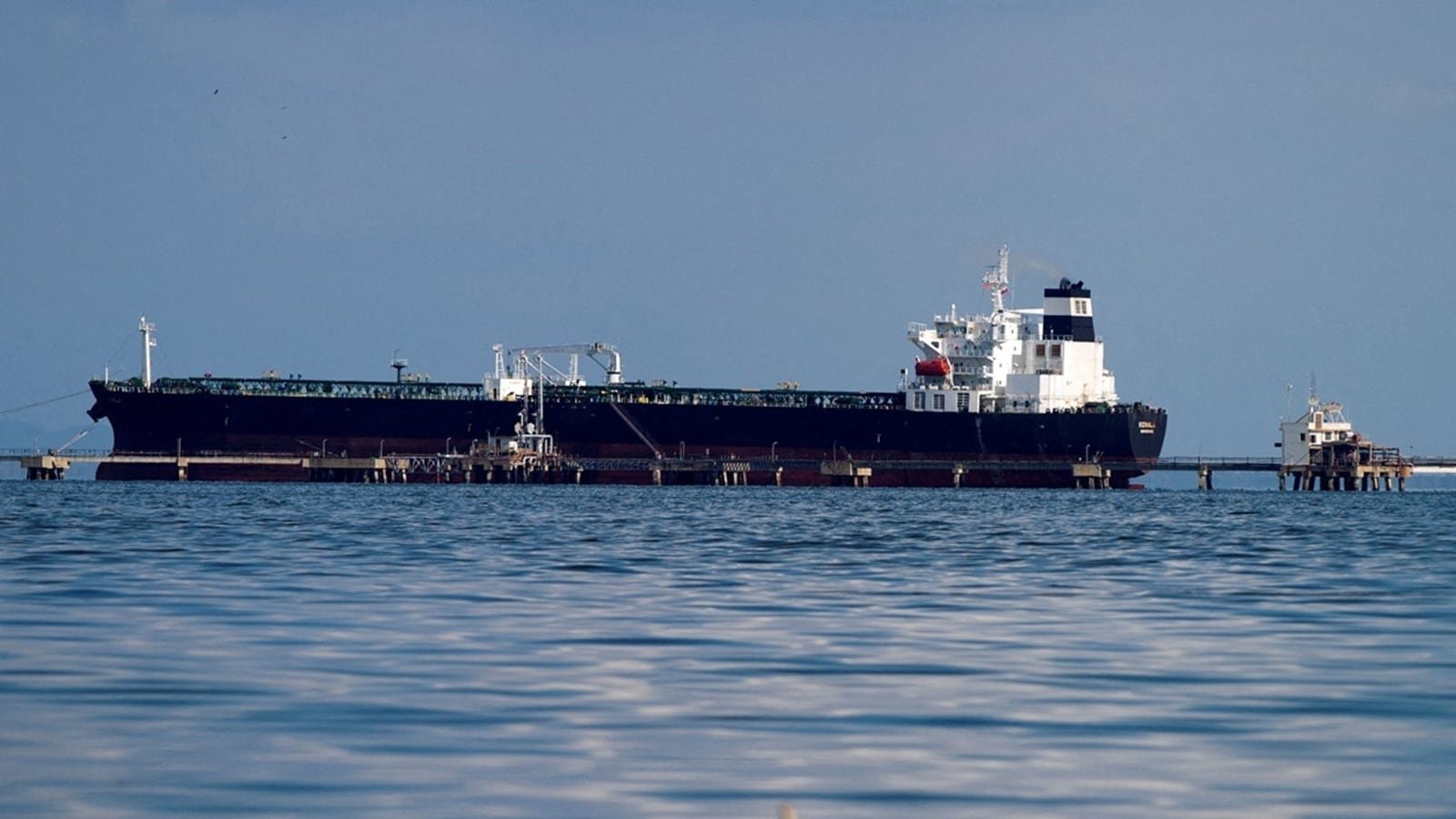
The Indian government has been categorically denying the payment of any toll or charge to the Iranians for the passage of India-flagged ships through the waterway. (Source: File)
Amid reports that Iran wants to impose tolls or transit fees on merchant vessels crossing the Strait of Hormuz, India continues to press for free and safe navigation through the narrow waterway between Iran and Oman, which connects the Persian Gulf with the Arabian Sea, and is a critical maritime chokepoint for shipments of oil, gas, and some other commodities. In response to reports regarding the potential formalisation of a toll by Iran for passage through the Strait, a senior Foreign Ministry official said that there has been “absolutely no discussion” on the issue between India and Iran, adding that India maintains its long-held stance on the matter and will evaluate future scenarios if and when they arise.
“Yes, we have also seen some reports…we continue to call for free and safe navigation through the Strait of Hormuz. We made this point in our statement yesterday as well and continue to do so now as well,” Foreign Ministry Spokesperson Randhir Jaiswal said on Thursday at the inter-ministerial press briefing on the West Asia crisis.
There had been reports that Iran was already charging a “toll” from some vessels before allowing them to cross the Strait of Hormuz. The Indian government has been categorically denying the payment of any toll or charge to the Iranians for the passage of India-flagged ships through the waterway. Since the war began, eight India-flagged vessels—all LPG tankers—have returned from the Persian Gulf. India has high dependence on West Asia for its oil and gas supplies, most of which come to the country via the Strait of Hormuz. The Strait is also important for India’s supplies of other commodities, including fertilisers and petrochemicals.
“On the question of toll…there has been no discussion on this point between us and Iran. So that is where we are. As to what will be the scenario if a certain situation arises or happens in future, we’ll see when the time comes. But our point of view at this point in time is that we continue to call for free and safe navigation through the Strait of Hormuz,” Jaiswal added.
Unlike man-made shipping waterways like the Suez Canal and the Panama Canal, straits are natural waterways there is generally no transit charge for crossing them. Turkey’s Bosphorus and Dardanelles straits are exceptions, where tolls are charged by Ankara under a special international treaty. Like most other natural waterways that are shipping chokepoints, the Strait of Hormuz is an international strait, and no tolls are charged just for crossing them, as per the United Nations Convention on the Law of the Sea (UNCLOS). Although neither Iran nor the US have ratified the convention, it is widely accepted as international law, and Washington and Tehran have mostly abided by it. Sources indicated that changing the status of the Strait of Hormuz is a question of international law and would be required to be done through the UN.
According to international media reports, Iran’s 10-point proposal for the West Asia war to end includes formalisation of Tehran’s de facto control over the Strait of Hormuz. Citing details shared by unnamed Iranian officials with state media, The New York Times reported that as part of the plan, Tehran would impose a toll of up to $2 million on merchant ships passing through the Strait, through which about a fifth of global oil and liquefied natural gas (LNG) flows transit.
US President Donald Trump’s comments also added to the speculation and confusion over the proposal of a toll being charged by Iran. “We’re thinking of doing it as a joint venture. It’s a way of securing it—also securing it from lots of other people,” Trump told ABC News said when asked whether he would allow Tehran to charge tolls for shipping to transit the strategic waterway. “It’s a beautiful thing,” the US president added. Earlier, Trump had set a deadline for Iran to fully open the Strait or face heavy destruction. Just hours before the deadline expired, the temporary two-week ceasefire was agreed upon on Wednesday. Trump said that it was subject to Iran agreeing to “complete, immediate, and safe opening” of the Strait of Hormuz.
Story continues below this ad
Iran’s Foreign Minister Seyed Abbas Araghchi said on Wednesday that safe passage through the Strait of Hormuz will be possible for two weeks but “via coordination with Iran’s Armed Forces and with due consideration of technical limitations”. The situation, however, remains tense with vessel movements through the Strait still highly constricted on Thursday.
© The Indian Express Pvt Ltd
