

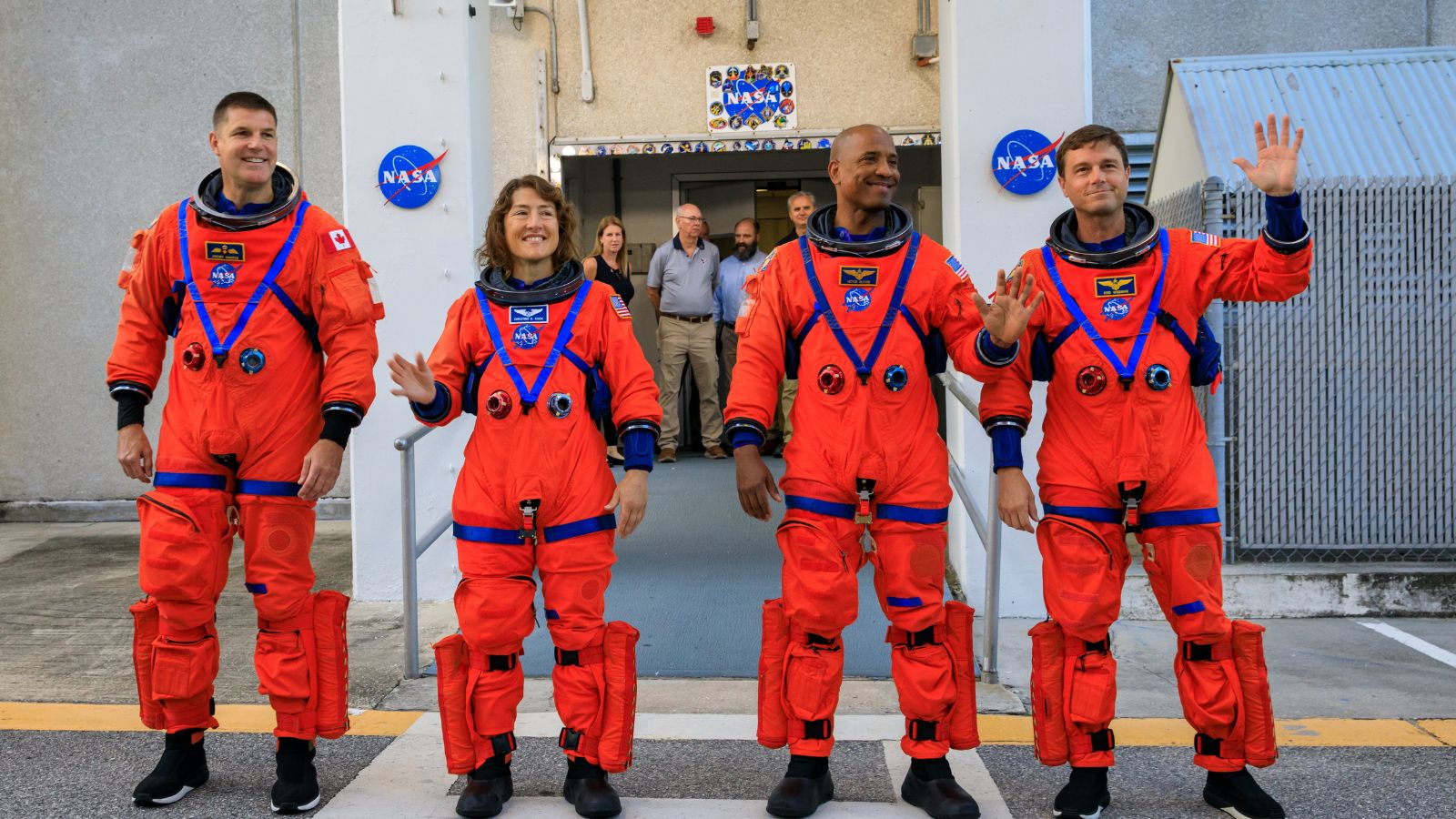
Post Content The astronauts have been in quarantine since March 20, when the mission’s rocket and spacecraft were rolled out to the launch pad. (Image: Nasa)
The crew of Nasa’s highly anticipated Artemis 2 mission has arrived at the Kennedy Space Center, marking a major step toward what could be the first crewed journey around the Moon in more than 50 years. The four astronauts landed on March 27 after flying in T-38 jets from Houston, touching down at the Shuttle Landing Facility in the afternoon.
The team includes Reid Wiseman, Victor Glover, Christina Koch, and Jeremy Hansen. They are now entering the final phase of preparations before liftoff, which is currently targeted for April 1.
“It’s awesome to be here. We love coming here,” Wiseman said after landing. “About 100 miles away, we said how much we love sliding to KSC.”
Final preparations underway
The astronauts have been in quarantine since March 20, when the mission’s rocket and spacecraft were rolled out to the launch pad. They will remain in isolation until launch, a standard precaution to ensure crew health ahead of spaceflight.
The Artemis 2 mission will use Nasa’s powerful Space Launch System rocket and the Orion spacecraft. The stack is already positioned at Launch Complex 39B, ready for final checks and fueling.
Also Read | NASA Artemis 2 countdown begins: Crew prepares for historic moon mission launch
Nasa plans to begin fueling the rocket on launch day morning, with liftoff scheduled within a two-hour window that opens at 6.24 pm. EDT. If needed, backup launch opportunities are available daily through April 6, with another window later in the month.
Mission decades in the making
Artemis 2 is expected to be the first mission to send humans beyond low Earth orbit since the Apollo 17 mission in 1972. Although the crew of the mission will not land on the Moon, they will fly by it on a predetermined path called a free return trajectory. This trajectory naturally leads back to Earth.
Story continues below this ad
The mission is expected to take about 10 days. During this period, the crew will test some of the major systems on board Orion. These systems include life support systems, navigation systems, and communication systems. These systems are essential for future missions that are expected to land humans on the Moon.
Challenges before liftoff
The road to launch has not been entirely smooth. Earlier this year, engineers detected a liquid hydrogen leak during a pre-launch rehearsal. Although the issue was resolved, another technical problem involving helium flow forced the rocket to be rolled back for further repairs.
Also Read | What does the ocean floor look like from space? NASA has the answer
After fixes were completed, the rocket returned to the launch pad, putting the mission back on track. Even so, officials have made it clear that safety remains the top priority, and delays are possible if any new concerns arise.
“We’re not trying to get it right out of the gate,” officials said, describing Artemis 2 as a test mission focused on learning and refinement.
Story continues below this ad
The Artemis programme is designed as a long-term effort to return humans to the Moon and eventually prepare for missions to Mars. If Artemis 2 goes as planned, the next steps will involve more complex missions, including testing lunar landers and eventually attempting a crewed landing later this decade.
For now, all eyes are on April 1. If the countdown proceeds without interruption, Artemis 2 will mark a historic return to deep space for human explorers, something not seen in over half a century.
© IE Online Media Services Pvt Ltd
