

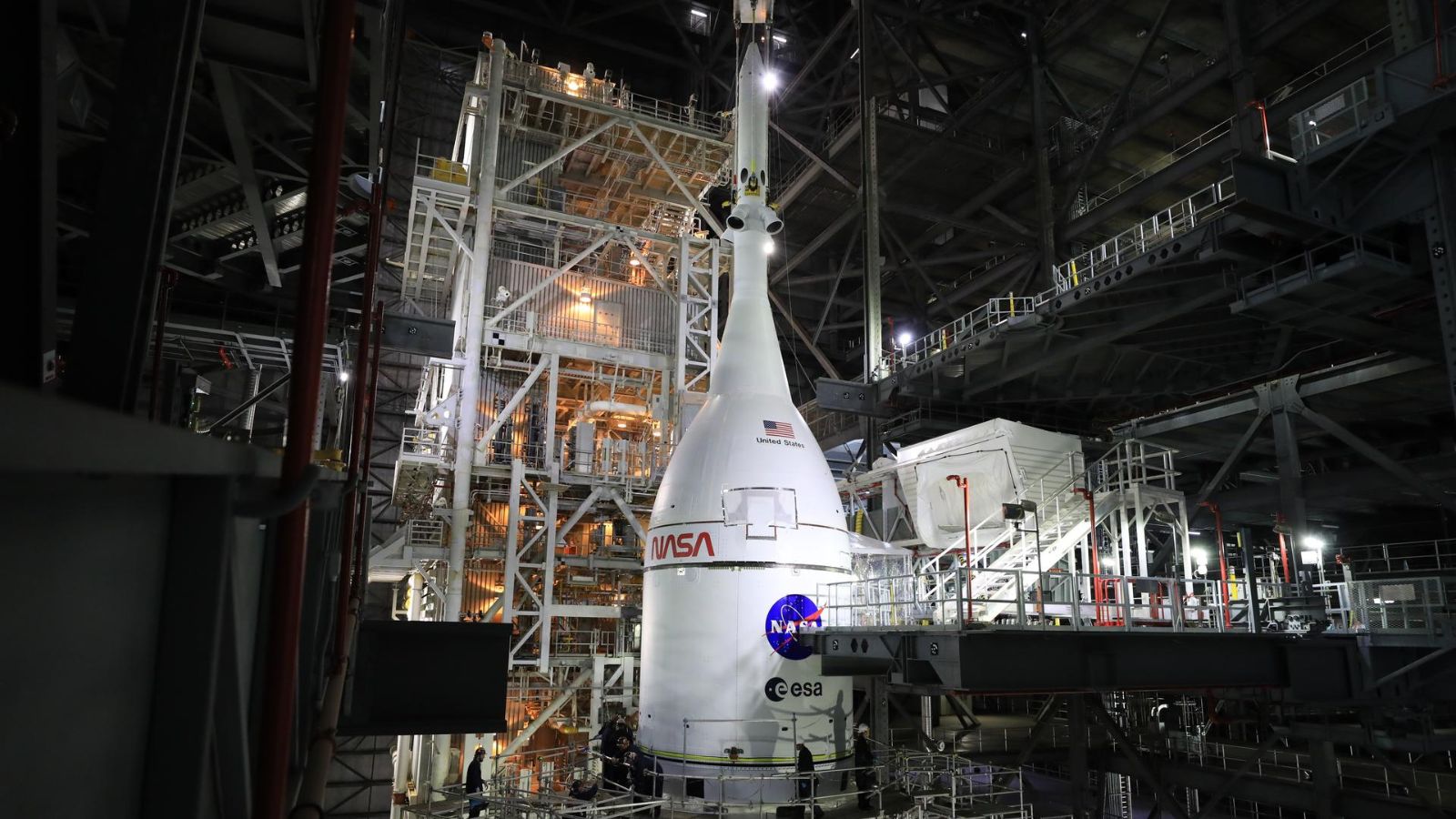
Post ContentThe rocket is carried on a large tracked vehicle called a crawler-transporter. It moves at roughly 1-2 km/h, so the full rollout typically takes between 8 and 12 hours.(Image: Nasa)
Nasa’s Artemis II rocket rollout is a scheduled ground operation where the fully assembled rocket is moved from its assembly building to the launch pad. The process is slow, takes several hours, and can be viewed online.
The rollout starts
The rocket is assembled inside the Vehicle Assembly Building at Kennedy Space Centre in Florida. From there, it is transported to Launch Complex 39B, where it will remain for final checks before launch.
The Artemis II rocket previously faced helium system issues, delaying its launch from March 6 to no earlier than April 2026.
Four astronauts who are boarding are Reid Wiseman, Victor Glover, Christina Koch, and Jeremy Hansen from the Canadian Space Agency. (Image: Nasa)
The four astronauts, who are scheduled to lift off as part of the Artemis II mission, have entered a quarantine period at Johnson Space Centre, where they will limit exposure to others before moving to Kennedy Space Centre approximately five days before launch. If everything proceeds as planned, the launch is set for April 1, commencing a 10-day mission around the moon from Pad 39B at Kennedy Space Centre.
How the rollout happens
The rocket is carried on a large tracked vehicle called a crawler-transporter. It moves at roughly 1-2 km/h. The distance between the assembly building and the launch pad is about 6-7 km, so the full rollout typically takes between 8 and 12 hours.
The rollout is scheduled to begin on the evening of March 19 in the United States. For viewers in India, this means early morning hours the next day.
How to watch it live
Nasa provides a live video feed of the rollout. The livestream is available on Nasa’s official website and YouTube channel. The stream will run continuously as the rocket moves toward the launch pad
Story continues below this ad
Context for Artemis II
Nasa is preparing for its new mission, Artemis II, which is part of its new lunar programme. The mission involves sending four astronauts into space on a journey around the Moon and back to Earth. This is set to be the first human mission of this nature since the Apollo programme.
The mission is part of the broader programme to create a human presence on the Moon. However, this mission is not intended for landing on the Moon. Instead, it is meant to pave the way for humans to return to the lunar surface.
© IE Online Media Services Pvt Ltd
