

“I was already in my seat, when I saw a man with the name of Lord Ram tattooed all over him, in the train opposite mine. I got off, hopped into his train and travelled with him to Chhattisgarh to know more about his community and their way of life,” says Asha Thadani. “It was a visceral reaction; I didn’t think twice.”
This spontaneity of spirit coupled with an insatiable curiosity about anyone different has led Asha to capture places and people through photographs. I to Eye: Shades of Humanity is a visual distillation of her experiences in the past decade.
The man on the train was from the Ramnami Samaj of Chhattisgarh. Asha recalls another time when she happened upon a monk at a roadside tea stall. “Till then, I had only seen Tibetan monks, and here was one with Indian features,” she says, adding how the encounter led her to learn about the Navayana Buddhist monks of Sarnath. I to Eye offers viewers a peek into both communities as well as 14 others in the show curated by Amrutha R, deputy curator at the National Gallery of Modern Art in Bengaluru..
Asha is candid in her admission, “All my stories happen on an impulse, not due to research or planning. I am termed an artist because my work does not qualify as traditional documentary or photo journalism. It is my way of looking at the world and I see myself as a storyteller for the most part.”
A lady from the Ramnami Samaj of Chhattisgarh
| Photo Credit:
ASHA THADANI
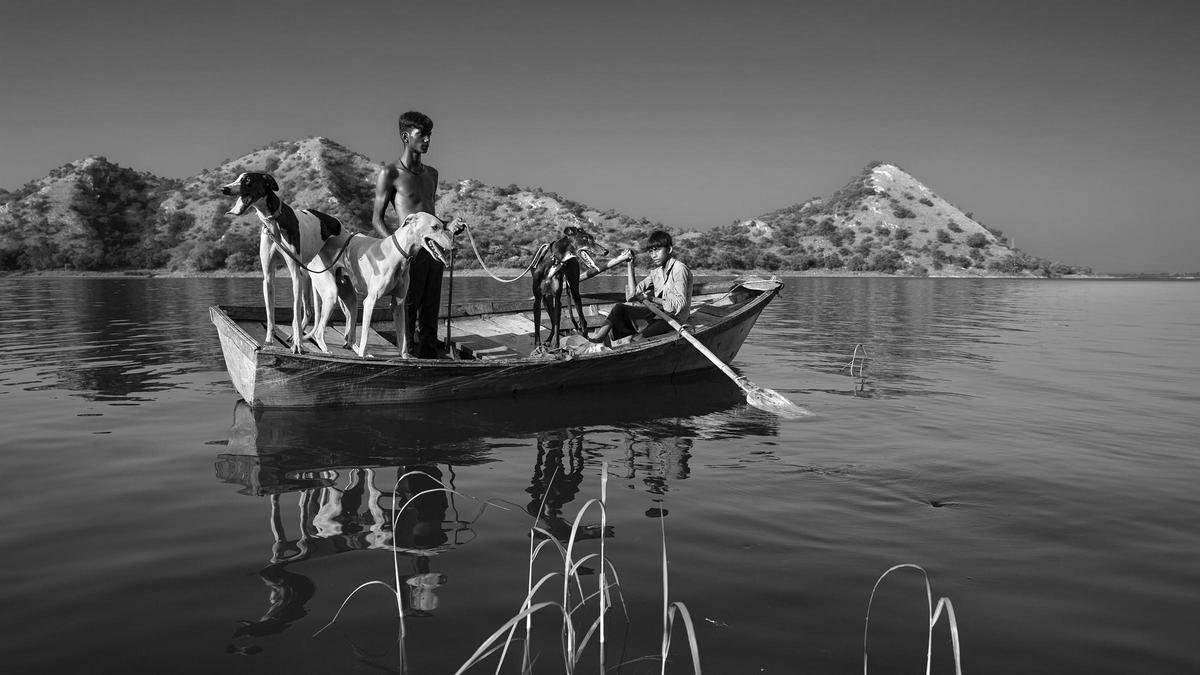
This is evident in the write-ups that accompany her black-and-white images of the communities that are on display at I to Eye. Asha’s words and visuals pique one’s curiosity about the unknown, and while one may have heard of some, such as the Theyyam artistes of Kerala or salt farmers of Kutch, the life of others such as the Joginis of Telangana and ghost mine workers of Jharia might come as a revelation.
It is obvious the body of work on display has been a work in progress for decades now.
“I started shooting in 1996; at the time, many territories in India were restricted, even to citizens. You needed a permit and had to register at a police station.”
It was also a time without Wikipedia, Google maps and digital cameras.
“I was merely covering the unseen, unwritten and unspoken. Much like any photographer, when you begin at an impressionable age, you see everything through a spirit adventure. I was shooting indigenous communities who looked exotic, whose lives were quite different from mine. I was looking at this as an outsider,” says Asha, a self-taught photographer who shoots on film.
Unseen mirror
With the passage of time, Asha says she began “understanding their stories in a more layered, complex way. I began to look at the tools they used; not just to work, but as a shield for protection. It was also how they perceived themselves.”
She continues, “I began to pull out one facet of their life that encapsulated their identity and the challenges they faced.”
No one opens the door to a stranger, let alone allow them into your home. Asha spent time with each community, gaining their trust before she began living with them. “I visited often. Then, I stayed with them anywhere from three weeks to over two months, till they felt comfortable enough to be photographed.”
An indigenous shape-shifter
| Photo Credit:
ASHA THADANI
She says the common theme in her photos is the work people engage in. “Work is the only thing that gives them dignity and a lot of these jobs are determined by caste. It is an inter-generational dichotomy — the jobs that see them shunned by society are the very same that give them dignity, an identity and money.”
“They are proud of their jobs and dress for it, no matter how labour intensive. “ A look at her work on the Gadiya Lohar (blacksmiths) of Madhya Pradesh or Banjara labourers and one sees women wearing perhaps every trinket they own, hammering away at rocks or slaving over forges.
“Their names too, in some cases, are indicative of their job description. It is their identity and not just a means of sustenance.”
Asha constantly emphasises she is not an activist, anthropologist, politician or academician. “My being irrelevant is the very qualification that enables communities to view me as a safe stranger. When one is uninformed, it encourages people to lower their guard and explain things they would normally keep hidden. Not being an “expert” makes entering private spaces easier.”
“I highly value the power of subjectivity. Human life isn’t lived in data points. It is lived in secrets, gossip, fears, and unmentionable truths. Sharing these is crucial to understanding an inner life,” she says.
A Banjara labourer
| Photo Credit:
ASHA THADANI
Personal conviction
Talking about why she shoots in black-and-white, Asha believes “it is devoid of distractions”.
“I believe a lot of the anxiety of our existence is camouflaged in colour and the carnivalesque atmosphere of our country. Visitors rave about its vibrant nature, but in reality, our situation is not colourful. Life is devoid of colour in many places here.”
Metaphorically too, Asha says a lot of her subjects seem to emerge from the shadows, her narrative bringing to light communities which are not so widely represented.
Of course, no venture is without its challenges and Asha says there have been times when she has returned without a single picture.
In 2016, when she “was just dabbling in photography”, her first job was that of a travel photographer. That enviable posting which required images of monuments, landscapes and heritage spots failed to hold her interest for long.
“My interest from the beginning has been people; it is the people who make a place,” says Asha, adding the first time she was given a choice, she visited Odisha because she was intrigued by its people, which came as surprise to most as it wasn’t a tourist hot spot.
“For me, it was the people and emotions it evoked; a few of my friends and office staff were from Odisha and what I heard from them intrigued me. I love stories and you can learn so much by talking to a person.”
“Allow life to unravel. My life story is in conjunction with the people I photograph. It is my interest and curiosity in wanting to know what goes on that drives me; one should do what sustains your soul.”
I to Eye: Shades of Humanity by Asha Thadani is on display at the National Gallery of Modern Art, Bengaluru, till April 12. Entry fee ₹20 for Indian nationals, Mondays closed
Published – March 31, 2026 08:49 pm IST
Read Comments
Copy link
Telegram
SEE ALL
Remove
Related Topics
The Hindu MetroPlus
