

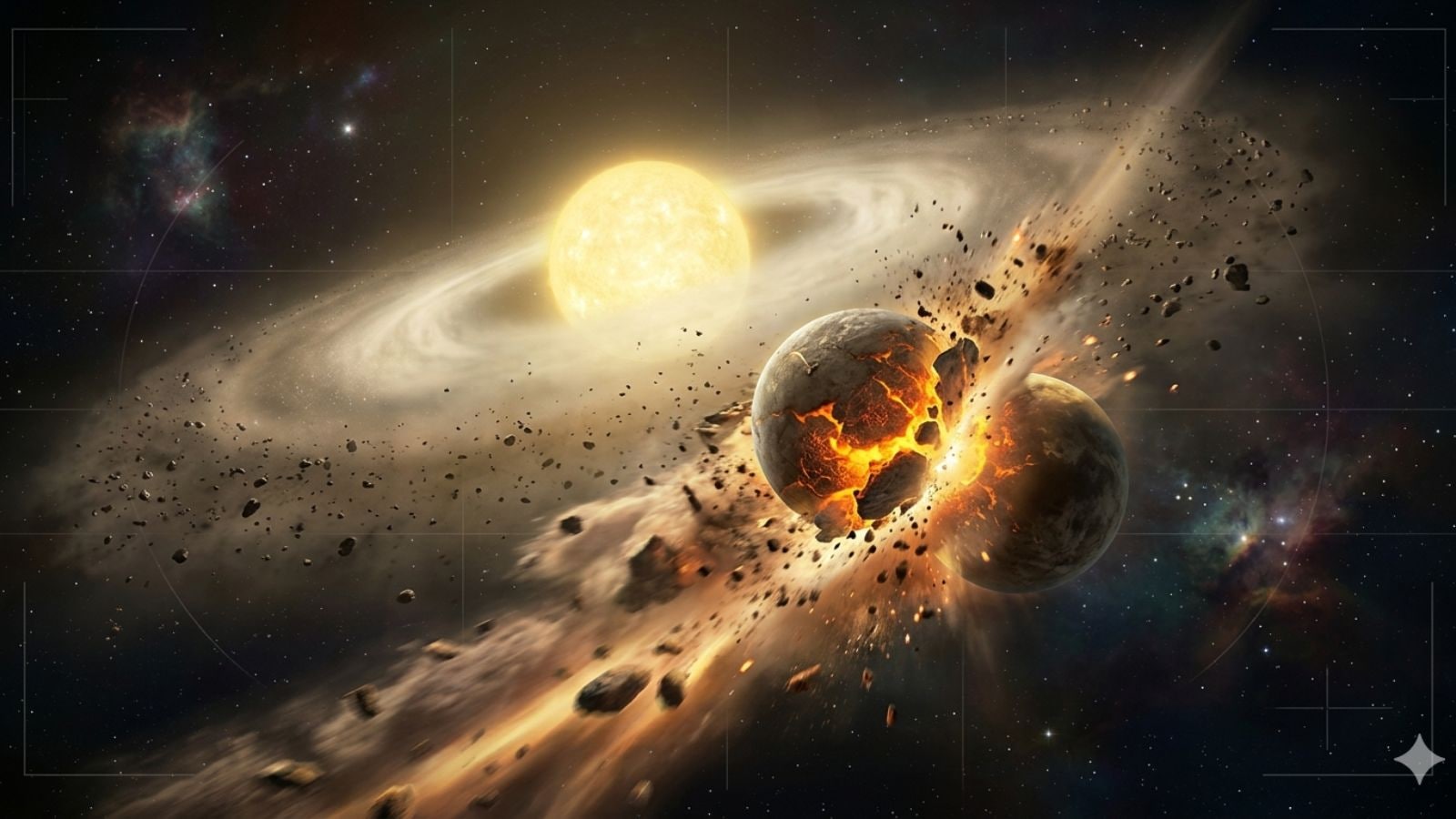
Post ContentAn AI generated image of two exoplanets colliding with one another. (Image Source: Google Gemini/AI)
In space, collisions between two celestial bodies are pretty common. However, astronomers have now collected evidence of what was a violent collision between two planets located in a pretty faraway star system.
The first clues of this celestial event came when Gaia20ekh, an ordinary star like our sun, started to behave unusually. Situated almost 11,000 light-years away from Earth, near the constellation Pupis, the star started to act up.
“The star’s light output was nice and flat, but starting in 2016 it had these three dips in brightness. And then, right around 2021, it went completely bonkers. I can’t emphasize enough that stars like our sun don’t do that. So when we saw this one, we were like ‘Hello, what’s going on here?’,” said Tzanidakis, a doctoral candidate at the University of Washington.
Investigators later found that the flickering had nothing to do with the star itself. Instead, it was caused by large amounts of rocks and dust that appeared to come from nowhere and passed in front of the star.
As this material orbited within the system, it periodically blocked some of the light from reaching Earth, causing the star to appear dimmer. Unsurprisingly, the source of this dust and rocks was the collision of the two planets that orbited the star.
“It’s incredible that various telescopes caught this impact in real time. There are only a few other planetary collisions of any kind on record, and none that bear so many similarities to the impact that created the Earth and moon. If we can observe more moments like this elsewhere in the galaxy, it will teach us lots about the formation of our world,” Tzanidakis added.
While planetary collisions are pretty common, seeing one in a distant star system is incredibly rare and hard to spot. To do so, the orbits of the planets should be directly between Earth and the star in question, so that the resulting debris limits some of the star’s light.
Story continues below this ad
The collision also shares similarities with the impact Earth experienced about 4.5 billion years ago, which ejected debris into space that later formed the Moon. The dust cloud orbiting Gaia20ehk is about 93 million miles wide, roughly the same distance between the Earth and the Sun.
© IE Online Media Services Pvt Ltd
