
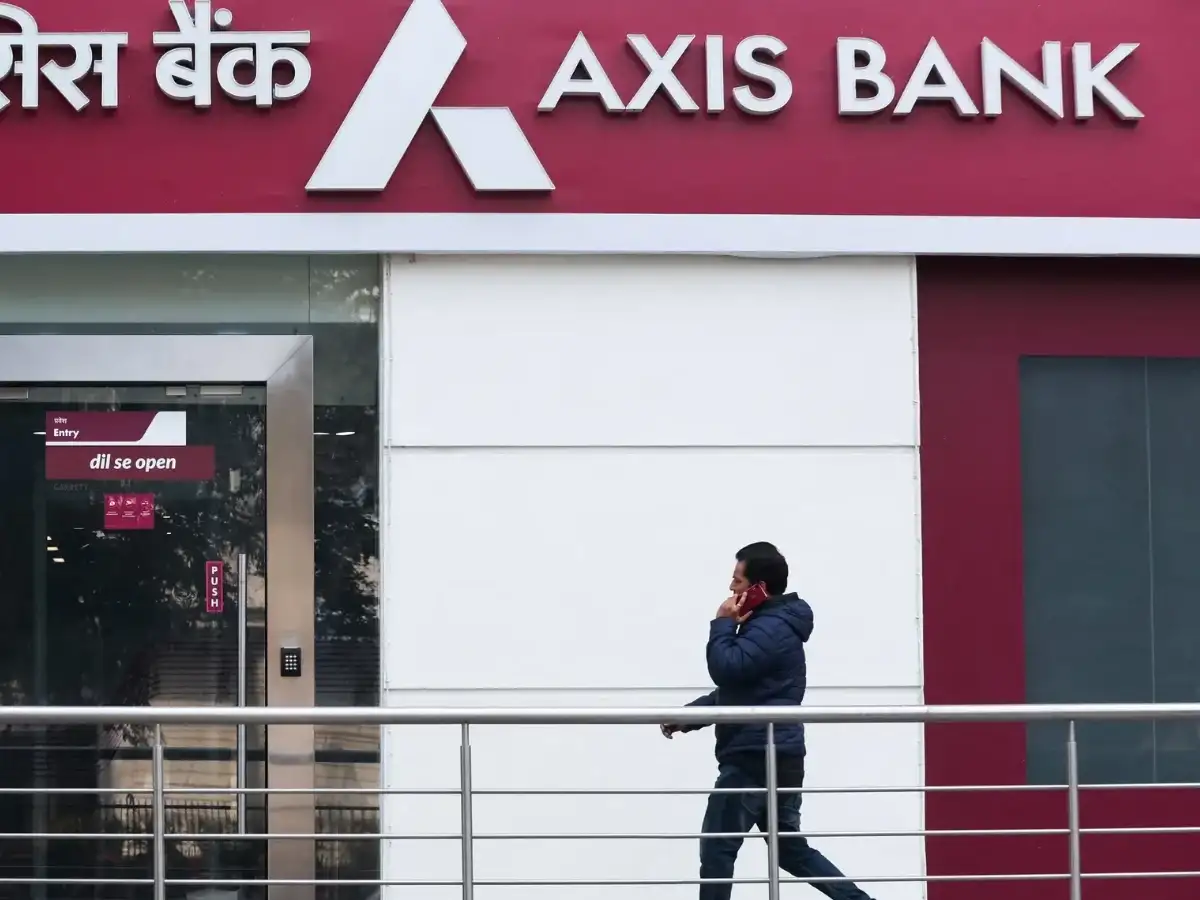
Axis Bank on Saturday reported a standalone net profit of Rs 7,114 crore for the April-June quarter of FY27, marking a 22.5% year-on-year rise from Rs 5,806 crore in the corresponding quarter of the previous financial year.
The private lender’s net interest income (NII) meanwhile rose more than 8% YoY to Rs 14,646 crore during the first quarter of the ongoing financial year 2027, from Rs 13,560 crore reported in the same period last year. Notably, this is higher than Nomura and Kotak Institutional’s estimates. Net interest margin during the quarter under review stood at 3.46%.
Axis Bank's gross non-performing assets (GNPA) declined around 4% YoY to Rs 17,124 crore, while net NPA rose around 2.5% YoY to Rs 5,193 crore. The gross NPA and net NPA ratios improved on a YoY basis to 1.28% and 0.39%, respectively. However, both increased sequentially from 1.23% and 0.37% in Q4 FY26.
The lender’s debt-to-equity ratio stood at 1.12% in Q1 FY27, as against 1.15% in Q4 FY26 and 0.98% in Q1 FY26. Axis Bank's net worth meanwhile rose around 14% YoY to Rs 2.03 lakh crore during the quarter under review, while net slippage ratio fell 121 bps YoY to 1.12%.
Return on Average Assets stood at 1.51% during the first quarter of FY27, as against 1.47% in the year-ago period. Its current account savings account (CASA) deposits rose 11% to Rs 5.22 lakh crore, as on June 30, 2026.
Provision and contingencies for Q1 FY27 stood at Rs 2,223 crore, while specific loan loss provisions stood at Rs 2,079 crore. Axis Bank said that during Q4 of FY26, it had proactively strengthened its balance sheet by voluntarily enhancing its prudent provisioning framework for standard assets, in line with conservative risk-management philosophy.
Based on an assessment of evolving and unpredictable macroeconomic and geopolitical uncertainties, Axis Bank said it had created an additional one-time provision of Rs 2,001 crore during Q4 FY26. “The Bank has not drawn down from the West Asia provision created in Q4 FY26, and the said provision continues to remain at Rs 2,001 crores at June 30, 2026. This provision continues to be prudent and precautionary in nature and does not reflect any deterioration in asset quality or adverse credit trends in the bank’s loan or investment portfolio as of the reporting date,” it added.
Axis Bank's balance sheet grew 20% YoY to Rs 19,21,966 crore as of June 30, 2026. Total deposits rose 3% QoQ and 18% YoY on a month-end basis, with current account deposits up 6% YoY, savings account deposits rising 14% YoY and term deposits increasing 23% YoY.
The share of CASA deposits in total deposits stood at 38%. On QAB basis, total deposits grew 6% QoQ and 18% YoY, within which savings account deposits grew 14% YoY, current account deposits grew 13% YoY, and term deposits grew 21% YoY.
The lender’s advances rose 19% YoY and 2% QoQ to Rs 12.62 lakh crore as on June 30, 2026. Retail loans grew 8% YoY to Rs 6,76 lakh crore and accounted for 54% of the net advances. The share of secured retail loans stood at around 73%, with home loans comprising 26% of the retail book. Small Business Banking (SBB) advances grew 2% QoQ and 18% YoY, while loans against property rose 11% YoY, personal loans increased 7% YoY, credit card advances grew 5% YoY and the rural loan portfolio expanded 16% YoY.
What Axis Bank’s management said
As customer expectations evolve and technology continues to reshape financial services, Axis Bank’s focus remains on building a franchise that combines trust, innovation and resilience at scale, said the private lender’s MD & CEO Amitabh Chaudhry.
“This quarter, we continued to invest across these priorities - strengthening digital security, deploying AI to simplify customer journeys, expanding growth platforms and supporting ecosystems that drive economic progress. With these investments, we hope to create enduring value for our customers, stakeholders and the communities we serve,” he added.
Axis Bank shares gained around 2% on Friday to close at Rs 1,328.50 apiece on NSE. While the stock has fallen around 2% in one month, it has gained over 4% in 2026 so far.
In the longer term, the shares of the company delivered around 15% returns over one year, 38% over three years and 72% in five years.