

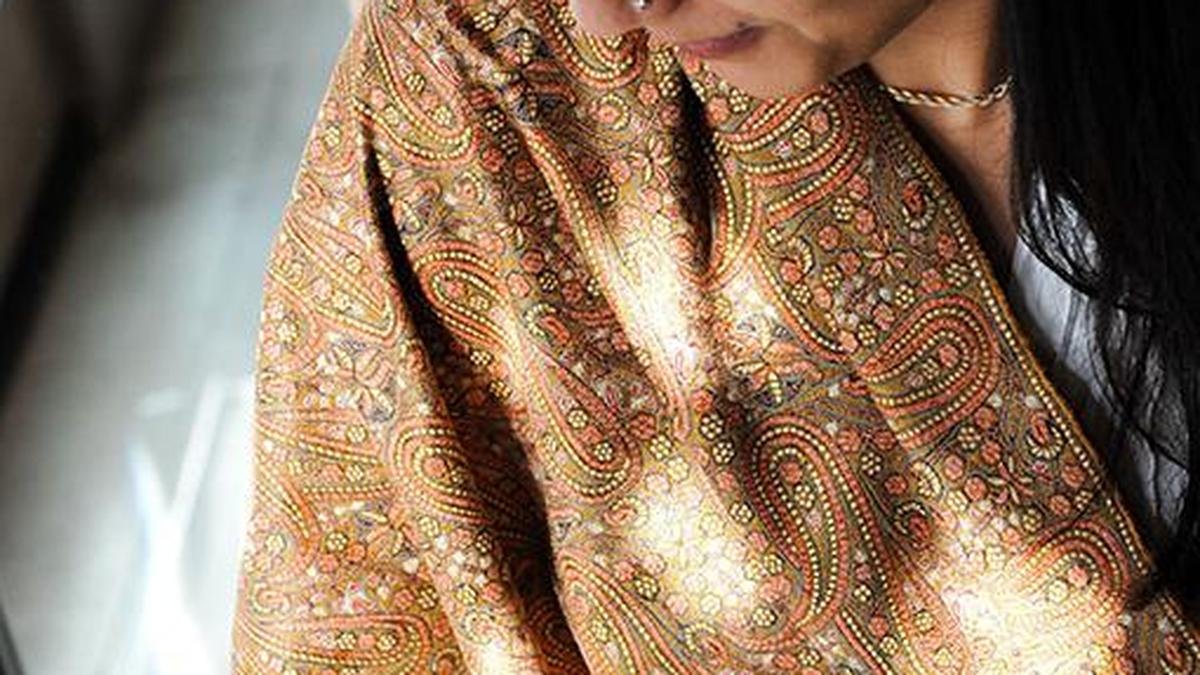
Model displaying Pashmina collections during a fashion show
| Photo Credit:
Photo: R.V.Moorthy
From Ab Rahman Lone’s painstakingly handspun Pashmina shawls of Kashmir to Doru Lakhabai Valabhai’s richly woven sarees of Gujarat, the Kamala awards honour a deep-rooted legacy of handloom excellence. Gurinder Kaur Bhullar’s revival of authentic Phulkari embroidery and Khawaja Nazir Ali’s mastery of intricate Sozni work highlight the importance of preserving endangered crafts. Representing the next generation, Suman Aspura reimagines rug weaving through bold, contemporary designs, while K. Srinivasrao carries forward the sacred tradition of temple woodcraft with a blend of heritage techniques and modern tools. The prestigious lifetime honour, Kamala Samman, was awarded to B. Krishnamoorthy, whose timeless kanjeevaram silk creations and extensive archival work stand as a testament to India’s enduring weaving heritage. Meet the award winners.
Lifetime achievement award: Kanjeevaram weaver B. Krishnamoorthy, Kanchipuram
Master weaver B. Krishnamoorthy preserves the legacy of Kanjeevaram silk through craftsmanship and a vast archive of traditional motifs. His work has been celebrated globally through patrons like Nita Ambani, who wore a sari designed by him while attending Donald Trump’s presidential inauguration in Washington, D.C. in January 2025.
Krishnamoorthy was honoured by the CCI with the Kamala Samman as a recognition of his achievements. A Kanchipuram-based master weaver who is a traditional silk saree designer, and heritage design activist, he is a third-generation practitioner of the Kanchipuram silk weaving tradition who has been acknowledged for the depth, grandeur, and artistic elegance of his work.
The kanjeevaram designed by Krishnamoorthi for Nita Ambani
| Photo Credit:
Special Arrangement
A defining moment in his journey came in 2010, when he was selected for the National Award, earning recognition for his exceptional saree design along with a cash prize of ₹1 lakh. He chose to utilise this award, to document and preserve the rich legacy of his craft. He began compiling samples of motifs and supporting designs—both his own creations and those he had collected over the years—into a comprehensive reference library for handloom enthusiasts and researchers. Today, the master weaver has built a repository of 5,015 basic designs, each meticulously woven in 25-metre silk fabric with a height of 60 inches, serving as a lasting archive of Kanchipuram’s weaving heritage.
Silk traditional saree designer and weaver B. Krishnamoorthy displaying his design repository, which he has documented.
| Photo Credit:
RAVINDRAN R
“I feel a deep responsibility to safeguard this art. So far, I have trained 20 weavers in the craft and am willing to train more. Anyone with a flair for drawing can begin by learning the graphic design of motifs, making punch cards, and understanding jala work. Gradually, they can progress to weaving,” he says.
“Currently, I am working on a publication that documents 500 supporting designs and motifs used exclusively in Kanjeevaram silk sarees,” he adds.
Award for Excellence in Craft: Master sculptor K. Srinivas Rao, Chennai
A door way designed by Srinivas Rao
| Photo Credit:
Special Arrangement
For master sculptor K. Srinivasrao who carries forward a lineage of temple craftsmanship by blending traditional woodcarving techniques with modern tools, sculpting divine forms is a meditative practice. He says he is committed to preserving this by training the next generation.
The Chennai-based 52-year-old sculptor, artist, woodcraft artisan and mythologist hails from a traditional lineage of Sthapathis—master craftsmen who have shaped temple architecture across generations. He has created puja mandapams, idols of Gods and Goddesses, intricately carved wooden doors, vahanas, and temple rathas. His work brings together ancient forms, traditional techniques, and time-honoured carving methods.
A wooden tailoring machine that Srinivas made for his wife
| Photo Credit:
Special Arrangement
“As a child, I was deeply fascinated by sculpting, watching my father and grandfather at work,” he recalls. “After completing class 10, I did not continue with formal schooling. Instead, I became an apprentice to my father in a village near Visakhapatnam. Later, in search of better opportunities and visibility, I shifted my base to Chennai nearly three decades ago,” he says.
Over the years, Srinivasrao has blended ancient woodcraft techniques with contemporary working methods, incorporating modern tools such as power saws and electric planers while retaining the essence of traditional craftsmanship.“I want youngsters to learn this handicraft and excel in it. A sculptor cannot be replaced by AI. I have been training the younger generation at my workshop, and so far, around 40 students have been trained at my centre,” he adds.
The sculptor has trained over 40 students in this art.
| Photo Credit:
Special Arrangement
Though there are nearly 300 different types of uli (chisels), a minimum of 50 are required to sculpt a single wooden figurine, he says. “For me, creating divine figurines is like tapas,a form of meditation. At the end of the process, when I look at the finished piece, I get goosebumps. It brings a sense of ecstasy;that is the true joy of this profession,” he adds.
Award for Contribution to Craft: Master artisan weaver Ab Rahman Lone, Kashmir
Ab Rahman Lone
| Photo Credit:
Special Arrangement
Ab Rahman Lone, a handloom master weaver and handicraft artisan from Anantnag, Kashmir, began his journey in Pashmina weaving in 1995, and has trained over 200 artisans to create shawls. Using techniques such as Sozni embroidery and handlooms, he stitches by hand, a traditional process that comes with its own set of challenges given the cold weather.
Each handspun shawl has a GI (geographical indication)tag code, which gives you information about the weaver, tailor, composition, design, size and technique used in the product. He aims to empower himself and the artisans of his village to become independent and create more products, while preserving age-old techniques.
Rahman and his family specialises in the Sozhi handspun shawls
| Photo Credit:
Special Arrangement
“The Sozni handspun shawls take two and half years to make. We’re currently working on the Aatmanirbhar programme started by our prime minister, Narendra Modi which is my dream to achieve. In our village, we have handlooms where we give space to our tailors to make this product, and for women to work from their homes,“ he says
Award for Excellence in Handloom Weaving: Master weaver Doru Lakhabai Valabai, Gujarat
Doru Lakhabai Valabhai
| Photo Credit:
Special Arrangement
Hailing from Jam Khambaliya, Gujarat and a recipient of the National and Khemka Awards, Doru Lakhabai Valabhai is a master weaver specilsing in handloom cotton saris, dupattas and stoles that reflect the rich weaving heritage of Gujarat. Born in a weaver family, these techniques have been taught fondly to every passing generation, he says. His design aesthetics spotlight intricately woven geometric patterns.
Doru Lakhabai’s design aesthetics are dominated by intricately woven geometric patterns
| Photo Credit:
Special Arrangement
“It is because of awards such as these that we get the opportunity to spread awareness about our craft, products and history. Hand weaving is something I’ve known to do for ages, and there is nothing else I could imagine doing”, he says. His woven shawls, stoles, saris, and dupattas bring to life designs of abstraction, intermingling the beauty of flowers and leaves with lyrical imagery of colourful birds. Traditional pit-loom weaving techniques, rich textures and artisanal finishes are the hallmark of Lakhabhai’s handloom textile creations.
Award for Revival of Languishing Crafts: Phulkhari hand embroidery, Gurinder Kaur Bhullar, Punjab
Gurinder Kaur Bhullar understands that Phulkari draws inspiration from everyday surroundings
| Photo Credit:
Special Arrangement
Specialising in Phulkari style hand embriodery from Punjab, Gurinder Kaur Bhullar creates saris, dupattas and home decor products incorporating this intricate craft. Concerned by the growing commercialisation of Phulkari in exhibitions and retail spaces, she set out to revive its original essence through research and by identifying artisans who continue to practice the authentic style.
Having learnt the craft from her grandmother and mother, she understands that Phulkari draws inspiration from everyday surroundings which includes motifs such as ear of wheat, and is then traditionally translated onto naturally dyed khadi, which is woven at home. By brining together skilled tailors and artisans, she ensures authenticity of the embroidery.
Phulkari is a unique style of embriodery originating in Punjab
| Photo Credit:
Special Arrangement
“When a girl was born, her parents would traditionally gift her khadi cloth, and she would begin working on it from a young age. By the time she was ready for marriage, she would have mastered the art of Phulkari. It is a tradition that goes back generations, and I am committed to working hard to preserve it,” says Gurinder.
Award for Excellence in Craft: Sozni embroidery on Pashmina, Khawaja Nazir Ali, Kashmir
Khawaja Nazir Ali’s family has been practising the art of Sozni embroidery on Pashmina shawls
| Photo Credit:
Special Arrangement
Hailing from Kashmir, Khawaja Nazir Ali has been practising the intricate art of Sozni embroidery on pashminas shawls and woven carpets while working from the historic lanes of Alamgari Bazaar in Srinagar. With over 45 years of experience, Khawaja has recieved the National Award in the past, and remains deeply committed to preserving the legacy of handmade Pashmina shawls, believing it to be integral to keeping the spirit of Kashmir alive.
His do-rukha shawl—a double-sided embroidered Pashmina adorned with exquisitely detailed paisley and floral motifs—epitomises the itricacies of Kashmiri embroidery.
“This is a skill I would never like to lose. If we stop practising these traditions ourselves, how will they be passed on to future generations? Being honoured at events like these makes me grateful, as it helps bridge the gap between our generation and the next.”, he said.
Award for Young Artisan: Rug weaver Suman Aspura, Rajasthan
Suman Aspura has mastered the art of hand-knotted rugs
| Photo Credit:
Special Arrangement
At 27, Suman Aspura has emerged as a promising rug weaver from Sikar, Rajasthan, having learnt the craft from her mother. Her hand-knotted rugs,marked by bold colours and abstract geometric patterns, draw inspiration from her everyday surroundings. Her rugs, woven in bold colours wih abstract and geometric designs take inspiration from the stories of her daily life, she says, bringing together storytelling and skill.
“It takes a great deal of time to create these rugs. My mother has taught me everything I know and I feel immensely proud to receive this award”, she says.
CCI presented the Kamala Award for seven master artisans on March 20, 2026, in Chennai
| Photo Credit:
Special Arrangement
Published – March 28, 2026 07:50 am IST
Read Comments
Copy link
Telegram
SEE ALL
Remove
Related Topics
The Hindu MetroPlus
