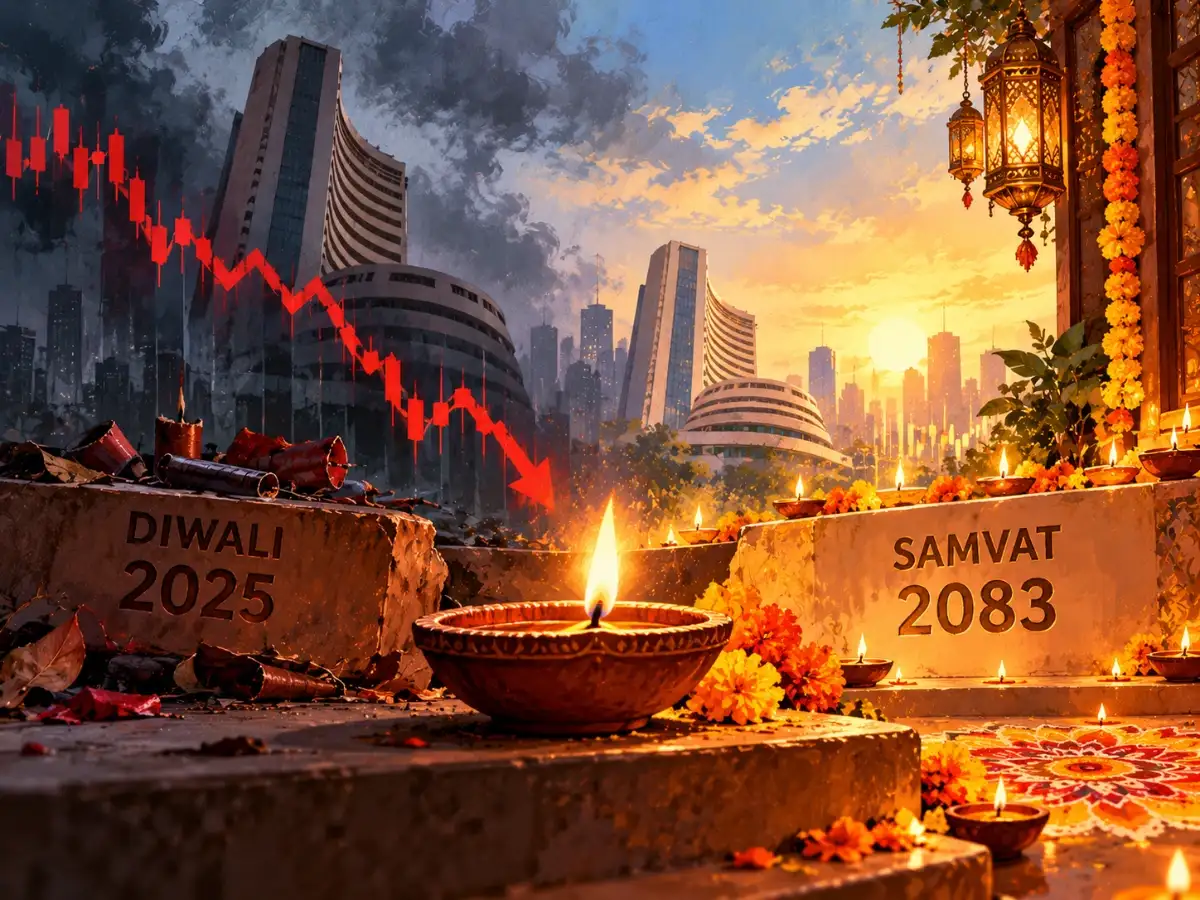
As India prepares for the festive season, Dalal Street’s bulls remain battered by the Iran-US conflict, persistent FII outflows and other headwinds that have dragged the Sensex down more than 10,000 points since last year’s Diwali.
India celebrated Diwali around October 20 in 2025, when the Sensex was trading at around 84,400. Since then, the index has shed over 10,750 points, slipping below 73,600. The Nifty has also fallen nearly 2,000 points to below 22,800 as of October 26. As Samvat 2083 begins, investors hope the new year brings much-needed relief to Dalal Street.
D-Street’s seesaw move since last Diwali
The market trajectory was not a straight line as sharp upswings and downswings kept investors on the edge. After last year’s Diwali, Sensex crossed the 86,000 mark for the first-time ever in early December. Then, the new year began with investors hoping to see the benchmark indices scaling fresh lifetime highs. However, the hopes soon began to fade as the global AI frenzy ensued with Anthropic’s launch of new plug-ins for its chatbot Claude, sparking a sharp selloff in India’s much-touted IT stocks, which weighed on the Indian market.
As hyperscalers continued to increase spending on the nascent technology, doomsday prophets began to sound the alarm for Indian IT companies, believing that the new innovations could lead to displacement in the sector. "We call it the ‘SaaSpocalypse,’ an apocalypse for software-as-a-service stocks," Bloomberg quoted Jeffrey Favuzza from the equity trading desk at Jefferies as saying.
While the market was already reeling under the impact of the global AI frenzy, a bigger and perhaps more powerful headwind was brewing a storm over the Indian stock market.
Also read | India braces for first Diwali after Gulf war with tighter budgets
The stock market was shut on the last Saturday of February when reports emerged that joint US-Israeli air strikes had killed Iran’s Supreme Leader Ayatollah Ali Khamenei. Analysts warned of a sharp selloff even before Dalal Street reopened, and their fears proved justified. The Sensex plunged over 1,000 points on Monday, fell another 1,000 points on Tuesday, recovered slightly on Wednesday, and then slumped by around 1,000 points each on Thursday and Friday.
What followed was a conflict that further escalated in the oil-rich Middle East and continues till today. The rising tensions choked off the Strait of Hormuz, a critical waterway that accounted for more than 20% of the global oil shipments back then. As a result, oil prices soared to as high as above $120 per barrel. India is the second biggest global oil importer after China and is highly dependent on imported crude oil.
Sensex plunged nearly 9,340 points in just March 2026 alone, while Nifty dropped 2,500 points. The stock market recovered slightly over the next few months as the AI frenzy fizzled out, with analysts noting India’s anti-AI advantage. Interim peace deals in the Middle East conflict further boosted the market.
However, the bulls soon failed to hold on to the momentum as more headwinds emerged. The Middle East war escalated inflationary pressures, leading to a global rate hike cycle. Bond yields soared to multi-decade highs, while FIIs massively sold Indian equities.
In this background, Sensex dropped to a 52-week low of 71,293 and Nifty fell to 22,180 earlier this month. While the indices have recovered slightly since then, they remain far away from the record high levels seen by Dalal Street right after Diwali last year.
Broader markets have also recorded a sharp plunge since Diwali last year although they have outperformed the benchmark indices that have fallen up to 13%. Nifty Midcap 10 index fell nearly 5% while the Nifty Smallcap 250 index dropped around 4% at the same time. The overall selloff has wiped off nearly Rs 14 lakh crore from the total market capitalisation of all companies listed on BSE since Diwali last year, despite several heavyweight new listings.
Also read | India Inc eyes a festive boom, but the bottom line holds a twist
Where will Sensex, Nifty be in Diwali 2027?
The sharp sell-off towards the end of Samvat 2082 underscored the importance of earnings visibility, reasonable valuations and disciplined stock selection in navigating an increasingly uncertain market environment, said Axis Securities. It noted that the market correction has improved the risk reward in stocks, particularly where share prices have adjusted more sharply than the underlying business outlook.
“We believe the appropriate response is neither indiscriminate buying after a correction nor a wholesale retreat from equities, but a measured approach that connects price paid with the quality and visibility of future earnings. Large-cap companies with established market positions and resilient balance sheets can provide portfolio stability, while selective mid-cap opportunities may offer attractive growth if valuations, liquidity and cash flows are supportive. SMID cap exposure calls for additional care, given the potential for sharper price swings and lower liquidity during periods of risk aversion. A staggered investment approach and a 12-month investment horizon can help investors manage entry risk, but stock selection and valuation discipline remain essential,” the brokerage said.
Crude oil relief due to de-escalation in West Asia, peak in interest rates, FPI flows and rupee stabilisation, earnings recovery, India-US trade deal, Budget, Resilient domestic liquidity and inflation normalisation were listed as the eight potential triggers for the market as Samvat 2083 kicks off.
“We believe returns over Diwali 2026 to Diwali 2027 will increasingly depend on buying the right businesses at sensible valuations, monitoring earnings delivery and avoiding excessive concentration in expensive or speculative ideas. Our Diwali Mahurat Picks seek to identify companies with a favourable combination of fundamentals, growth visibility and valuation support,” Axis Securities said.
Also read | Diwali stock picks! Axis picks Eternal, Hindalco, 7 other stocks with upside potential of up to 20%. See full list
Disclaimer: This article has been written by Debaroti Adhikary, who is not a SEBI-registered Research Analyst or an Investment Adviser. Debaroti Adhikary and his/her ‘relative(s)’ (as defined under Section 2(77) of the Companies Act, 2013) do not hold any financial interest in the companies mentioned in this article as of the date of publication. The views/recommendations mentioned in this article, wherever applicable, are those of the respective SEBI-registered Research Analyst/brokerage and have been reproduced/reported with due attribution. They should not be construed as the views or recommendations of The Economic Times Digital or the journalist. Readers are advised to consider the original research report and make their investment decisions based on their own assessment. Brokerage disclaimers here.