
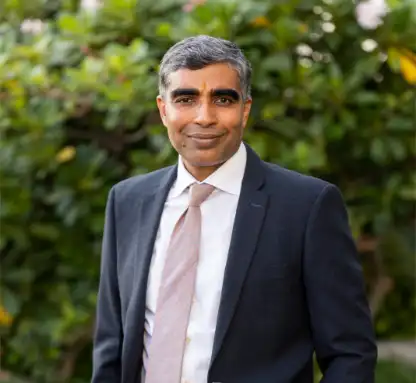
Artificial intelligence may be one of the most transformative technologies of our time, but investors should not mistake a great innovation for a great investment, cautions Manoj Bahety, Founder and Fund Manager at Carnelian Asset Management & Advisors.
In an exclusive conversation with Kshitij Anand of ETMarkets PMS Talk, Bahety argues that while AI is undeniably real, the sky-high valuations attached to many AI companies are reminiscent of past market bubbles.
He explains why he believes the market has entered the "FOMO" phase of the AI cycle, highlights the risks of chasing expensive listings such as OpenAI and SpaceX, and shares why India’s manufacturing, financials and consumption sectors could emerge as long-term beneficiaries if the global AI frenzy eventually fades. Edited Excerpts –
Q) Your latest letter says AI is real but AI valuations are not. What makes you say the enthusiasm has become a bubble?
A) Investing in long run is all about Return on Invested Capital (ROIC) which is a combination of price you pay and the business you own.
Too high price even for the most successful business will lead to mediocre outcome. Artificial Intelligence (AI) is real and one of the most significant revolution post internet. It may be the most important technology of our lifetime.
My problem isn't the AI technology. It's the price tag. Look at the math. Today, SpaceX getting 93 times sales, OpenAI 35 times, Anthropic 21 times. No investor is questioning the ROIC on their investments.
On top of that, US stocks have never been this expensive on almost any measure. The Warren Buffett Indicator is at an all-time high, and valuations are near 1999 levels. And the growth is deceptively narrow.
For the full year 2025, Magnificent 7 grew their earnings by roughly 22%. The other 493 companies in the S&P 500, the banks, retailers, manufacturers, healthcare firms, the real economy grew by about 9%, less than half the pace and it gets narrower still.
When prices are this high, growth this narrow, and capital raise this heavy, all at once, that's not optimism. That's a bubble.
Q) You call the cycle "FAD, FOMO, then FADE." Where are we today?
A) We're in the FOMO stage, the most dangerous one. FAD is when a theme becomes the hot story. FOMO is when the fear of missing out makes people stop asking what they're actually buying and valuation metrics.
FADE is when reality returns and everyone wonders how they missed the warning signs. How do I know we're in FOMO? By the questions I get.
Nobody asks "is this a good business?" They ask "how do I get into the AI trade?" or "can I buy OpenAI through GIFT City?" When the first question is about access, not the business, we've seen this movie before.
In Korea, retirees are cashing out insurance policies and borrowing money to buy chip stocks. When that's happening, you're not early. You're late.
Q) Are the OpenAI, SpaceX and Anthropic IPOs themselves the risk, or the prices?
A) All are great business. It is the prices. The IPO doesn't cause the top. It shows up because everyone's already euphoric. These three could be great companies. But together they're worth about $4 trillion and more, roughly the size of the entire Indian stock market, all hitting the market at once.
History is clear on what that means. The biggest IPOs almost always cluster right at the peak. It happened in 2000, in 2007, and in 2021, and in each case those stocks fell 70% to 95% afterward. Three giant IPOs arriving together isn't the start of the AI trade. It's the top of it being sold to you.
Q) For someone worried about missing the AI boom, how do you get exposure without overpaying?
A) First, relax. You're not missing out. With new technology, people overestimate the next two years and underestimate the next twenty.
The companies that win big from AI may not even be listed yet, and probably aren't the ones being sold to you today at 90 times sales. Remember Cisco and Wipro.
Investors were completely right that the internet and IT would be huge. They just paid too much and waited 20 years to break even. Being right about the technology and right about the price are two different things. So, the rule is simple.
Separate the story from the price, and don't buy out of fear. The question isn't "is OpenAI great?" It's "am I paying a sensible price?" Own good businesses that benefit from AI at fair valuations, and don't let one bad, oversized bet wipe out years of steady gains.
Q) Once the AI bubble unwinds, why would India do well, and which sectors benefit most?
A) Because everything that looks risky abroad looks the opposite in India. Less debt, less concentration, fairer valuations, and earnings that are rising rather than falling.
India is the only big economy that has cut its debt since 2008. When global money that rushed into AI chip stocks comes back, India is the natural place for it to go.
As for where the wealth gets made over the next decade, in my order of conviction it starts with manufacturing, which is only 14% to 15% of our economy today and heading to 20% to 25%, a genuine multi-decade opportunity.
Next come financials, because as incomes rise, savings flow into financial products, and this could be the single biggest pool of wealth ahead. Then consumption, as Indians trade up to better, premium products, a trend that is still early.
After that come services, including IT, and finally infrastructure, where returns are slower but the government tailwind is steady. India's variety across all these isn't a weakness. It's our cushion.
Q) Should investors cut exposure to US tech funds and AI-heavy global ETFs?
A) At the very least, know what you actually own. A lot of "global diversification" today is really one bet in disguise. The big US tech names are about a third of the entire S&P 500.
TSMC alone is over 40% of Taiwan's market. Spreading money across the US, Taiwan and Korea isn't diversifying. It's the same AI chip bet wearing three different jerseys. One slowdown in AI spending hits all of them together.
I won't tell you exactly what to sell, because that depends on your goals. But ask yourself one honest question. If a single thing going wrong can move most of your portfolio, you're far less diversified than you think.
Q) If you had to pick one signal that the AI bubble is starting to deflate, what would it be?
A) Hyperscale spending, the money Nvidia, Google, Microsoft and Meta pour into AI. That's what holds this whole thing up. Chip-maker profits look amazing today, but we've seen this cycle before.
Margins go from great to deeply negative and back. The moment the big spending even pauses, prices fall and profits collapse. We saw it in 2019 and again in 2023. The day that slows, everything else follows, including weak earnings and falling IPOs.
Q) Indian IT firms are spending big on AI. Is the market expecting too much from them too?
A) “The most important layer — the one that will define real economic impact — is the application layer on top of AI layers.” Indian companies will play a key in the application layer and fast adapting their business models.
Indian IT is a real, profitable, world-class business. That said, the discipline is the same everywhere. AI will reward the IT firms that adapt and challenge the ones that don't. Judge each company on its actual earnings and the price you pay, not on how often it says "AI."
In the end, stock prices follow earnings. Always have, always will. Own good businesses at fair prices, ignore the noise, and zoom out. The India story still looks very good.
(Disclaimer: Recommendations, suggestions, views, and opinions given by experts are their own. These do not represent the views of the Economic Times)