
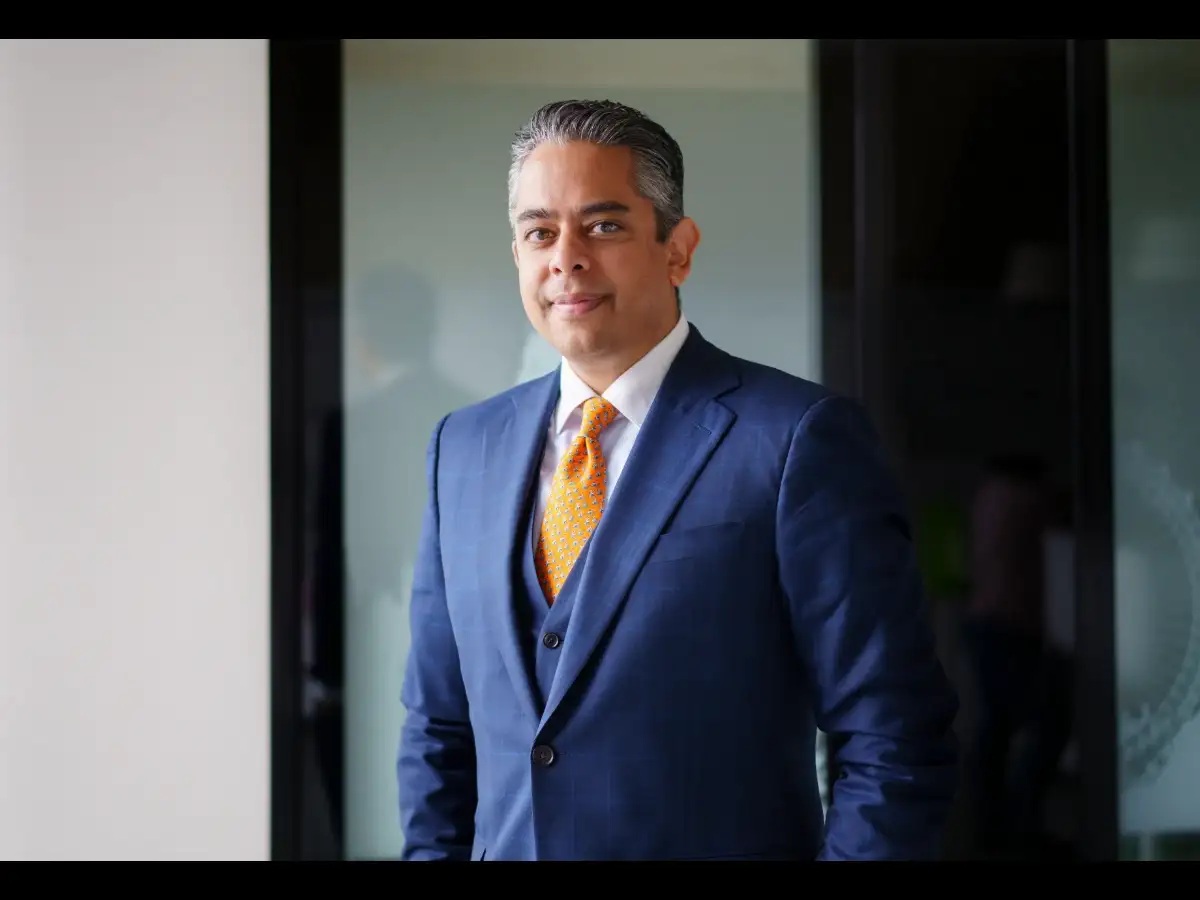
Mark Zuckerberg was one of Vikas Pershad’s classmates at Harvard, but it was the institution’s multidisciplinary approach that left a deeper imprint on the investment philosophy of the Fund Manager at M&G Investments, managing about 400 billion pounds sterling in assets.
Pershad, who has been investing in Indian equities for nearly three decades, believes investors need to look beyond short-term market noise and focus on long-term earnings growth, return on equity and structural changes in the economy.
Despite India’s relatively elevated valuations, Pershad argues that the market is “pricey, not necessarily expensive” when investors are getting strong earnings growth, high ROEs and increasing formalisation in return.
He remains constructive on India’s long-term prospects, particularly in areas such as precision manufacturing, healthcare services and defence, while emphasising that active stock selection will become increasingly important as India’s investable universe expands. Edited Excerpts –
Kshitij Anand: Well, let me start off with the education. Your education at Harvard Kennedy School exposed you to policymakers, economists, and business leaders from around the world. So, how has that shaped your investment philosophy and the way you assess global markets?
Vikas Pershad: It is a wonderful place to start, and this is at the heart of my investment process: taking a long-term view and integrating multiple disciplines into investment. This is what you need to do increasingly. That has always been the case, but increasingly now, especially if you look at the opportunity set in India and the economic arc India is on. It would be applicable to any market that we would invest in, any asset class, but in Indian equities in particular, it has been very important.
Two decades ago, if I think back to my couple of years at Harvard, it is not just the people that I met along the way. Mark Zuckerberg was a classmate of mine. I met Dalai Lama there. The current Prime Minister of Singapore, Lawrence Wong, was my classmate. So, it is that, but it is also the skills that you learn and the frameworks that we have.
And when I look at India in particular, having an understanding of public policy in defence, healthcare, infrastructure investment, and education is clearly reflected in the portfolio holdings that we have. It has also kept us out of the wrong sectors. It has kept us in the right sectors. It has given us the right timeframe to understand that this India story gets a lot of attention.
The markets are open five days out of seven. We all look at the markets going up and down day to day, but really, this will continue to play out over the rest of our lifetimes, just as it has over the past two to three decades. And you bring those things together, and you get different perspectives and a different portfolio outcome as well.
So, I would say that experience was at the heart of my investment process. And I leverage everything I learned there every day when I show up to work.
Kshitij Anand: Let me also start off with the India story. FIIs have been selling India in the past 12 to 18 months, but recently the flows have sort of been coming back. How are you viewing India, and what is the percentage of AUM you have invested in India within the Asia or the EM region?
Vikas Pershad: Well, many FIIs might have left and are striving to come back. We never left. India has been an important part of our portfolio since we started allocating more capital to that market as part of our active strategies.
As you shared earlier, we are a global investment firm. We invest across asset classes. It is about 400 billion pounds sterling that we have invested around the world. About 20% of that is in equities, and nearly half of the equities exposure is now in Asia.
In Asia, it is tough to put aside one figure for the India allocation because other markets in the last couple of years have gone up so much and the rupee has weakened.
So, optically, it looks like India is only about 10% or so, plus or minus, as a percentage of the equities. It had been more, and as the rupee is stabilising, the markets are coming back, and other markets are falling, that allocation will necessarily rise.
But our commitment to India is long-standing. We never left in the past couple of years. We do have multiple strategies, I should highlight, and in our India-dedicated strategies, we have been fully deployed throughout this period.
In our Asia ex-Japan strategies and our pan-Asia strategies, India had been a larger underweight a couple of years ago, in 2024 and early 2025. We have actively reduced that in the past few months.
What is interesting, and what I would highlight, is that our team has been investing in India for close to three decades. The portfolio today looks very different from how it did three decades ago, two decades ago, or even just before COVID, and that is mirrored in the performance as well of the broader markets.
If you look at where the underperformance has been concentrated, it is in the winners of yesteryear—staples, IT services, private banks, and oil and gas names. Ten years ago, these would all have been overweights and large portfolio allocations for us.
For us today, in the top 10 holdings, there is not a private bank. A few years back, I would not have thought that that would be the case, but it is. Healthcare services are well-represented, advanced manufacturing is represented, and defence is represented. But the financial sector, in the form of NBFCs, is well-represented, not so much in banks.
And so, when I think about India over the next 10, 15, or 20 years, the nature of the benchmark is changing, the drivers of the economy are changing, and so the drivers of portfolio returns necessarily will change, and our portfolio necessarily has changed.
Kshitij Anand: And one interesting fact that you did mention is that you never left India, but many global investors sort of remain underweight India despite its strong fundamentals. What could change, let us say, over the next 12 to 24 months that could change that perspective?
Vikas Pershad: Some of it will change internally, and other factors, other variables, might change externally. Let us start with the external factors for a moment. The capital that has followed the AI trade, hardware and software, but largely hardware when it comes to Asia, if that starts finding another home, then I presume some, if not a lot, of it will find its way to India. That is number one.
Second, just internally, if the rupee starts to strengthen and the oil price stays calm. It is not so much a high oil price; it is a volatile oil price that causes issues. It is the same thing with any commodity. It is not so much a gradual rise in a commodity price or gradual weakening of a currency; it is rapid fluctuations that can cause problems for companies, for earnings growth, and then, of course, for investors as well. So, stability is key.
And I think the most important thing is that, for a quarter century, India was the best-performing market in the world, from around 2000 to late 2024, in dollar terms or in local currency terms. And why was that? It is because it had the highest earnings growth in the world, the highest ROEs in the world, sector after sector after sector.
Now what we have seen over the last 21 months or so is the largest-ever repricing of Indian equities relative to other emerging markets, relative to other developed markets, even in 40 years. Meanwhile, our view is that the long-term drivers of that growth remain intact.
Given that you see the highest economic growth rate in the world of any major economy and still a very high rate of formalisation, not only will you have a rapidly growing economy, but within that, you will have earnings shifting from the informal sector to the formal sector, which is why then corporate earnings can grow faster than the overall growth rate of the economy.
And within that, you now have a market that has 7,000 listed companies, nearly 2,000 with a market cap of over $100 million. So, if you are genuinely a long-term active manager, when you have high earnings growth rates, high ROEs, a stable currency, and a stable government, the foreigners will come back.
Meanwhile, the domestic..., we presume as a base case, should remain intact—the domestic flows that we see every month, because the growth rate is high, but also because it is not very easy for domestic investors to invest elsewhere.
So, when you put all these things together, the setup for Indian equity returns from here is constructive. What I would say also is that it does not pay to be blindly optimistic. There are many reasons to be constructive on Indian equities. There are some reasons to be cautious, but this is why, then, in a market like this, active management plays a key role. Having a long-term time horizon plays a key role.