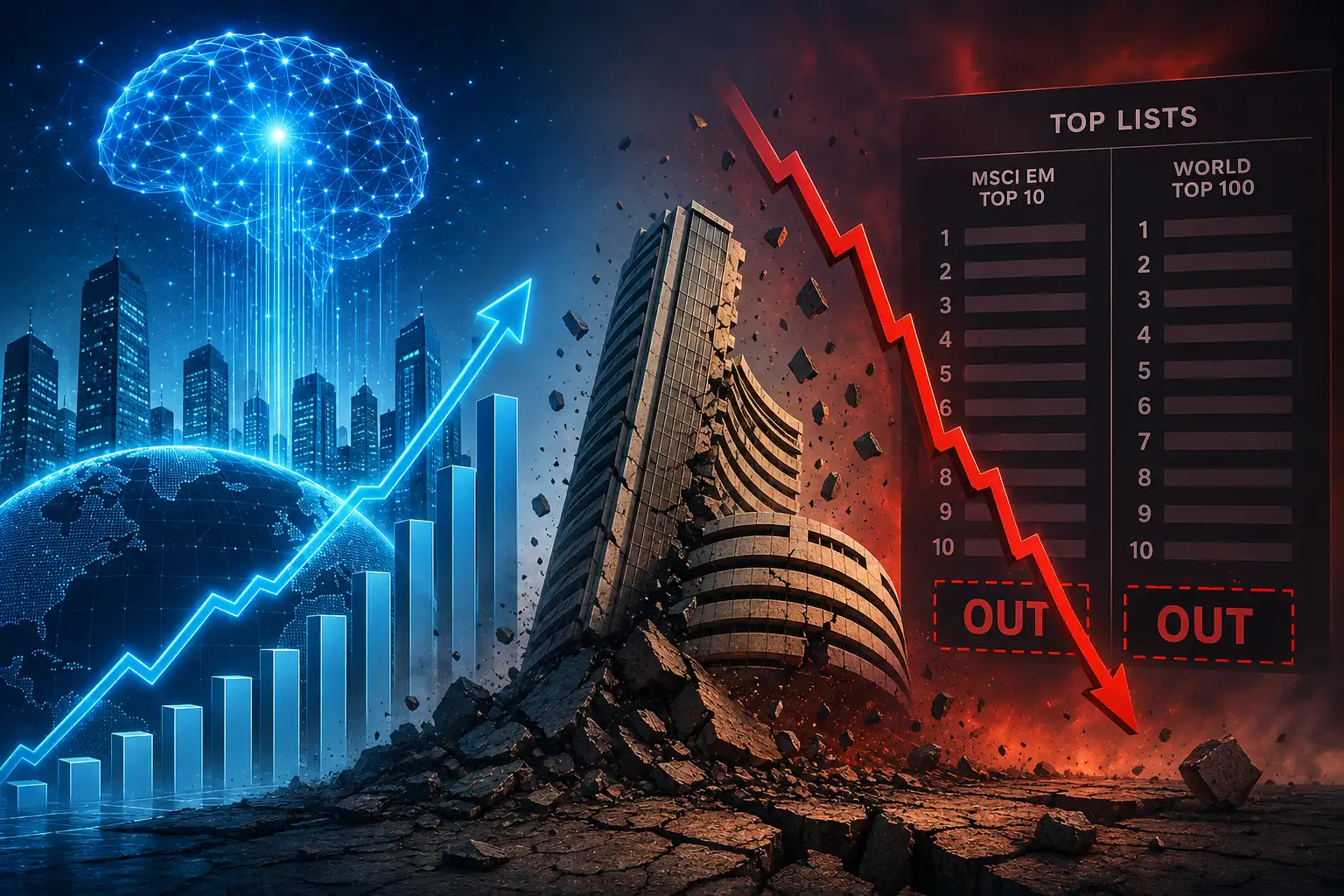
For the first time in years, not a single Indian company features among the top 10 constituents of the MSCI Emerging Markets Index, nor among the world's 100 largest companies ranked by market capitalisation, as a thundering rally in AI-linked stocks has concentrated global capital into a sliver of the investable universe with a speed and ferocity few anticipated.
The MSCI EM Index's top 10 is now dominated almost entirely by Taiwan and South Korean chipmakers and Chinese tech giants. Taiwan Semiconductor Manufacturing Co (TSMC) sits at the apex with a float-adjusted market cap of $1.85 trillion and an index weight of 14.46%, more than the entire contribution of several mid-sized emerging markets, including India. Behind it, Samsung Electronics commands 7.78% and SK Hynix 6.60%, making Korean memory chipmakers alone responsible for over 14% of the benchmark.
Six of the top 10 slots are occupied by information technology companies. The full top 10 — TSMC, Samsung, SK Hynix, Tencent, Alibaba, MediaTek, Delta Electronics, Hon Hai Precision, Samsung Electronics (preferred shares), and China Construction Bank — together account for 39% of the entire index, with a combined market cap of nearly $5 trillion.
India is nowhere in this list.
Also Read | Ghayal hoon isiliye ghatak hoon! Why a global tech crash could be the right medicine for wounded Nifty bulls
HDFC Bank and Reliance Slip to 11th and 12th Spot
HDFC Bank and Reliance Industries Ltd, India's two largest constituents in the MSCI EM Index, have fallen to 11th and 12th positions respectively, from seventh and eighth as recently as March. Their individual weightings have dropped below 0.8% each, reflecting weakness in their share prices this year.
India's overall weight in the index has slid to a fresh six-year low of 10.87%, nearly half the record level reached in 2024. By contrast, Taiwan commands the largest country weight at 26.41%, followed by South Korea at 23.06% and China at 20.36%.
Reliance Now 109th in the World
The picture is equally sobering in the global market cap rankings. Data from market capitalisation trackers shows Reliance Industries, India's largest company, now sits at 109th place globally with a market cap of $178.59 billion. HDFC Bank follows at 181st, and Bharti Airtel at 192nd.
At the top of the global table, Nvidia has cemented its position as the world's most valuable company with a market cap exceeding $5 trillion, followed by Apple, Alphabet, Microsoft, Amazon, and TSMC. India has also slipped behind Taiwan and South Korea in global market cap country rankings, now sitting at 7th place.
According to Yes Securities, which studied the top 10,000 listed companies globally, representing roughly 95% of world equity market capitalisation, global markets have added approximately $12 trillion in market cap so far in calendar year 2026. Yet nearly 95% of that wealth creation has come from just 100 stocks, equivalent to a mere 1% of the investable universe.
"This is a striking indication that headline market strength materially overstates underlying breadth," Yes Securities noted. "While global indices continue to post gains, participation beneath the surface remains limited, suggesting leadership concentration rather than synchronised equity expansion."
Critically, the brokerage argues this narrowness isn't necessarily a bubble. "The market is rewarding companies with demonstrably superior growth visibility, rather than indiscriminately allocating capital into thematic momentum trades," it said, pointing to earnings upgrades — not just liquidity — as the engine behind the rally.
Not everyone reads the rankings shift as cause for alarm. Bajaj Finserv AMC argues that India's slide behind Taiwan and South Korea "reflects the current AI-fuelled concentration of global capital rather than any weakening in the country's economic fundamentals," adding that India's structural growth story remains "largely unchanged."
The fund house draws a sharp distinction between the three markets. India is a diversified, domestic-economy-led market, it contends — supported by financials, consumption, and IT — while Taiwan is heavily tied to the global semiconductor supply chain and South Korea is anchored in export-oriented manufacturing.
Financials, India's largest sector, account for roughly 29% of market weightage, compared with around 61% for South Korea's IT sector and a staggering 88% for Taiwan's. At the stock level, India's largest constituent represents only about 6.6% of its index, versus nearly 57% for Taiwan's largest stock, TSMC.
"India offers a significantly more diversified market structure than its regional peers," Bajaj Finserv AMC said, arguing this translates into lower concentration risk and a broader earnings base.
Taiwan may continue to benefit from tactical AI and semiconductor opportunities, South Korea offers exposure to global trade cycles, but India remains a structural investment story, underpinned by domestic growth, diversified earnings drivers and lower dependence on global technology cycles,” the AMC said.