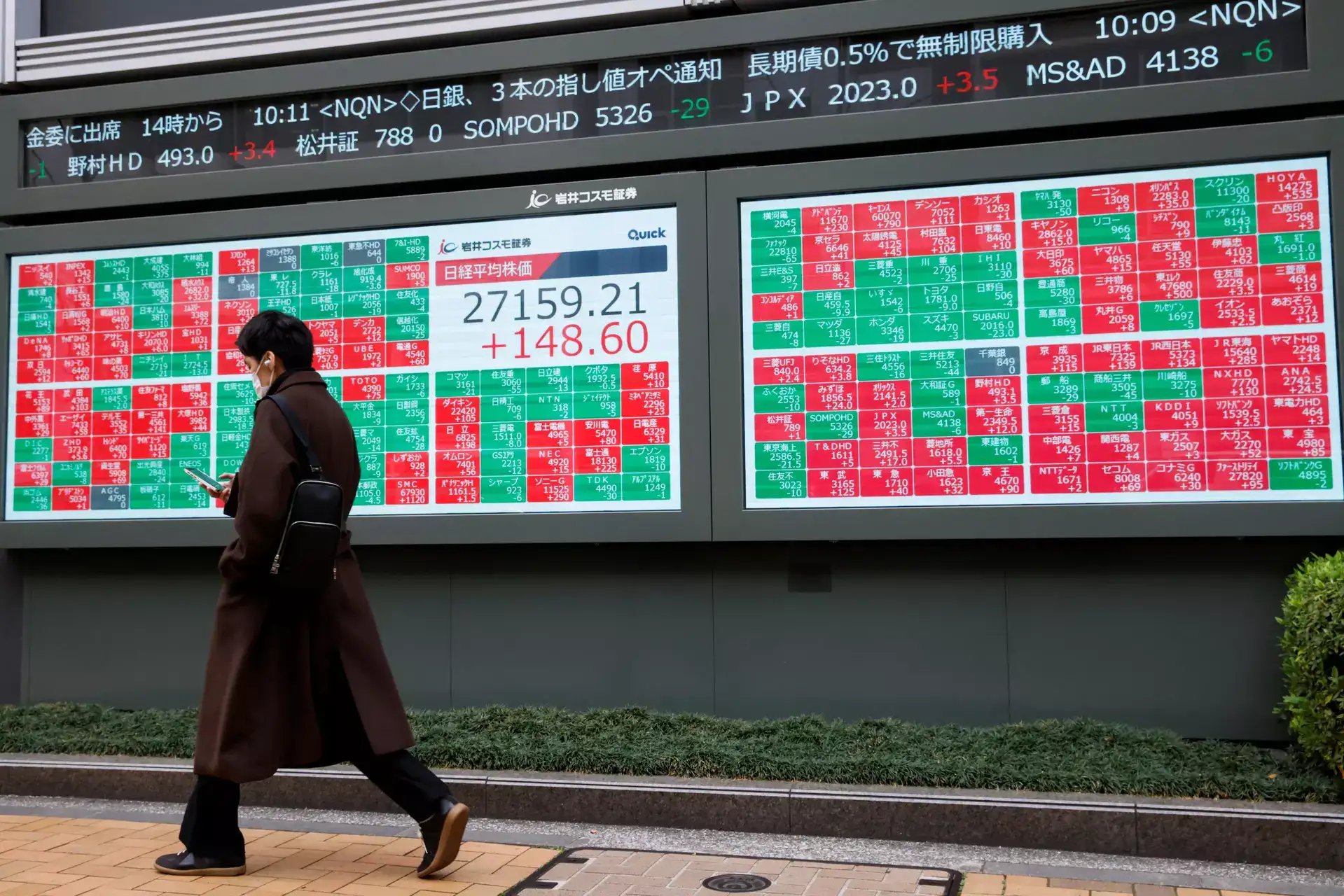
Japanese equities fell sharply on Monday, retreating from the previous session's one-week high as a rapid appreciation in the yen weighed on export-oriented stocks. The stronger Japanese currency came after Tokyo and Washington confirmed they had carried out a rare joint currency intervention to support the yen, according to Reuters.
The benchmark Nikkei 225 dropped 2.2% to 62,956.48 in early trading, while the broader Topix index declined 2.8% to 3,893.17. Market weakness was widespread, with 212 of the Nikkei's 225 constituent stocks trading lower and only 13 posting gains.
Yen Rally Pressures Export-Focused Shares
The yen strengthened as much as 1.4% to 155.20 against the U.S. dollar, its strongest level in nearly three months. The currency has now gained around 3.8% over the past two trading sessions.
According to Reuters, the sharp appreciation in the yen followed confirmation from Japan's finance ministry that Japan and the United States had jointly intervened in currency markets to support the Japanese currency. Officials also indicated they remain prepared to take additional action if necessary after the yen had hovered near a 40-year low against the dollar late last month.
A stronger yen typically hurts Japanese exporters by reducing the value of overseas earnings when converted back into the domestic currency, putting pressure on shares of globally exposed companies.
Tech Stocks Give Back Some Recent Gains
The latest decline came after the Nikkei had surged more than 4% on Friday, reaching its highest level since July 24. The rally had been driven by optimism surrounding artificial intelligence after Microsoft's upbeat outlook eased investor concerns over heavy AI-related spending, Reuters reported.
However, semiconductor-related stocks came under pressure on Monday as investors booked profits.
Tokyo Electron fell 2.3%, while Advantest declined 1.3%, reflecting broader weakness across Japan's chip sector.
SoftBank, Lasertec and Kioxia Defy Market Trend
Despite the broader market sell-off, a few technology-related stocks outperformed.
SoftBank Group erased early losses to trade 1.2% higher, while semiconductor equipment maker Lasertec gained more than 5%.
Memory chip manufacturer Kioxia emerged as one of the session's biggest gainers, jumping around 10% after announcing a share buyback programme, according to Reuters.
Auto Stocks Lead Sectoral Declines
Selling pressure was evident across all 33 industry groups on the Tokyo Stock Exchange.
Transport equipment stocks suffered the steepest losses, falling 5% as the stronger yen raised concerns about exporters' profitability. Toyota Motor dropped 5.3%, while Suzuki slumped around 8%.
Precision instrument manufacturers were the most resilient sector, though they still recorded a decline of 1.2%.
Investors will continue to monitor the impact of the stronger yen on Japan's export-driven economy and corporate earnings. Market participants are also expected to closely watch whether authorities undertake further currency intervention if volatility in the foreign exchange market persists.
While optimism around artificial intelligence remains supportive for technology shares globally, Monday's session highlighted that currency movements can quickly overshadow sector-specific positives in Japan's equity market. According to Reuters, the coordinated intervention has become the dominant factor driving investor sentiment at the start of the week.