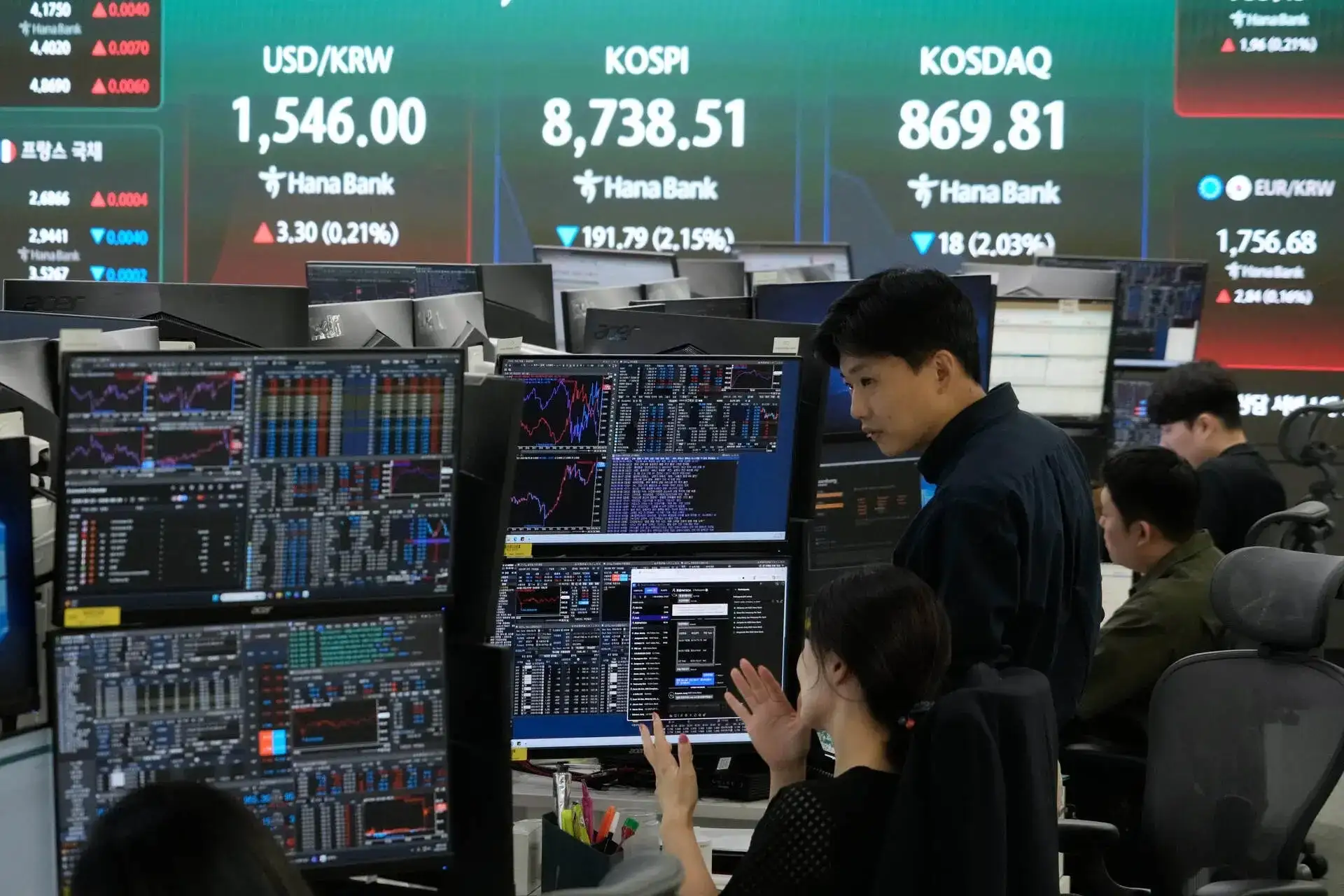
Asian stocks rose after US technology shares advanced on Friday. Oil climbed after the US and Iran traded tanker attacks in the Strait of Hormuz.
Benchmark indexes in Japan and South Korea both gained, while those for Australia were little changed. Contracts for US stocks were steady after the tech-heavy Nasdaq 100 Index advanced 0.2% on Friday and the Philadelphia Semiconductor Index jumped 3.4%. There’s no cash trading of Treasuries Monday due to a US public holiday.
Brent crude climbed 0.4% after Iran said it targeted three oil tankers using an unauthorized route through the Strait of Hormuz, as well as several US-linked vessels, in retaliation for American attacks on Iranian tankers.
The latest attacks suggest little immediate prospect of an end to the war the US and Israel launched against Iran more than six months ago, adding to inflation concerns. That puts added focus on US inflation data due this Friday after stronger-than-expected US payroll numbers last week nudged up bets on a Federal Reserve interest-rate hike this month.
“A September 16 Fed funds rate hike hinges on Friday’s US August CPI print,” Elias Haddad, global head of markets strategy at Brown Brothers Harriman, wrote in a note to clients. “A hot CPI print would all but seal a September hike and underpin a firmer US dollar. A cooler reading would strengthen the case for a hold and leave USD vulnerable to a dovish Fed repricing.”
The Islamic Revolutionary Guard Corps Navy gave no further details on the strikes, and its Telegram post late Saturday did not specify whether the vessels were hit. The IRGC later said it also attacked a US naval drone and an American unmanned surface vessel attempting to enter the strait.
Iran’s top security official Mohsen Rezaee said a new restricted zone would be declared outside the strait in the coming days, Press TV reported.
In Asia, the yen remained in focus and fluctuated around 156 per dollar after last week’s more than 2% gain, spurred by an unwind in carry trades amid growing expectations for successive Bank of Japan rate hikes. Speculation has also grown that Japan’s Government Pension Investment Fund may raise its target allocation to domestic bonds.
“The market has come to anticipate a combination of GPIF reallocation and aggressive BOJ tightening as catalysts for a potential convincing break of dollar-yen towards 150 and, potentially, beyond,” strategists at Barclays Securities, including Shinichiro Kadota, wrote in a note. “From here, however, the bar to a much stronger yen is getting higher, as follow-through hinges largely on BOJ delivery on the perceived hawkish signals.”
Elsewhere, China’s Ministry of Finance will inject 300 billion yuan ($44.7 billion) in special bonds into its largest banks and insurers, aimed at easing margin pressure, expanding lending capacity and bolstering provisions against potential bad loans.
European bonds, including German bunds, will also be closely watched Monday after the far-right Alternative for Germany scored its best-ever result in a state election on Sunday. The euro was little changed in early Asian trading.
The AfD secured 44% of the vote in the eastern state of Saxony-Anhalt, more than doubling its support and putting it ahead of the long-governing Christian Democratic Union, whose backing collapsed to 17.5%, according to a projection broadcast by ARD.
In corporate news, Hon Hai Precision Industry Co., Nvidia Corp.’s server assembly partner, reported a 52% rise in monthly sales, driven by demand for servers as companies race to build data centers and AI capacity. The Taiwanese company’s sales are closely watched as a gauge of AI spending amid growing concerns over overcapacity, rising debt and intensifying competition.