
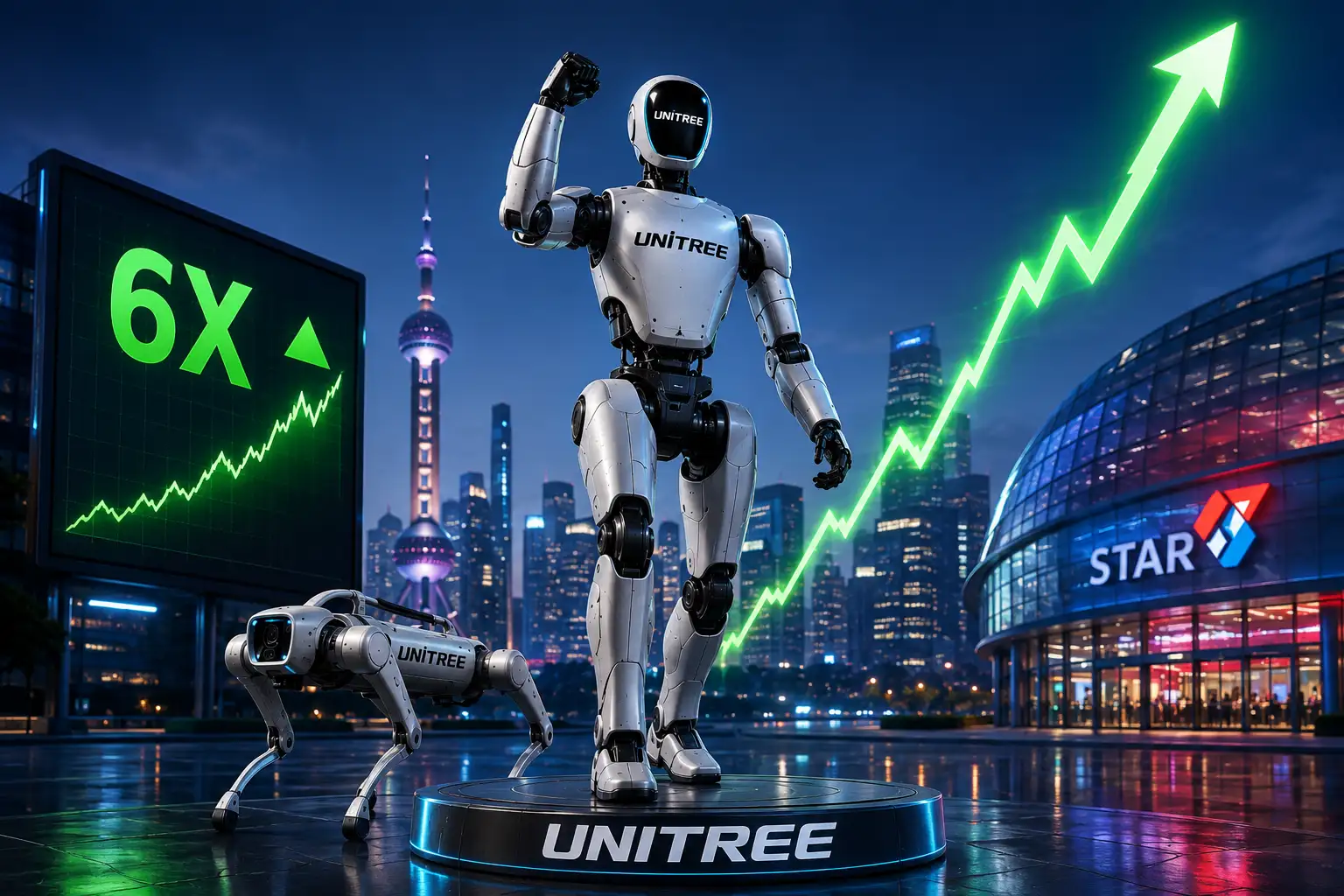
Shares of Unitree, one of China's best-known humanoid and quadruped robot makers, surged nearly six-fold in its Shanghai debut on Wednesday, marking a landmark listing for China's rapidly expanding robotics industry, Reuters reported.
The company, which competes with Hyundai Motor Group-owned Boston Dynamics and Tesla, has gained global attention for robots capable of running, dancing and performing martial arts. Its blockbuster stock-market debut also highlights the growing importance of robotics as China seeks to build strategic technology industries amid intensifying competition with the United States.
Unitree's shares finished the morning session at 883.87 yuan on the technology-focused STAR Market, compared with an initial public offering price of 150.8 yuan. The stock had opened as high as 1,100 yuan before paring gains, giving the company a market value of roughly $50 billion.
The jump far exceeded the average first-day gain of 279% for Chinese stock listings so far this year. It also came as China's broader equity market weakened, with benchmark indexes falling sharply amid heavy selling in technology shares.
Robotics sector gets a major boost
Unitree's debut coincided with the opening of the World Robot Conference in Beijing, where hundreds of companies, predominantly from China, are showcasing new robotic products and technologies.
Beijing has identified robotics as a strategic industry that could help address labour shortages arising from the country's demographic challenges. Unitree's listing is therefore being closely watched as a potential benchmark for other Chinese robotics companies preparing to tap public markets.
Reuters reported that investors and industry participants see Unitree's public listing as giving it greater visibility and access to capital at a time when many robotics companies are still operating at a loss.
The company is unusual among its peers because it has managed to remain profitable despite the relatively limited commercial deployment of its robots. Many of its products have instead been sold to research institutions and universities.
Investors bet on first-mover advantage
The strong market debut reflects investor enthusiasm for Unitree's position as an early leader in China's robotics industry.
The company has attracted backing from some of China's most influential technology businesses, including Tencent, Alibaba and DeepSeek. Founder Wang Xingxing also received prominent exposure after attending a technology leaders' summit hosted by Chinese President Xi Jinping last year.
Around 10% of Unitree's shares were offered in the IPO, raising approximately $900 million. Wang continues to own roughly one-fifth of the company, and the surge in its stock price has pushed his paper wealth above $12 billion.
The listing could give Unitree additional resources to expand production, develop new technologies and strengthen its position as competition in China's robotics market intensifies.
US restrictions create a major challenge
Despite the enthusiasm surrounding the listing, Unitree faces significant challenges in overseas markets, particularly in the United States.
In July, the US Federal Communications Commission moved to block imports of future models of foreign-made humanoid and quadruped robots, including products from Unitree, citing national security concerns. The move effectively limits Unitree's access to a potentially important market.
Unitree's most successful robot-dog designs were based in part on innovations supported by US military research. The research was publicly available and intended to encourage technological development, with Unitree using the information without evidence of wrongdoing.
The US Pentagon also added Unitree to a list of Chinese military companies in June, identifying it as a contributor to China's defence industrial base. The designation is not a direct sanction, but it restricts the US military's ability to use Unitree's technology in the future.
Commercial adoption remains a key test
Unitree's rapid rise in the stock market comes despite questions over how quickly humanoid and quadruped robots can move from demonstrations and research environments into widespread commercial use.
Reuters reported that many of Unitree's sales so far have been one-off transactions, while only a limited number of its robots are being deployed in commercial settings. The company's ability to convert technological visibility into recurring commercial demand will therefore be an important factor in determining whether its lofty valuation can be sustained.
The challenge is shared across China's robotics sector, where companies are racing to develop machines capable of performing increasingly complex tasks while bringing down manufacturing costs.
More Chinese robotics firms prepare for IPOs
Unitree's debut could pave the way for a new wave of listings among Chinese robotics companies.
At least six other humanoid robotics companies are preparing to go public. Deep Robotics and Leju Robotics have applied for listings on mainland Chinese exchanges, while Mech-Mind Robotics, X Square Robot and AgiBot are pursuing listings in Hong Kong.
The strong investor response to Unitree could encourage these companies to accelerate their fundraising plans and give the sector greater access to capital.
For Unitree, however, the challenge now shifts from winning investor attention to proving that its technology can generate sustainable commercial demand. Its ability to expand beyond research and one-off sales, while navigating growing US restrictions, will be central to whether its spectacular market debut marks the beginning of a durable robotics success story.
(Disclaimer: Recommendations, suggestions, views, and opinions given by experts are their own. These do not represent the views of The Economic Times.)