

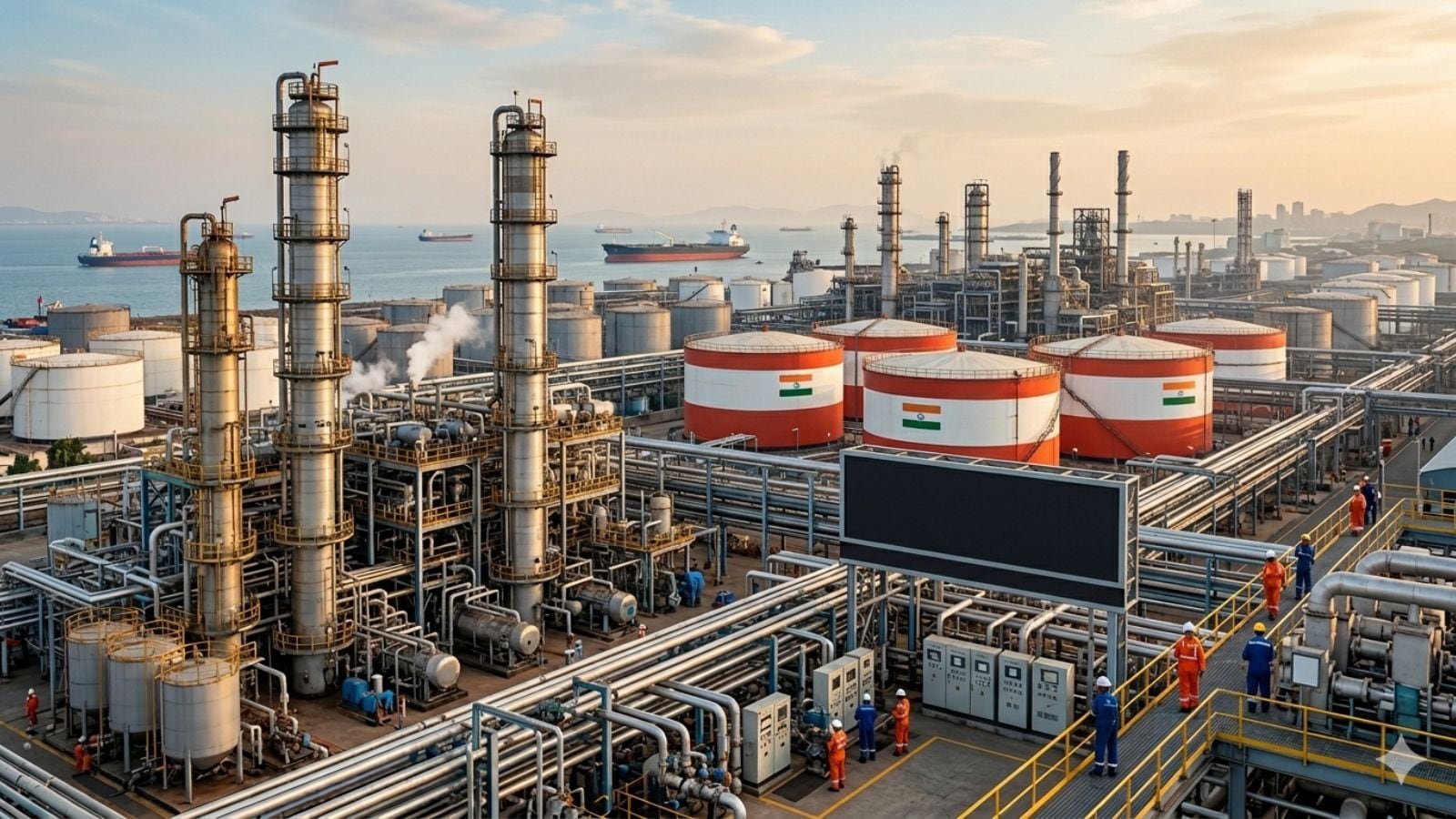
On March 26, the government had said that domestic production is now meeting over 60% of India’s current daily requirement of 80,000 tonnes, which is predominantly household demand. (Image generated using Google Gemini)
In a bid to ensure stable and adequate fuel supplies, public sector refiners Indian Oil Corporation (IOC) and Bharat Petroleum Corporation (BPCL) have postponed routine maintenance shutdowns—or turnarounds—at some of their refineries, a senior government official said Monday. India is the world’s third-largest consumer of crude oil and the fourth-largest refiner, with a bulk of the petroleum fuels—like petrol and diesel—and petroleum products consumed within the country, and some volumes exported. India has a refining capacity of roughly 260 million tonnes per annum (mtpa).
IOC is the country’s largest refiner with 70.25 mtpa of refining capacity spread over nine refineries. BPCL has three refineries with a cumulative crude processing capacity of 35.3 mtpa. Refineries take periodic planned maintenance shutdowns, or turnarounds, to ensure operational safety, comply with regulations, and replace equipment that needs to be changed. These scheduled refinery outages help with inspection, cleaning, repairs, and upgrades to maintain and even improve operational efficiency.
All Indian refineries are operating at peak capacity utilisation rates with some even operating at over 100% of their nameplate capacity, with adequate crude oil inventories, Petroleum Ministry Joint Secretary Sujata Sharma said, adding that sufficient stocks of petrol and diesel are being maintained in the country and there is no shortage of the two critical fuels. Sharma also said that some of the IOC and BPCL units that were scheduled to go under maintenance in the coming days will continue operating at optimum capacity, and the maintenance shutdowns have been deferred for the time being. She did not provide details on these units and their planned maintenance shutdown plans.
The move comes at a time when Indian refiners have stepped up domestic production of liquefied petroleum gas (LPG) to partly cover the shortfall in LPG imports, which have been hit hard due to the effective closure of the Strait of Hormuz amid the West Asia war. While the effective halt in vessel movements through the maritime movement have impacted India’s crude oil and liquefied natural gas imports, the hit has been the hardest for LPG. Around 40% of India’s oil imports and over 55-60% of LNG imports come from West Asia through the Strait; as for LPG, a whopping 90% of the country’s imports depend on the narrow waterway between Iran and Oman.
Moreover, private sector refiner Nayara Energy is proceeding with a month-long turnaround at its 20-mtpa refinery in Gujarat from April 9-10. Nayara had already been deferring its planned shutdown for several months now. It was scheduled for last year, but had to be deferred after Nayara was slapped with European Union sanctions due to its links with Russian oil major Rosneft, which is a major shareholder in Nayara. Nayara’s refinery turnaround, which cannot be deffered further, is expected to tighten domestic LPG production to some extent, and the shortfall is likely to be covered by increasing LPG imports.
Also Read | Oil and beyond: With Russia, India has to balance old ties, new realities
While India has been in a comfortable position with regard to crude oil, petrol, diesel, and jet fuel availability, it still has to bear the brunt of high prices. In the case of LPG, apart from high prices, supplies to India have been notably hit, forcing the government to ration commercial and industrial LPG sales in order to prioritise supplies to crores of households that depend on LPG. The government had also ordered refiners to maximise LPG production, and directed them to divert propane, butane, and other streams from petrochemical manufacturing to LPG production. These measures have helped raise domestic LPG production by around 40% vis-à-vis the pre-war levels, which translates to around 16% of the country’s overall LPG demand.
On March 26, the government had said that domestic production is now meeting over 60% of India’s current daily requirement of 80,000 tonnes, which is predominantly household demand. The average daily LPG demand in the country was around 90,000 tonnes, but with commercial LPG supplies heavily curtailed, the daily requirement has fallen. “The net daily import requirement has consequently come down to only 30 TMT (thousand metric tonnes) — meaning India is now producing much more than it needs to import. Over and above domestic production, 800 TMT of assured inbound LPG cargoes are already secured and en route from the United States, Russia, Australia, and other countries… Approximately one full month of supply is firmly arranged, with additional procurement being finalised continuously,” the Petroleum Ministry had said.
Story continues below this ad
It had also assured that India currently had crude oil and fuel stocks to cover 60 days of consumption, and crude oil procurement for April and May had also been tied up, which meant that the country was secure for the next many months. According to sources, as crude gets processed into fuels and current fuel stocks get consumed on an ongoing basis, the oil and fuel supply situation should remain stable with non-West Asian crude supplies continuing unabated. India has ramped up oil imports from such sources, particularly Russia, to mitigate the impact of the Gulf supply hit.
