

Post Content
HP has outlined plans to make a deeper push into enterprises with the hope that businesses are key to adoption of generative artificial intelligence and Agentic AI.
Palo Alto, California-based computer maker HP, at its Imagine event in New York on Tuesday, introduced HP IQ, a device-level intelligence layer designed to bring automation and context-aware assistance into everyday work alongside new high-performance enterprise AI PCs and an expansion of its Workforce Experience Platform (WXP).
Executives at one of the world’s top PC maker spent a lot of time on HP IQ, a new AI-powered software layer designed to run directly on enterprise PCs. The goal is to minimise friction so work flows seamlessly across tasks, apps, and systems.
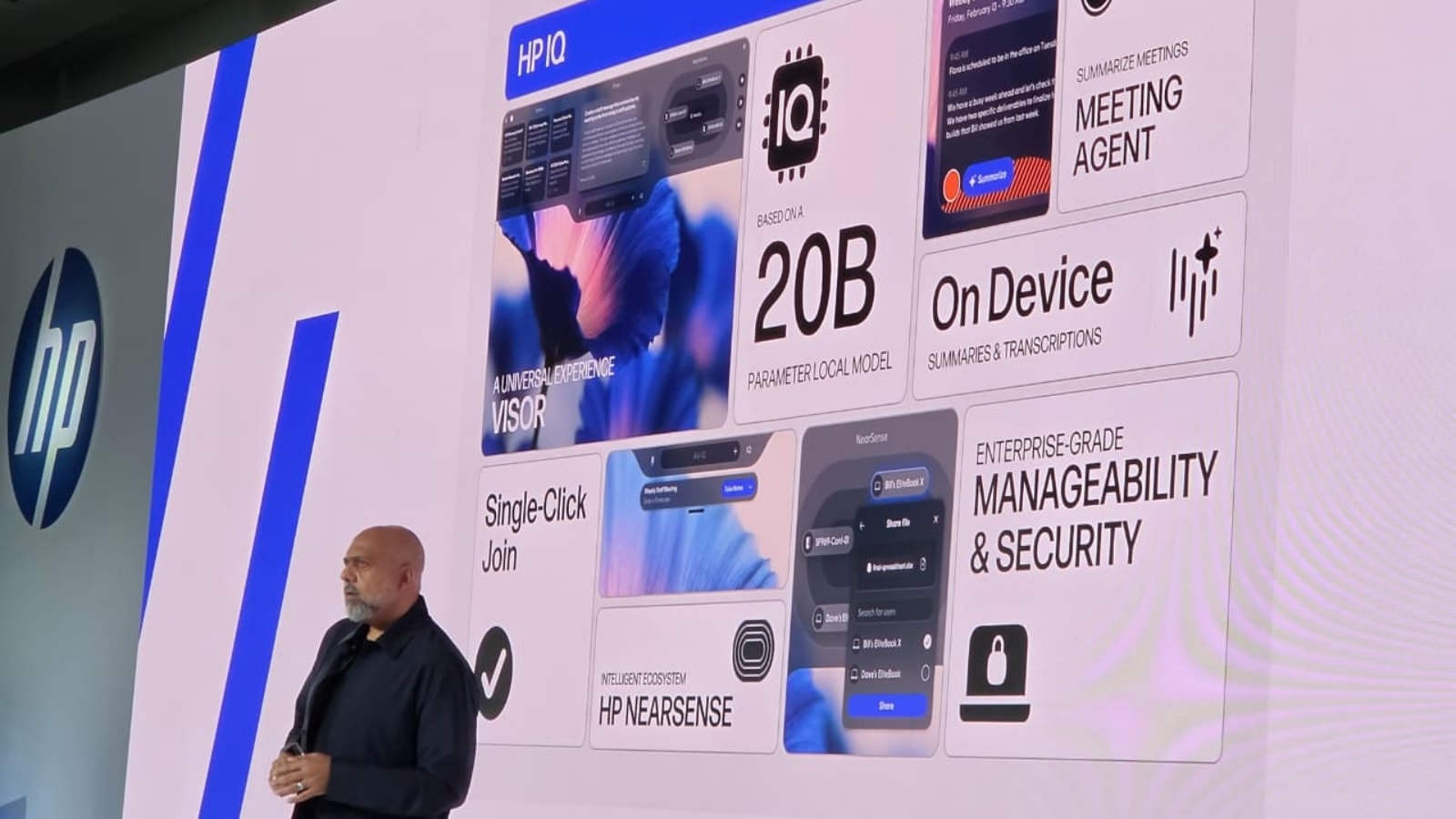
IQ is built around a local 20-billion-parameter AI model that enables users to interact with their devices using natural language. According to HP executives, the idea behind IQ is to make interactions seamless. Rather than requiring users to open separate applications or services, the system is designed to operate across the device environment and respond directly to user intent.
HP has outlined plans to make a deeper push into enterprises with the hope that businesses are key to adoption of generative artificial intelligence and Agentic AI.
In fact, it is designed around a local-first architecture that prioritises speed, privacy, and reliability, particularly when connectivity is limited. The system then routes tasks to the cloud only when permitted by enterprise policy.
The platform supports tasks such as searching files, summarising content, organizing notes, and assisting with meeting workflows. Competitors like Lenovo and Dell are also offering similar AI-driven workplace solutions, but HP is taking a slightly different approach: the goal is to design and embed IQ into the operating experience itself, rather than positioning it as a standalone tool that users must actively open and manage.
Think of the IQ as the new software layer between devices and AI.
HP used the Humane acquisition to bring AI more deeply across its product portfolio, from PCs, printers to broader work systems, while adding a integrated AI model approach. Humane co-founder Imran Chaudhri, joined HP after it acquired Humane, the company that made the infamous AI Pin that didn’t do well commercially. Chaudhri now serves as SVP of Design & Technology at HP’s IQ Lab. He is best known as a former Apple designer, recognised for his work on the iPhone interface.
Story continues below this ad
HP IQ offers a glimpse into the company’s vision for using AI on and across devices.
The company said the HP IQ will begin an early access rollout in Spring 2026, with broader availability expected later in the year across notebooks, desktops, and collaboration hardware.
HP combined updated commercial AI PCs with a new on-device AI system that makes it simple to interact with their devices and manage them at scale. (Image credit: Anuj Bhatia/Indian Express)
Refreshed AI PCs for enterprises
HP also used its annual Imagine event to introduce newer, updated high-performance AI PCs to the market. Over 30 new business laptops were announced, featuring Intel, AMD, and Qualcomm chips. The EliteBook 6 series, for instance, is aimed at mobile professionals working across hybrid environments. Meanwhile, the HP Z8 Fury G6i workstation is built for high-performance computing, AI development, visual effects, and simulation workloads.
HP is targeting users who increasingly work across multiple locations and expect consistent performance whether they are in the office, at home, or traveling. The company promises that the new systems deliver longer battery life, thinner form factors, and improved efficiency compared to previous generations. Integrated 5G connectivity is also included in some AI PCs.
Story continues below this ad
Alongside the flagship devices, the company is restructuring its commercial portfolio into clearer tiers designed to serve different segments of the enterprise market. The updated lineup separates devices aimed at small businesses, mainstream enterprise users, and high-performance professional workloads.
IT automation on the rise
As organisations move toward automated device management and AI-powered applications place heavier demands on memory, computing, and network capacity, enterprise IT operations are shifting. HP says it aims to move beyond traditional reactive IT support toward systems that can detect, decide, and act autonomously before employees experience disruption. This is where WXP, the company’s cloud-based, AI-powered platform, comes in. It is designed to optimise IT operations and improve employee productivity across enterprise device fleets. WXP’s latest updates focus on detecting signals early and acting on them automatically. Instead of generating alerts that require manual triage, the platform attaches AI-generated remediation paths to each issue, prioritizing actions based on context, historical outcomes, and system conditions.
Focus shifts to enterprise AI
With tech companies spending billions on building AI infrastructure, and with AI becoming increasingly integrated into everything, it is likely to become ubiquitous in the near future because firms that do not adopt it risk losing a competitive edge. AI companies are actively trying to persuade business leaders to adopt their technology and invest in it.
HP is betting on the future of enterprise AI, but much also depends on how tightly it is integrated. Owning the ecosystem is important, but the future of enterprise AI also depends on who builds the systems that make AI models usable at scale.
Story continues below this ad
Although consumer AI is still growing, enterprise AI is where the real action currently is. In fact, how AI technologies are being developed and their applications within the workplace have become the top priority for business leaders. Enterprises are increasingly partnering with hyperscalers and software vendors, using architectures that allow local AI model deployment while ensuring secure, policy-driven access to distributed data.
For HP and other PC vendors, there has been a shift toward enterprise AI PCs. Experts say that consumer response to AI PCs has been encouraging.
As AI becomes integrated into enterprise systems, companies like HP are looking to own every layer themselves. To achieve this, they are ready to work with trusted partners to align infrastructure, data, models, and operations. At the same time, there is also a strong emphasis on how leaders must monitor deployment, data flow, and accountability for system failures or misbehavior.
HP has approximately 21 percent of global PC shipments, placing it second behind Lenovo. In India, it leads the PC market with roughly a 30 percent share in early 2026, including about 34 percent in the commercial segment.
