
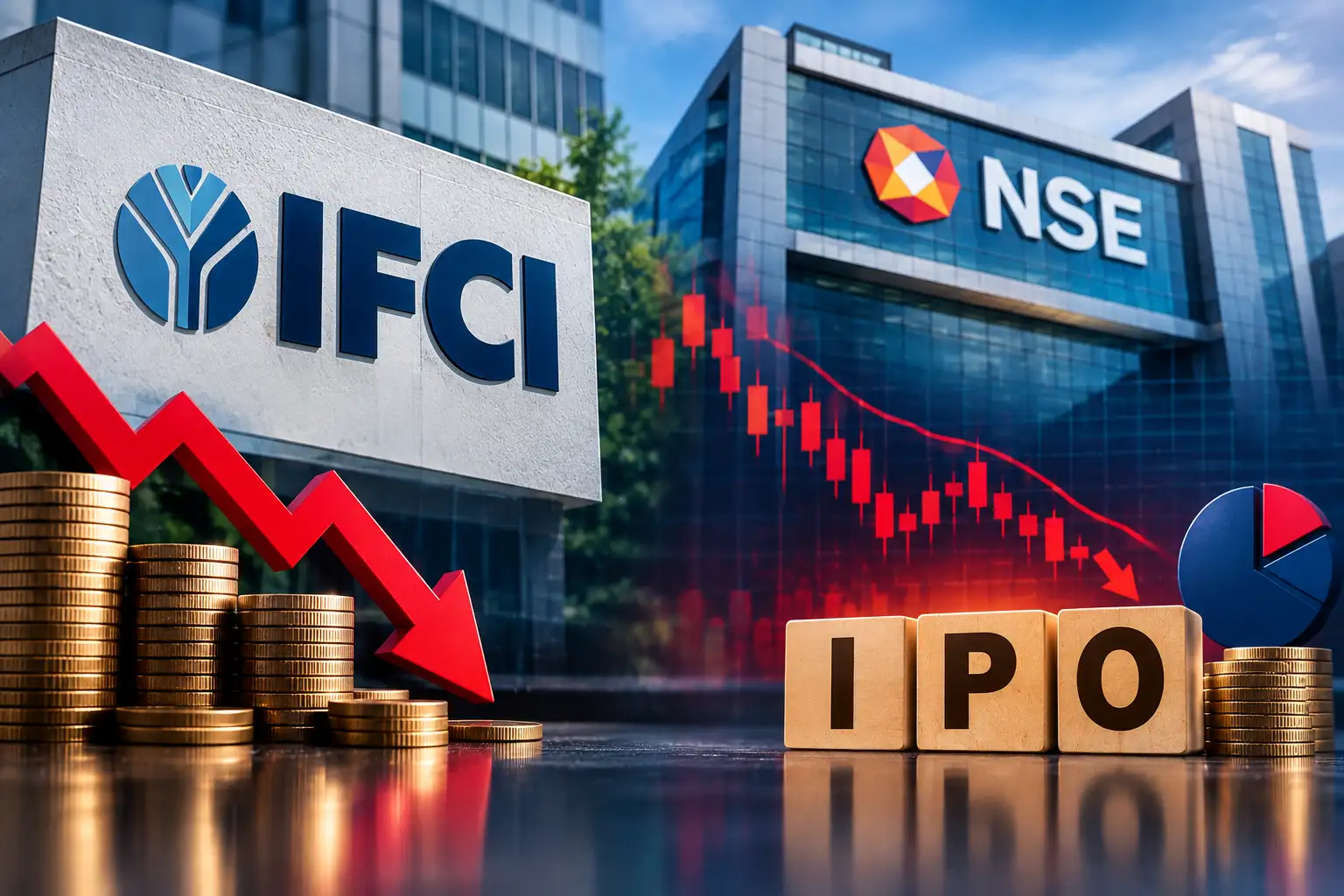
Shares of IFCI Ltd fell more than 4% on Wednesday after reports suggested that the National Stock Exchange could price its initial public offering below earlier indications and reduce the stake offered in the issue.
At 9:27 am, IFCI shares were trading 4.01% lower at Rs 88.90 on the NSE, compared with their previous close of Rs 92.61. The stock opened at Rs 92.50, touched a high of Rs 93.56 and slipped to an intraday low of Rs 88.31.
The stock underperformed the broader market, with the Nifty 50 trading about 0.5% lower during the same period.
NSE is likely to price its IPO between Rs 1,700 and Rs 1,785 per share, below the Rs 2,000-Rs 2,100 range previously marketed, according to reports.
At the upper end of the proposed band, the exchange would be valued at around Rs 4.4 lakh crore, or $46.4 billion, Bloomberg reported.
The exchange may also reduce the stake offered to about 5.5% of its equity capital from the previously planned 6%. NSE’s draft offer document had proposed an offer for sale of up to 14.89 crore shares.
The lower-than-expected price range and potential reduction in the offer size weighed on IFCI because of its indirect exposure to NSE. IFCI owns more than 50% of Stock Holding Corporation of India, which, in turn, holds over 4% of the exchange.
As a result, developments affecting NSE’s valuation have a bearing on the value investors assign to IFCI’s indirect holding. NSE did not immediately respond to a Reuters request for comment on the reported price band.
Also read: ESDS Software shares rally 10%, skyrocket 235% from IPO price in 4 days. Should you buy or sell?
The long-awaited IPO could still rank among India’s biggest public issues. NSE, which dominates the country’s equity derivatives market, is reportedly targeting a listing in the week beginning September 21.
Despite Wednesday’s decline, IFCI shares remained up 20.22% over the past month, outperforming the Nifty 500, which fell 2.95% during the same period. The stock was also up around 68% year-to-date.
Disclaimer: This article has been written by Somanjali Das, who is not a SEBI-registered Research Analyst or an Investment Adviser. Somanjali Das and his/her ‘relative(s)’ (as defined under Section 2(77) of the Companies Act, 2013) do not hold any financial interest in the companies mentioned in this article as of the date of publication. The views/recommendations mentioned in this article, wherever applicable, are those of the respective SEBI-registered Research Analyst/brokerage and have been reproduced/reported with due attribution. They should not be construed as the views or recommendations of The Economic Times Digital or the journalist. Readers are advised to consider the original research report and make their investment decisions based on their own assessment. Brokerage disclaimers here