

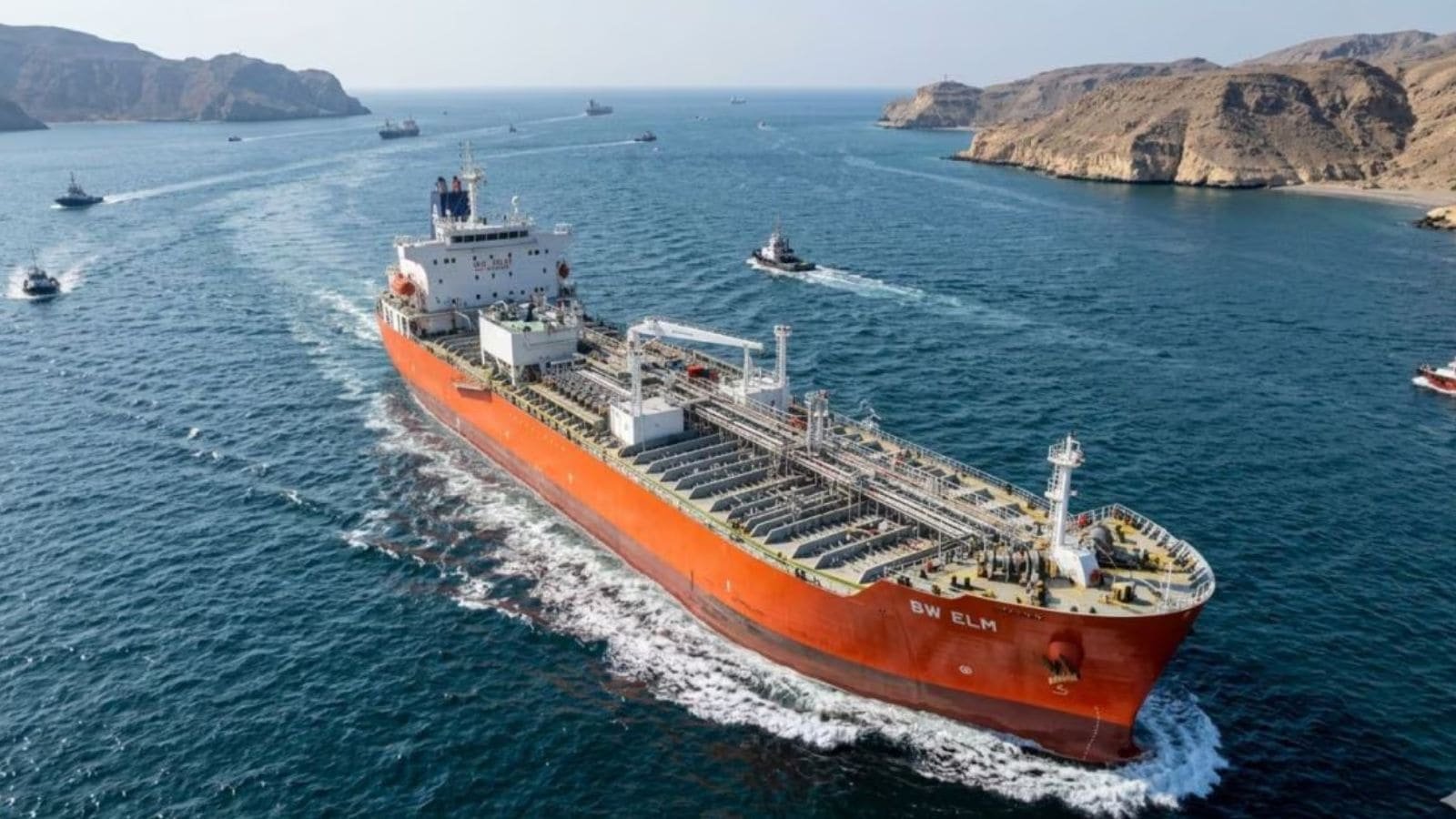
Jag Vikram Strait of Hormuz transit marks the first Indian vessel crossing after the US-Iran ceasefire, indicating a gradual resumption of shipping through the critical chokepoint. (Representative image)
Liquefied petroleum gas (LPG) tanker Jag Vikram crossed the Strait of Hormuz between Friday night and Saturday morning, becoming the first India-flagged vessel to cross the maritime chokepoint since the announcement of the temporary two-week ceasefire between the US and Iran, according to ship tracking data. Jag Vikram is the ninth Indian ship to exit the Persian Gulf since early March; another 15 India-flagged vessels are in the Persian Gulf with its exit. As of 8 pm (India time) on Saturday, the tanker was in the Gulf of Oman, well beyond the Strait, and was sailing eastwards towards India’s west coast.
According to the government, Jag Vikram is carrying around 20,400 tonnes of LPG with 24 seafarers on board. It is expected to arrive at Mumbai on April 15. The tanker is a mid-sized gas carrier (MGC) owned by Mumbai-based Great Eastern Shipping Company, as per shipping databases. The tanker has a deadweight capacity of over 26,000 tonnes. Deadweight tonnage is the total weight a vessel can carry, including cargo, fuel, fresh water, ballast water, provisions, and crew.
According to trade sources, Jag Vikram had been waiting to cross the Strait of Hormuz for over a week now. On April 3, The Indian Express had reported that LPG tankers Green Asha and Jag Vikram were expected to cross the crucial waterway in a few days’ time. Green Asha transited the Strait on April 5. Scores of vessels have been stranded in the Persian Gulf since the war began, with only a few being able to safely transit the Strait, and that, too, in coordination with Iran.
Seven of the eight other Indian LPG tankers that crossed the Strait of Hormuz over the past few weeks were very large gas carriers (VLGCs), with more than double the LPG carrying capacity than an MGC. One was an MGC. The remaining 15 Indian vessels in the Persian Gulf include at least one more LPG tanker, four crude oil tankers, one liquefied natural gas (LNG) tanker, one chemical products tanker, three container ships, two bulk carriers, and a few vessels undergoing routine maintenance.
While transiting the Strait of Hormuz, Jag Vikram was signalling that it was an Indian ship with Indian crew on board. Such identity broadcasts have become a standard of sorts among vessels crossing the Strait in coordination with Iranian authorities, which are regulating vessel movements. The Strait of Hormuz is a narrow waterway between Iran and Oman that connects the Persian Gulf with the Arabian Sea; it is a critical maritime chokepoint for global energy flows. Around one-fifth of global oil and gas flows transited the Strait before the war began.
India is among the countries that have been engaged with Iran at the diplomatic level for safe passage of their ships through the Strait of Hormuz, where Tehran brought vessel movements to an effective halt amid the ongoing West Asia war. With the ceasefire announcement on Wednesday, there were hopes that vessel movements through the Strait would progressively increase. While some movement in traffic has reportedly picked up a bit, flows remain highly constricted.
Amid reports that Iran wants to impose a toll or a transit fee on merchant vessels crossing the Strait of Hormuz, India continues to press for free and safe navigation through the waterway. In response to reports regarding the potential formalisation of a toll by Iran for passage through the Strait, a senior Foreign Ministry official recently said that there has been “absolutely no discussion” on the issue between India and Iran, adding that India maintains its long-held stance on the matter and will evaluate future scenarios if and when they arise.
Story continues below this ad
There had been reports that Iran was already charging a “toll” from some vessels before allowing them to cross the Strait of Hormuz. The Indian government has been categorically denying the payment of any toll or charge to the Iranians for the passage of India-flagged ships through the waterway. Since the war began, eight India-flagged vessels—all LPG tankers—have returned from the Persian Gulf. India has high dependence on West Asia for its oil and gas supplies, most of which come to the country via the Strait of Hormuz. The Strait is also important for India’s supplies of other commodities, including fertilisers and petrochemicals.
“On the question of toll…there has been no discussion on this point between us and Iran. So that is where we are. As to what will be the scenario if a certain situation arises or happens in future, we’ll see when the time comes. But our point of view at this point in time is that we continue to call for free and safe navigation through the Strait of Hormuz,” Foreign Ministry Spokesperson Randhir Jaiswal said on Thursday.
Like most other natural waterways that are shipping chokepoints, the Strait of Hormuz is an international strait, and no tolls are charged just for crossing them, as per the United Nations Convention on the Law of the Sea (UNCLOS). Although neither Iran nor the US have ratified the convention, it is widely accepted as international law, and Washington and Tehran have mostly abided by it. Sources indicated that changing the status of the Strait of Hormuz is a question of international law and would be required to be done through the UN.
Prior to the ceasefire, Iran had said that non-hostile vessels linked to countries other than the US, Israel, and their allies can cross the strait in coordination with Iranian authorities. With the ceasefire announcement on Wednesday, Iran’s Foreign Minister Seyed Abbas Araghchi said that safe passage through the Strait of Hormuz will be possible for two weeks but “via coordination with Iran’s Armed Forces and with due consideration of technical limitations”.
© The Indian Express Pvt Ltd
