

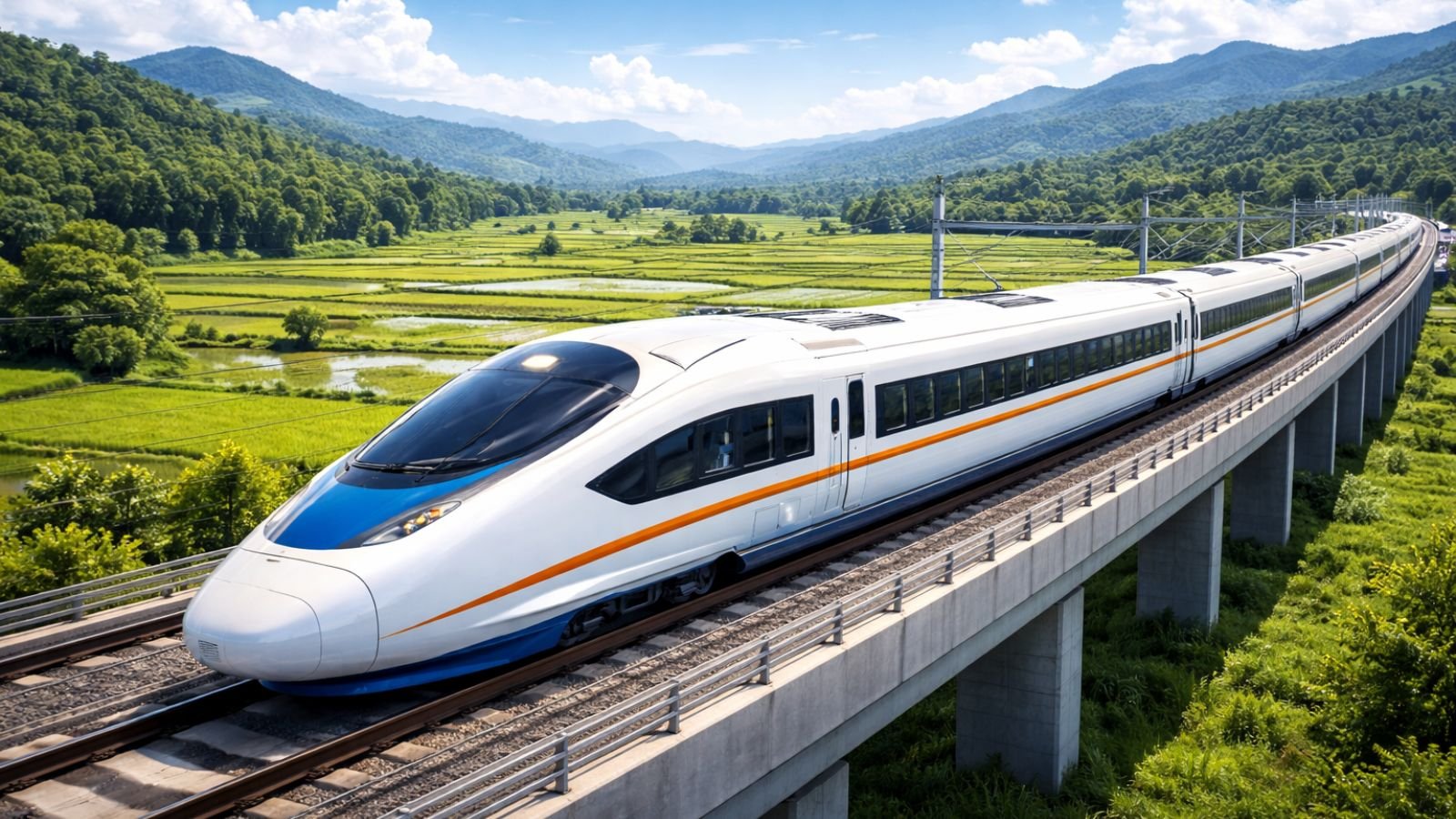
The MAHSR project is passing through Gujarat, Maharashtra and Union Territory of Dadra & Nagar Haveli. (Image generated using AI)
Mumbai-Ahmedabad bullet train project: The National High Speed Rail Corporation Limited (NHSRCL) is progressing at full swing on the country’s first bullet train project connecting Mumbai and Ahmedabad. The 508-km-long high speed rail project is under execution with technical and financial assistance from Government of Japan.
The project is passing through Gujarat, Maharashtra and Union Territory of Dadra & Nagar Haveli with 12 stations planned at Mumbai, Thane, Virar, Boisar, Vapi, Billimora, Surat, Bharuch, Vadodara, Anand, Ahmedabad and Sabarmati.
Also Read | Mumbai-Ahmedabad bullet train project: Here’s why B28 trainset is crucial for 2027 launch
In a report published by the Standing Committee on Railways, (Demands for Grants 2026-27), the Ministry of Railways stated that the cost escalation in the Mumbai-Ahmedabad High Speed Rail (MAHSR) project is due to detailed engineering requirements, exchange rate fluctuations, land, resettlement & Rehabilitation cost, normal inflation and expenses not considered in the initial feasibility report.
It also stated that construction was initially planned to be partly on viaduct and mostly on embankment. However, in 2016, the Empowered Committee decided to construct entirely on viaduct, as embankments would have led to higher land acquisition costs, divided villages, would result in lesser safety because people are likely to trespass and would affect drainage.
“The cost of Rs 97,636 crore, approved by CCEA in December, 2015, was based on the feasibility report. Detailed engineering review was to be done subsequent to the approval of the feasibility report.
The cost escalation is thus due to the detailed engineering, fluctuation in exchange rate, land, resettlement & Rehabilitation cost, normal inflation, costs which were not considered in the feasibility report (like utility shifting, power sourcing, station approach development, ticketing, Statutory charges etc.) including GST and cess and certain other enabling cost to make the corridor operational,” it said.
It further said that the revised cost estimate for the Mumbai–Ahmedabad bullet train project is under sanction.
Story continues below this ad
In its report, the Standing Committee on Railways recommended that the Ministry adopt a robust execution framework to ensure effective inter-agency coordination, early identification and resolution of bottlenecks, and timely completion of utility shifting works. “Such measures are essential to prevent time and cost overruns and to secure timely delivery of projects,” it said.
