

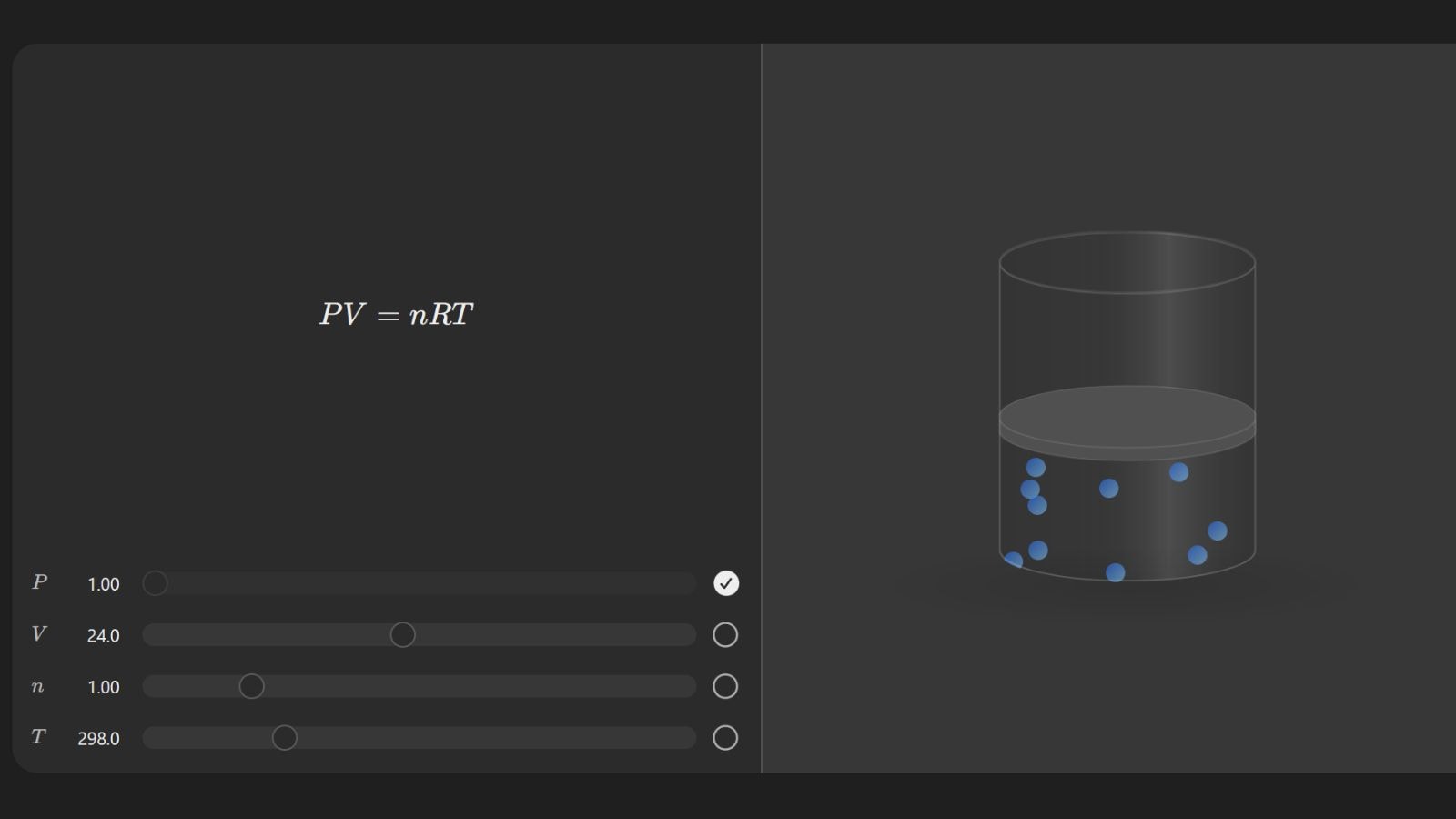
Post ContentChatGPT interactive visual explanation of Ideal Gas Law. (Screenshot: OpenAI)
As AI becomes a part of classrooms around the world, OpenAI has announced a new ChatGPT feature that generates interactive, visual explanations to help users understand complex concepts in mathematics and science more easily.
These new dynamic visual explanations will show users how formulas, variables, and relationships behave in real time, OpenAI said in a blog post on Tuesday, March 10. ChatGPT can explain and present interactive visual modules on more than 70 core math and science concepts relevant to high school and college students.
Some of these topics include binomial square, Charles’ law, circle area, circle equation, compound interest, cone surface area, cone volume, Coulomb’s law, cylinder volume, degrees of freedom, difference of squares, exponential decay, Hooke’s law, kinetic energy, lens equation, linear equation, Ohm’s law, period–frequency relation, potential energy, PV = nRT equation, Pythagorean theorem, slope–intercept form, surface area of sphere, triangle area, trig angle sum identity, and others.
Within an interactive module, users will be able to adjust variables, manipulate formulas, and see how those changes affect graphs and outcomes. It is designed to turn abstract ideas and concepts into something they can experiment with directly in ChatGPT, OpenAI said.
The new feature is being rolled out to all logged-in ChatGPT users globally across all plans from today (March 11). “Over time, we plan to expand interactive learning with additional subjects and continue building tools that strengthen learning with ChatGPT,” OpenAI said.
India is a key market for OpenAI’s education-focused AI tools and products as demonstrated by the fact that 50 per cent of ChatGPT users in India are under age 24, as per Leah Belsky, VP of Education, OpenAI. Globally, an estimated 140 million (14 crore) people use ChatGPT to help them understand math and science concepts alone. “People also come to ChatGPT to explore new topics, work through homework problems, prepare for exams, and break down concepts they’ve always found difficult,” OpenAI said.
Also Read | OpenAI launches new ChatGPT guide for Indian college students: 5 must-try prompts
Based on early testing of ChatGPT’s new learning feature, OpenAI said that college and high school-age students found that the interactive modules helped them better understand how variables relate to one another. Parents further said that it gave them a more dynamic way to walk through problems alongside their children.
Story continues below this ad
In August 2025, OpenAI rolled out ‘Study Mode’ in ChatGPT to all logged-in Indian users. With Study Mode enabled, ChatGPT provides a step-by-step learning method instead of quick AI-generated answers to queries. It is designed to help students with homework, test preparation, and learning new topics. To enable Study Mode, one needs to select ‘Study and learn’ from the tools in ChatGPT and ask a question.
