

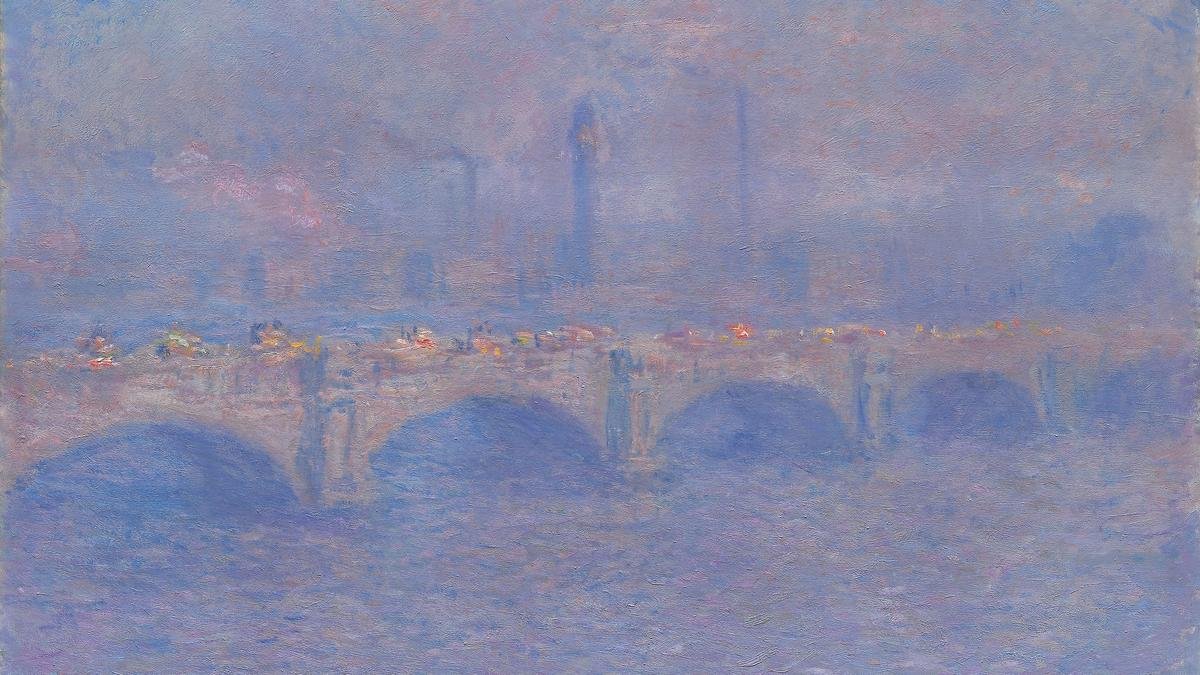
Familiar you may be with the commonplace colour violet (including all the different shades and ways of calling it — purple, lilac, the list goes on) but in fact, it is the rarest colour in nature. In the 19th Century Impressionist era, if you were to paint with violet or had violet in your palette, you apparently contracted a disease. A sickness, that of ‘violettomania’.
Often, violet is perceived and learned as a red-blue colour. Depending on how much red or how much blue there is, the hue varies. Violet is closely associated with purple and so is indigo. In this story, we faithfully stick with the name ‘violet’, corresponding to the term ‘violettomania’ to avoid complex confusion.
Sleeping on violet
Let’s take a look at some of the popular traditional paintings that existed before the 19th Century. The first one is, of course, the unmissable “Mona Lisa” portrait by Renaissance painter Leonardo da Vinci.
Mona Lisa, Da Vinci,16th C.
| Photo Credit:
Wikimedia Commons
The broader themed second one is “The Night Watch” by the iconic Baroque painter Rembrandt. Take a minute and observe the colour palette of both paintings.
The Night Watch by Rembrandt, 17th C.
| Photo Credit:
Wikimedia Commons
What do you see? Now, before you conclude that they have sombre and dark yellow-ish tones, let me tell you that both the paintings in their original, novel state were lighter (all the colours were lighter). These paintings look dull now because of centuries of ageing. So imagine for a second, a freshly painted vibrant Mona Lisa and The Night Watch, and answer the question again.
If you said something along the lines of earthy tones, yellow-brown-golden hues, then you have a keen eye!
The majority of paintings before 19th Century modern art used such colour palettes where violets were rare. If someone did use violet, it was by mixing red and blue together. Russian American artist Allen Tager was curious about all this and did a thorough investigation where he found out that until the middle of the 19th Century, fewer than 4% of paintings had violet appearing in them.
Landscape at Eragny, church and farm by Camille Pissarro. Look at the violet strokes all throughout.
| Photo Credit:
Corbis via Getty Images
Rise of Cobalt Violet
In 1859, a true violet colour, one that didn’t form by mixing other colours and was a single, primary pigment, was created for the first time. The shade was called ‘Cobalt Violet’ and it was chemically created initially from cobalt arsenate (highly toxic) and later, cobalt phosphate. No sooner had this pigment been invented than the artists went crazy.
A few years later, in 1866, another permanent violet shade was created called ‘Manganese Violet’. This too, was a favourite among the impressionist artists, especially Claude Monet.
Extras: Not just violet, the 19th Century saw an exceptional explosion of new colours and pigments (as a result of the Industrial Revolution and significant advance of chemistry). Eg: Cerulean Blue, Emerald Green, Cadmium Yellow, Viridian, and so on.
Impressionism
Beginning in France, “Impressionism” was one among the many avant-garde art movements that flourished in 19th Century Europe. It was an artistic, literary movement and an ideological one at a deeper level. Camille Pissarro, Edgar Degas, Claude Monet, and Pierre-Auguste Renoir were among the founding artists of Impressionism. The movement was a reaction against classical subjects, rigidity and restriction of dominant art styles, and painting indoors. Impressionist painters went outside to paint which explains their large variety of scenic, natural, and everyday subjects (or lightscapes).
Impressionist Violet
Go outside this instant and look at a tree. Does the tree look violet? Does the sky above look violet? This is what an average 19th Century critic asks to which an impressionist painter replies yes. The subjective impressionist psyche saw the light around the world and shouted that the atmosphere was violet, that the shadows which light left behind were violet. This meant that the impressionist painting looked misty, whimsical, and fleeting. It was the psyche’s ethereal perception of nature.
“I have finally discovered the true colour of the atmosphere. It is violet. Fresh air is violet!”Édouard Manet
For Claude Monet, the poster child of impressionism, cobalt violet was a constant presence in his palette. In his iconic painting “Water Lilies”, cobalt violet appears all over as striking shadows of the water-lilies.
Claude Monet “Water Lillies”.
| Photo Credit:
Wikimedia Commons
Edgar Degas, an impressionist painter who loved ballet, also had cobalt violet as one of his favourite colours. He even has a painting called “Dancers in Violet”! Seen below is another of his violet-clad paintings called “Three dancers in Violet Tutus”.
Three dancers in Violet Tutus by Edgar Degas.
| Photo Credit:
Wikimedia Commons
Suffering in violet
Famous art critic Albert Wolff just straight-up loathed this violet and wrote in the French paper Le Figaro on April 3, 1876, about the 1876 impressionist exhibition that “Someone should tell Monsieur Pissarro forcibly that trees are never violet” and that “lunatics” are given the chance to exhibit works. A lot of people shared the sentiment with Wolff. Derisive Violettomania attributed to the impressionist painters meant something was seriously wrong with their brains.
Violettomania.
| Photo Credit:
iStockphoto
Despite the criticism, the impressionist painters continued rampantly using unusual violet, making impressionist paintings subconsciously distinct from others. Nature around us was dressed in vivid light under the hands of the impressionists. This was significant at that time when the industrial revolution was vigorously occupying culture and people were living monotonous routines. Impressionism was potent in that it threw light on individualism and projected a confident subjective perception. My perspective and your perspective would matter. Even if Monet and I drew waterlilies, my imagination and perception of water-lilies would procure a whimsy that would be different from Monet’s and inherently mine own, even though we use the same colour palette.
Violet trivia
The violet colour is a namesake of the flower violet.
Violettomania was also called Indigomania by critics.
Cobalt violet was the first permanent violet pigment available to artists.
Once, a rumour spread around that Claude Monet could actually see the ultraviolet spectrum of light! (violettomania was just that shocking!)
Published – March 31, 2026 08:00 am IST
Read Comments
Copy link
Telegram
SEE ALL
Remove
Related stories
Why are school buses yellow
What is Impasto painting?
From lapis-laden trade routes to mass armies: the changing value of blue
Related Topics
In School
/
arts, culture and entertainment
/
arts (general)
/
fine arts education
/
history
/
culture (general)
/
painting
