

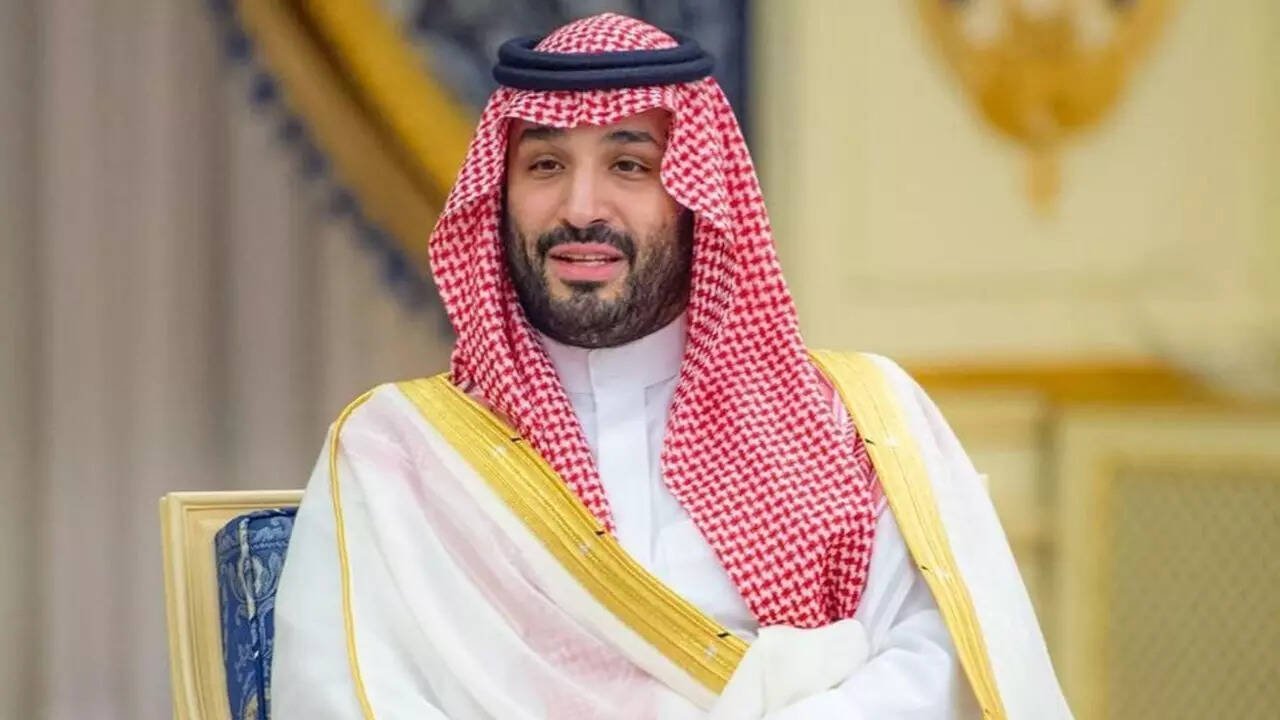
Driving the newsSaudi Crown Prince Mohammed bin Salman appears to be making a blunt calculation about the US-Iran war: the biggest threat to Saudi Arabia may not be the fighting alone, but a conflict that ends before Iran is weakened enough to stop threatening the Gulf.According to the New York Times,MBShas urged President Donald Trump in recent conversations to keep pressing the war, arguing that the US-Israeli campaign offers a “historic opportunity” to reshape the Middle East. The Wall Street Journal too reported that Saudi Arabia and the UAE are alarmed by Trump’s appetite for a diplomatic deal that could leave Iran battered but still capable of projecting force across the Gulf.
Watch
‘MBS Is Fighting With Us’: Trump Puts Stamp On Saudi Arabia’s Role In Raging Iran War | Watch
That captures Riyadh’s core fear. Saudi leaders do not want an endless war on their doorstep. But they also do not want a rushed settlement that leaves Iran wounded, enraged and still armed with enough leverage to menace Saudi oil, Gulf shipping and regional security.That is the strategic trap for MBS: he may want Trump to keep pounding Iran, but only because he fears the alternative may be worse.Why it mattersFor MBS, this is not just a foreign policy crisis. It is a direct threat to the political and economic model on which his rule now rests.Vision 2030 depends on a simple proposition: Saudi Arabia can be transformed into a hub for investment, tourism, logistics and global business because it is stable. War shreds that proposition fast.As Bernard Haykel told the Financial Times, MBS wants “stability and order” and does not want “missiles and drones flying around.” But that is exactly what Saudi Arabia is confronting now. Semafor reported that emergency missile alerts sent to phones across Riyadh this week punctured the sense that the Saudi capital would remain insulated from the conflict, even if much of daily life quickly returned to normal.The contradiction is brutal. A weaker Iran may serve Saudi strategic interests. But the process of weakening Iran is already undermining the calm, predictability and investor confidence MBS has spent years trying to manufacture.The big pictureSaudi Arabia’s Iran policy has swung sharply over the past several years, and this war is now blowing up the balance MBS tried to strike.After the 2019 attack on Saudi oil facilities exposed the limits of American protection, Riyadh moved away from open confrontation and toward managed de-escalation with Tehran.The 2023 restoration of diplomatic ties was not a sign of trust. It was an attempt to lower the temperature and buy space for economic reform.Now that buffer is collapsing.According to Reuters, Saudi Arabia has ordered Iran’s military attaché, his assistant and several other embassy staff to leave the kingdom after repeated Iranian attacks on Saudi territory. Saudi officials have also hardened their public language.Prince Faisal bin Farhan said that “what little trust there was before has completely been shattered.”The return of direct hostility means MBS is being dragged back toward the very regional security logic he had tried to partially escape: more dependence on US military cover, more focus on oil infrastructure vulnerability, and less room for the diplomacy and strategic hedging that defined Saudi policy after 2019.Between the linesThe real Saudi fear is not simply that Iran survives this war. It is that Iran survives it angry, bloodied and still dangerous.That is why Trump’s apparent interest in an off-ramp is unnerving Gulf leaders. According to WSJ, Saudi Arabia is uncomfortable with mediation efforts that could trade sanctions relief for Iranian concessions while leaving Tehran with enduring influence over Gulf energy routes and regional security.Riyadh’s concern is not abstract. It is rooted in the possibility that a partially damaged Iran would spend the next several years exacting revenge through missiles, drones, proxies and periodic disruption of the Strait of Hormuz.Yasmine Farouk of the International Crisis Group distilled that logic in NYT “Saudi officials certainly want the war to end, but how it ends matters.”That may be the most important line in understanding MBS’s position.Riyadh does not necessarily want more war for its own sake. It fears the wrong ending more than the continuation of the current campaign.Zoom inThe recent reporting suggests MBS’s argument to Trump is shaped by precisely that concern.According to NYT, the crown prince has argued that Iran remains a long-term threat to the Gulf and has pressed Trump not to pull back too early. The paper also reported that MBS has pushed for attacks on Iranian energy infrastructure and even advocated more ambitious military options, though Saudi officials denied he had pushed to prolong the war.The Journal described a similar Saudi view from another angle: Gulf Arab states are growing increasingly alarmed that Trump may do a deal too soon and leave them stuck living beside a hostile but still potent Iran.That is the Saudi calculus in a sentence. A decisive blow to Iran could remove a long-running threat. A partial blow could harden it.And Riyadh has reason to think in those terms. The 2019 strike on Abqaiq showed how a relatively low-cost Iranian or Iran-linked attack could rattle global oil markets and expose Saudi vulnerabilities.In the current war, Iranian retaliation has already disrupted shipping, driven up crude prices, and threatened energy and military sites across the Gulf. Even Saudi efforts to reduce reliance on Hormuz have not eliminated that exposure.What they are sayingSaudi public messaging remains cautious, but it is getting sharper.The Saudi government told NYT that “the kingdom of Saudi Arabia has always supported a peaceful resolution to this conflict, even before it began.”It added: “Our primary concern today is to defend ourselves from the daily attacks on our people and our civilian infrastructure.”At the same time, Prince Faisal has warned that Saudi Arabia reserves the right to respond and that Iranian escalation will have “significant consequences,” according to Reuters.That split-screen posture is telling. Publicly, Riyadh is emphasizing self-defense and diplomacy. Privately, according to US and Western reporting, it appears to be signaling that diplomacy without sufficient Iranian weakening could leave the Gulf exposed to something even more dangerous later.What’s nextMBS now faces two deeply unattractive scenarios. If Trump keeps escalating, Saudi Arabia risks more attacks, more economic disruption, and more pressure on the domestic stability Vision 2030 requires. If Trump pivots too quickly to diplomacy, Riyadh could be left facing an emboldened Iran that has absorbed punishment, preserved core capabilities and learned that the Gulf can still be held at risk.That is why MBS’s preference appears less about war versus peace than about the end state.Riyadh wants an outcome in which Iran emerges too weak to keep coercing its neighbors after the fighting stops.The problem is that wars rarely deliver such clean endings, especially in the Gulf.The bottom lineMBS appears to fear that the most dangerous outcome is not simply a wider war, but a war that stops short of breaking Iran’s ability to threaten Saudi Arabia and the Gulf.For MBS, this is the grim logic of the moment: a prolonged war is dangerous, but an unfinished war may be worse.(With inputs from agencies)
