

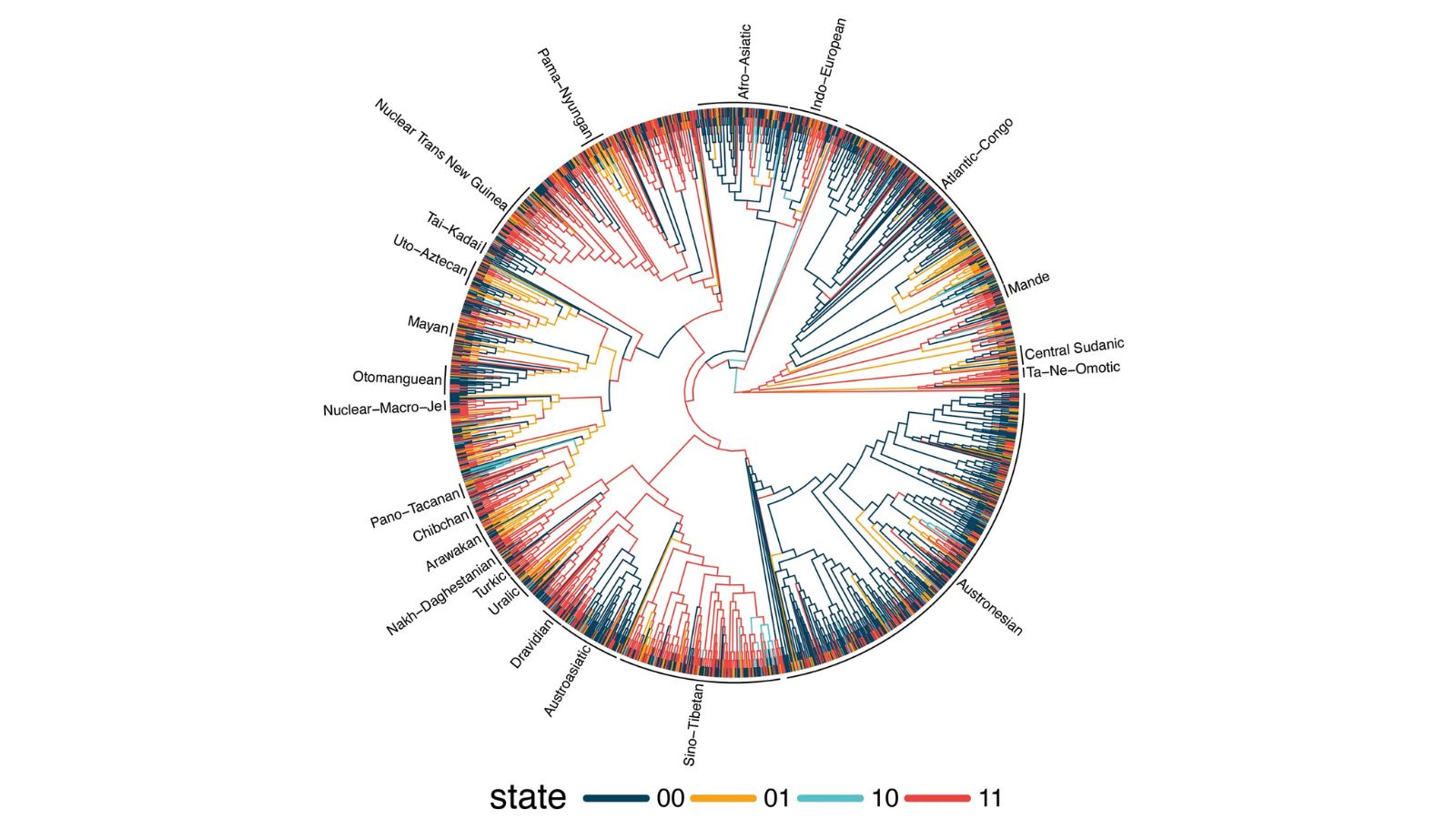
Post Content The data set included 1,700 languages worldwide and constituted one of the greatest attempts to prove or disprove the existence of common grammatical rules among diverse nations and regions. (Image: Max Planck Gesellschaft)
While languages spoken across the world vary greatly in terms of pronunciation and writing, it is clear from recent findings that there is method to this madness. After analysing more than 1,700 languages, researchers discovered that many of them have similar structures based on human psychology.
The findings challenge long-standing debates in linguistics and suggest that some “universal” grammar rules do, in fact, exist.
A global look at language
The study was carried out by an international team led by Annemarie Verkerk of Saarland University and Russell D. Gray of the Max Planck Institute for Evolutionary Anthropology in Germany. The scientists used Grambank, which holds records for the greatest number of grammatical features ever assembled in one data set, to study 191 linguistic universal candidates.
The data set included 1,700 languages worldwide and constituted one of the greatest attempts to prove or disprove the existence of common grammatical rules among diverse nations and regions.
Also read | Pen, paper and brain: Why writing by hand still matters in the age of screens
Traditionally, linguists attempted to minimise potential bias by including only those languages from distant geographic locations since similar grammatical rules might be due to language proximity and historical heritage. Nevertheless, this approach had limitations. They did not eliminate the underlying interconnection between languages and could not adequately describe language development.
Approach to language evolution study
The researchers employed Bayesian spatio-phylogenetic analysis to tackle these problems. With this technique, scientists can account for both the common ancestry of languages and their geographic origin, thus obtaining unbiased results.
Through this method, the scientists determined that nearly one-third of the linguistic universals are backed up by solid statistical proof. In other words, even though not all the rules are true, a considerable number of them indeed are.
Story continues below this ad
Another interesting finding made by the scientists is that languages develop through patterns, not chaos.
“In the face of huge linguistic diversity, it is intriguing to find that languages don’t evolve at random,” Verkerk was quoted as saying by the website of Max Planck Gesellschaft, or the Max Planck Society. “I am delighted that the different types of analyses we did converged on very similar results, suggesting that language change must be a central component in explaining universals.”
The study highlights recurring patterns such as word order — for example, whether verbs come before or after objects — and how grammatical relationships are structured within sentences. These similarities have reappeared time after time in languages that belong to totally unrelated language families and are used in entirely separate geographical areas.
What makes this happen?
This kind of recurring phenomenon implies that something else must be driving this development. According to the scientists, similar human cognitive processes and communicative needs could affect the evolution of languages.
Story continues below this ad
Also Read: Brain freeze: the science behind the sudden cold shock
Gray explained the team’s perspective on the finding. “We discussed whether to write this up as a glass-half-empty paper —’look how many proposed universals don’t hold’ — or a glass-half-full paper — ‘there’s robust statistical support for about a third’. In the end, we chose to highlight the patterns that evolve repeatedly, showing that shared cognitive and communicative pressures push languages towards a limited set of preferred grammatical solutions,” he was quoted as saying by the website.
Through determining what linguistic patterns prove consistent even through intensive scrutiny, this research contributes to the identification of areas that require further research while providing valuable information about human cognition’s impact on communication.
Even though languages keep developing and evolving, this research shows that they are still constrained by a universal characteristic of the human species, one that dictates how humans communicate with each other all over the world.
