

You know one of my bucket list wishes is to go see the Rio carnival in Brazil. Whenever I think about the Rio carnival, an array of bright colours take over my mind. There’s a vivid culture and an exuberant participating crowd where every individual mingles and conspicuously stands out in glory. Think about any other carnival you know. This fundamental attitude and evocation is similar and universal. Hence, why it is quite thought-provoking to sit down and understand its characteristics and look at the larger meaning it entails.
Carnival + esque
No, not the carnival but everything carnival — the carnivalesque! Carnivalesque is a succinct celebration of rebellion and spectacle. The word was coined by Russian philosopher Mikhail Bakhtin (who was also a lover of parodies) and the concept developed in his book Rabelais and His World. The concept of the carnivalesque had a profound impact on literature and the way many literary works were understood. Bakhtin looked at writings that featured carnivalesque themes as well as looked at writings whose form embodied the carnivalesque to acquire knowledge for the concept.
Rabelais and His World by Mikhail Bakhtin was published in 1965. Here, he explores humour and folk culture of the Middle Ages, sources which encouraged and inspired the French renaissance writer, François Rabelais. The Middle Ages was also an age when carnivals flourished.
“The Fight Between Carnival and Lent” by Pieter Brueghel the Elder.
| Photo Credit:
Wikimedia Commons
Subversion and Rebellion
Simply put, carnivalesque means subverting the dominant norms or authority. In a carnival, the so-called ‘normal’ social hierarchies are suspended. Let me give you a simple example. It is not everyday we see people wearing clown costumes or a dress with structured wings on the road. We may see it once in a blue moon but for the ‘normal’ society, it is more often than not, a subject of ridicule or abnormality, unless a situation warrants it.
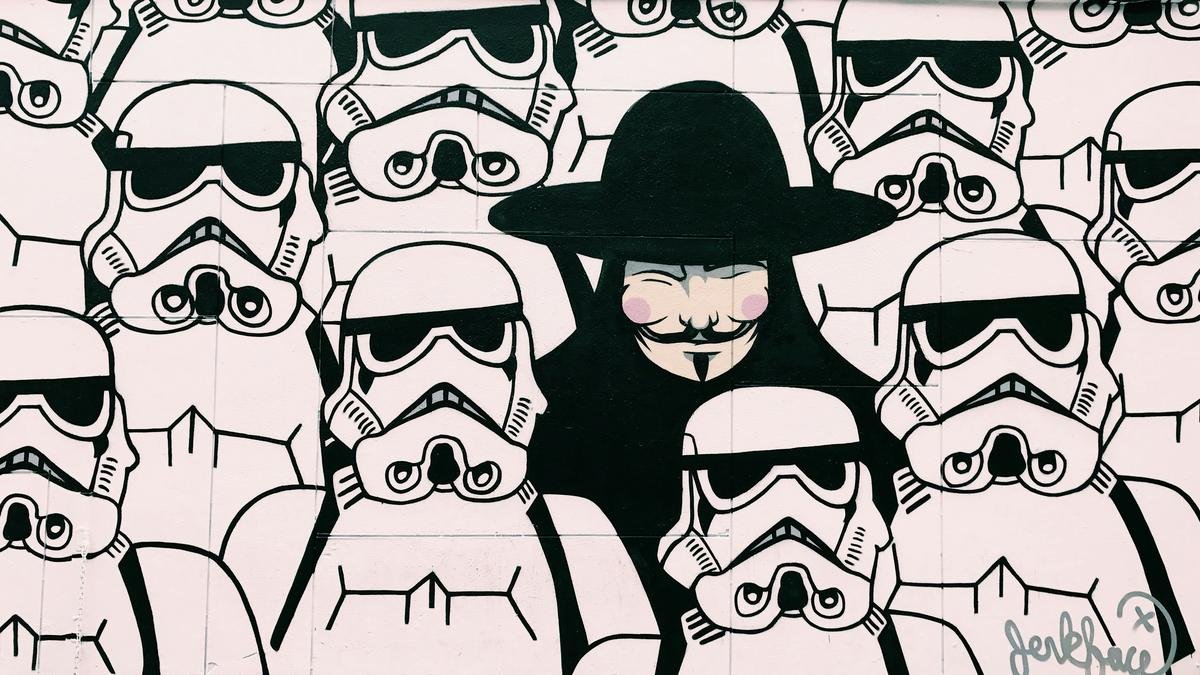
Take a look at the interesting picture on top which borrows two iconic characters from two iconic films — V for Vendetta and Star Wars. There is one ‘odd’ guy out there among the loyal crowd of stormtroopers (stormtroopers are loyal, enforcers to their fictional dictatorial government, the Empire). That is V, the masked vigilante who, in his filmic world, seeks to inspire rebellion against his fictional dictatorial government, Norsefire. Visually, when we look at this picture, the figure of the smiling V (his smile feels to us as if he’s mocking the authority that controls the others) stands out to us, yet, all of the people in the picture are masked characters.
Did you know?
Masks, a crucial feature of the carnival, have been historically worn to mock society.
Grotesque and Spectacle
What originally was an analysis of writings, people realised that the elements of the carnivalesque could be spotted in our reality, in worlds outside of the book. Take Star Wars and V for Vendetta again. Both these films involve elements of the carnivalesque such as ‘grotesque’ and ‘spectacle’. And this reveals within the film, the effective existence of a dialogue between the authority and the others which oftentimes we see as one-sided in real life. That’s what precisely makes carnivalesque so great; questioning and levelling of social power structures through wit and geniality!
Cookie Info!
GROTESQUE is an exaggeration of the human bodies (eg: wearing masks and costumes that look unreal) as well as an inversion of social norms.
SUBVERSION is the act of changing something to the opposite ,i.e., damaging the power of an established system or government.
SPECTACLE in carnivalesque is any striking performance or display which allows the subversion of traditional ideas, rules, and hierarchies (eg: a jester becomes a king).
Published – March 23, 2026 10:00 am IST
Read Comments
Copy link
Telegram
SEE ALL
Remove
Related stories
What is Avant-Garde thinking?
Related Topics
In School
/
history
/
culture (general)
/
arts, culture and entertainment
/
literary greats
/
books and literature
/
society
