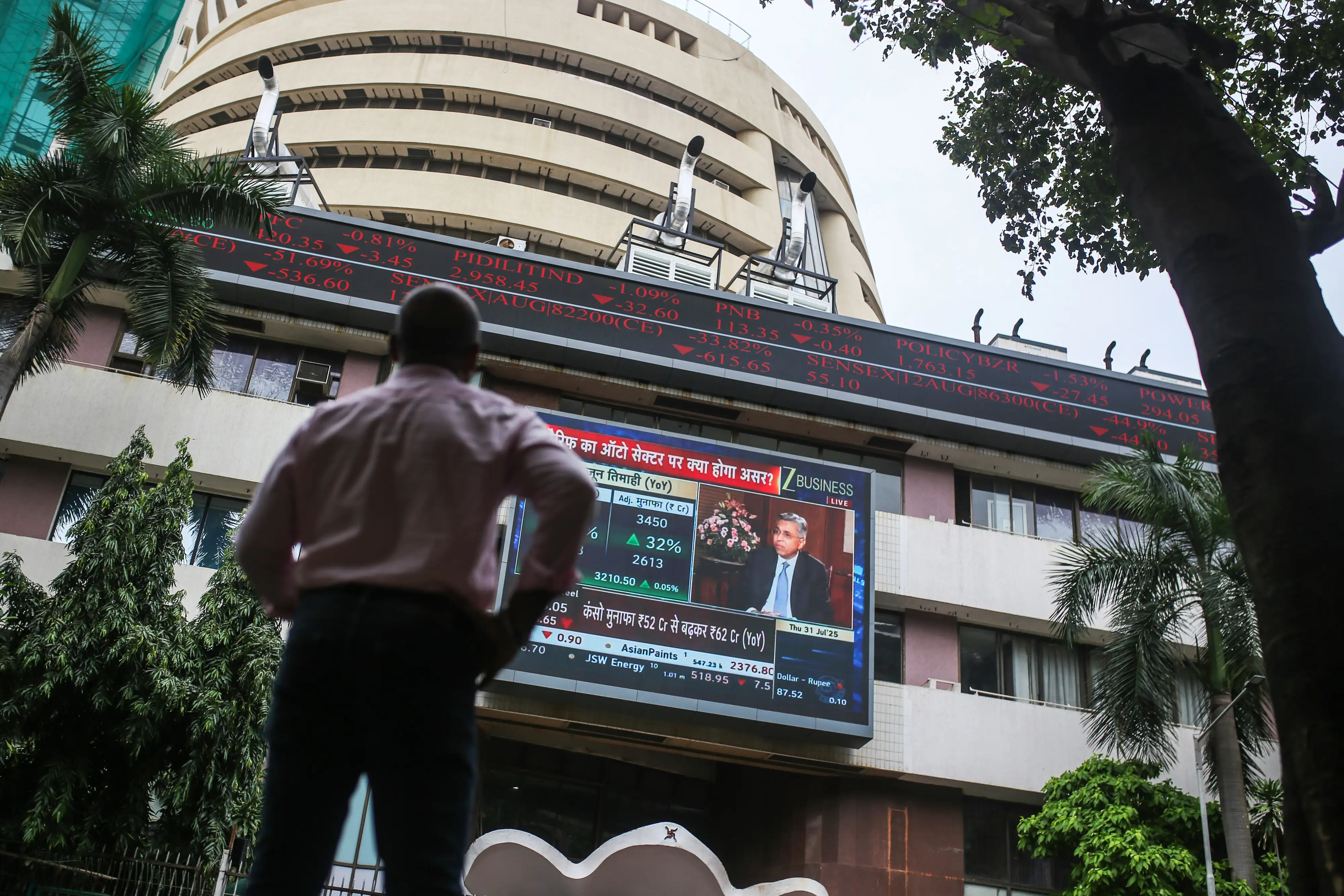


Benchmark indices Sensex and Nifty came under heavy selling pressure on Tuesday, wiping out nearly Rs 5.77 lakh crore in investor wealth as the market capitalisation of BSE-listed companies fell to around Rs 474 lakh crore. Weak global cues such as a massive crash in Kospi and a sharp selloff in technology stocks weighed on sentiment.
The Sensex ended 893 points lower at 76,200, meanwhile, Nifty 50 index dropped 279 points, slipping below the 23,850 level. Infosys, TCS, Tata Steel, BEL and Adani Ports were among the biggest losers on the BSE, falling as much as 3.5% in afternoon trade.
Here are the key factors behind the market decline:
South Korea's benchmark Kospi index witnessed a steep selloff on Tuesday after recently scaling record highs. Investors rushed to book profits in semiconductor heavyweights amid concerns that valuations had become stretched following the market's strong rally. The Kospi slumped as much as 10%, with SK Hynix falling over 12% and Samsung Electronics dropping nearly 13%. The Korea Exchange halted trading for 20 minutes after market-wide circuit breakers were triggered.
The correction comes after the index had surged to fresh all-time highs earlier this month and crossed the 9,000 mark for the first time, as investors looked past uncertainties related to the Iran conflict. Sentiment toward technology stocks weakened further after losses in U.S. tech names during Monday's session, with investor focus now turning to Micron Technology's quarterly earnings due later this week.
2.) US Fed rate hike fears
Higher oil prices emanating from the Middle East conflict have renewed concerns about inflation, strengthening expectations that interest rates could remain elevated.
Bank of America has flipped its interest-rate outlook for 2026 and now expects the US Federal Reserve to deliver three rate hikes this year, compared with its forecast of no change as recently as last week.
The brokerage now projects a total of 75 basis points of tightening across September, October and December, which would take the benchmark policy rate to the 4.25%-4.50% range. The sharp shift in expectations comes amid resilient labour market data and persistently elevated inflation.
Higher interest rates in the US can potentially lead to foreign outflows from the Indian capital market as higher yields across US treasuries offer attractive returns for foreign investors. Higher bond yields in the US also reduce the attractiveness of Indian bonds for foreign investors.
3.) IT stocks selloff resume
After a brief respite on Monday following last week's sharp selloff, IT stocks came under renewed pressure on Tuesday, with TCS, Infosys, Wipro and HCLTech falling at least 3.5% each amid mounting concerns over AI-led disruption and slowing technology spending. Nifty IT index closed over 2% lower.
The latest round of selling was triggered after Accenture trimmed the upper end of its annual revenue growth guidance, reviving worries about weak discretionary spending by global enterprises. While investments in areas such as artificial intelligence and cybersecurity remain resilient, companies continue to hold back on broader IT consulting and digital transformation projects.
Accenture's commentary has added to investor concerns that demand recovery may take longer than expected. The outlook is particularly significant for Indian IT firms, which generate a large share of their revenue from North America and often compete with Accenture for major digital transformation contracts.
The Indian rupee ended slightly lower on Tuesday as shifting expectations around US interest rates lifted the dollar to a one-year high against a basket of major currencies, weighing on Asian currencies and dampening sentiment in global equity markets. The domestic currency settled at 94.7350 against the US dollar, down 0.1% from its previous close of 94.6775.
Ponmudi R, CEO of Enrich Money said immediate resistance for the rupee is seen in the 94.70-94.75 range. A sustained move above this level could weaken the currency further towards 94.80-94.85 against the US dollar.
On the downside, a break below 94.50 may pave the way for a move towards the 94.20-94.30 zone, which had earlier acted as a key long-term support level and is yet to be retested. The near-term outlook remains cautious as the rupee trades close to important technical levels, with geopolitical developments, dollar demand and domestic policy factors likely to influence direction.
The Nifty has ended higher in six of the last eight trading sessions, aided by easing geopolitical tensions following progress on a US-Iran peace agreement and the resulting decline in crude oil prices.
However, caution persists among market participants. Analysts note that despite the recent correction in oil prices, a full restoration of shipping through the Strait of Hormuz is likely to be a gradual and complex process. It will require coordinated movement of vessels, the restart of oil production facilities, infrastructure repairs and agreement on de-mining operations. In addition, some shipowners remain reluctant to fully resume operations in the strait and the broader Persian Gulf region.
Experts also point out that global oil inventories were drawn down during the prolonged disruption to Hormuz shipping routes and may take time to replenish. As a result, stockpiles could continue to decline before additional Gulf crude supplies begin reaching global markets in meaningful volumes.
From a technical perspective, the 24,100–24,000 region now becomes the immediate resistance zone. A sustained move above this band will be required to revive bullish momentum and improve the near-term outlook. A decisive breakout above 24,000 could open the door for a recovery towards the 24,200 region.
On the downside, the 23,800 level remains the immediate and crucial support. Holding above this zone will be essential to prevent further weakness and preserve the broader recovery structure. However, a decisive break below 23,800 could trigger fresh selling pressure and accelerate the decline towards the 23,600 support zone.