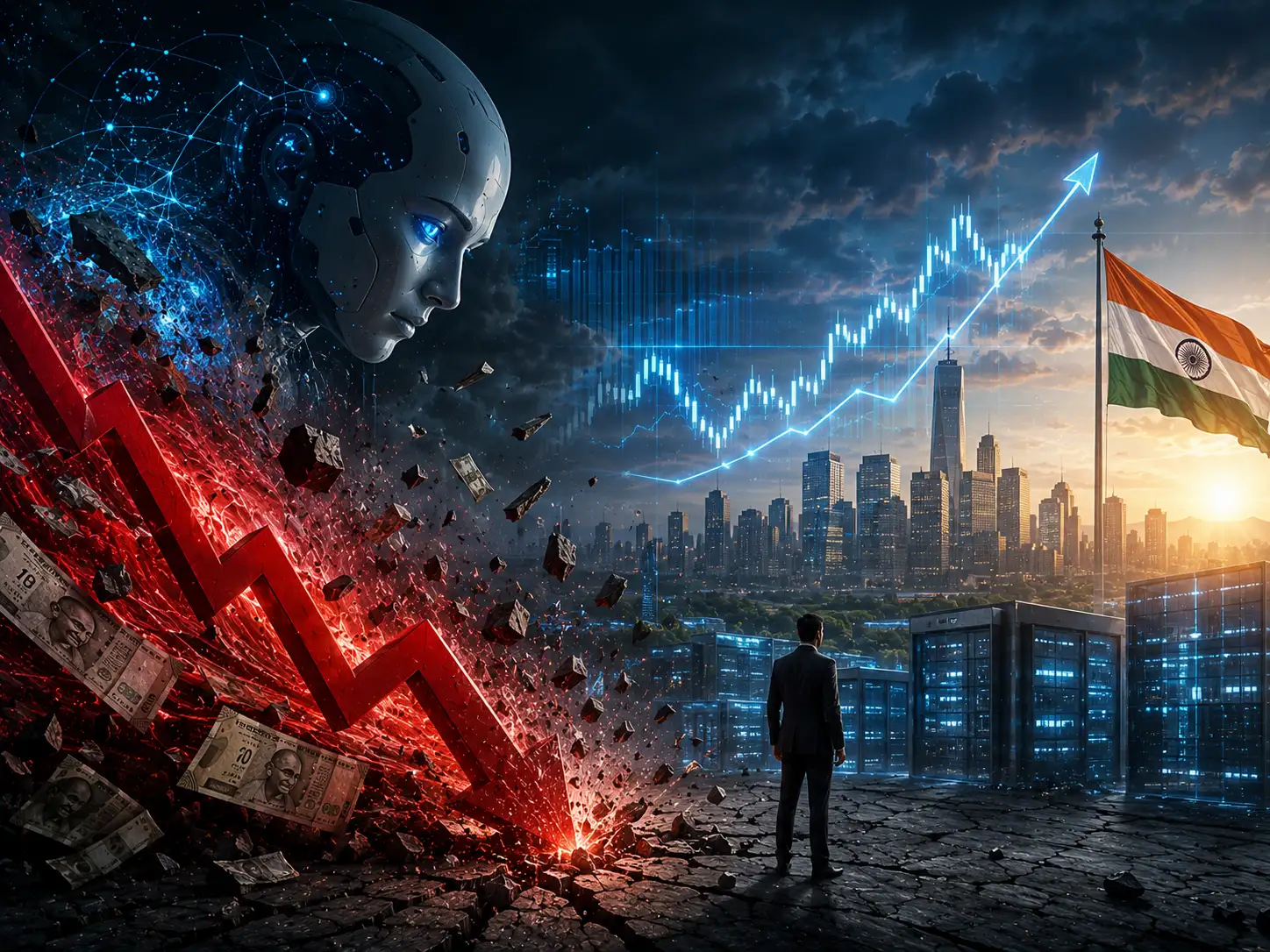
Are fears around artificial intelligence finally turning into reality? A brutal technology selloff in recent sessions has rattled global markets and shaken investor confidence in what is widely seen as the most compelling investment theme. AI and semiconductor stocks, the undisputed market darlings of 2025 and 2026, have suddenly come under pressure as concerns grow that the rally may have run ahead of fundamentals.
The pain has been especially visible in markets most exposed to the AI supply chain like Korea, whose benchmark Kospi has declined 14% from its recent record high in just 3 sessions. Yet on the other side of the spectrum sits India, a market often criticised for its limited exposure to the semiconductor and AI manufacturing cycle.
Nifty has delivered a zero percent return this year as several of its heavyweight constituents have come under sustained pressure from global investors. Among the biggest casualties has been the information technology sector. Shares of TCS, Infosys, Wipro, HCL Tech and other IT services companies have plunged as much as 30-35% in 2026.
Foreign investors have pulled nearly $24 billion from Indian equities so far this year, redirecting capital toward East Asia's technology manufacturing hubs. Off this chunk, FIIs have pulled a whopping Rs 60,000 crore from IT stocks in 2026. Taiwan and South Korea have cruised past India and are now valued higher than the Indian stock market. Further, India’s weight in the MSCI Emerging Markets Index has fallen sharply to about 12% from 19% last year.
Will AI unwinding change the script?
Among the most optimistic voices is Nuvama Institutional Equities. In a recent report, the brokerage invoked Mark Twain's famous observation that "reports of my death are greatly exaggerated" to make the case that Indian IT is not heading toward extinction but is instead setting up for a significant recovery.
Nuvama argues that the industry finds itself at a familiar crossroads. Just as concerns surfaced during the Y2K transition, the rise of remote infrastructure management and the digital transformation wave between 2015 and 2018, Gen-AI is now being portrayed as an existential threat to the offshore services model.
The brokerage disagrees. "We see no existential threat from Gen-AI," Nuvama said, arguing that enterprises will continue to require system integrators to customise plug-and-play AI and software tools for complex legacy technology environments. More importantly, companies will still need partners willing to take responsibility when mission-critical systems fail.
Nuvama attributes the sharper selloff to a combination of more disruptive technology and the growing presence of hedge funds and high-frequency trading strategies, which have amplified market swings. The result, it says, is that valuations have fallen to highly attractive levels, with large-cap IT stocks trading close to their lowest multiples in 15 years and mid-cap companies approaching near-bottom 1x PEG valuations.
Against this backdrop, the brokerage has upgraded all 10 leading IT services companies under its coverage to "Buy". The list includes TCS, Infosys, HCL Tech, Wipro, Tech Mahindra, LTIMindtree, Coforge, Persistent Systems, Mphasis and Hexaware.
Its broader thesis is that the industry is transitioning from a phase of short-term AI-driven revenue deflation to a much larger long-term opportunity. Nuvama estimates the AI services market could be worth between $300 billion and $400 billion by 2030 and believes investors "would make handsome returns in any/all of these stocks from current levels."
Is SaaSpocalypse real?
Earlier this year, the term "SaaSpocalypse" gained traction across markets, capturing fears that artificial intelligence could disrupt the traditional software business model. Jefferies was among the first brokerages to popularise the phrase, highlighting how investor sentiment had rapidly shifted from "AI helps these companies" to "AI replaces these companies."
However, not everyone is convinced that scenario is playing out. Just days ago, Hong Kong-based CLSA revisited the debate and questioned whether the fears were justified. The brokerage acknowledged that AI is pushing software companies away from traditional seat-based pricing models toward consumption-based structures. Yet despite those changes, it noted that earnings estimates and management guidance across the sector remain remarkably resilient.
CLSA believes IT services firms with strong relationships with software providers remain well positioned to benefit from continued demand for product engineering and implementation services.
Systems of Record, or SoR platforms, appear less vulnerable because they require deterministic outputs, while AI models are inherently probabilistic and may generate different responses to the same query. Rather than replacing these platforms, CLSA argues AI is more likely to sit on top of them as an additional interface layer.
"Most SaaS players we analysed have either maintained or increased their revenue and margin guidance for the upcoming fiscal year and beaten consensus EPS expectations in the latest reported quarter. This implies no negative impact of AI visible yet," CLSA said in a note.
Aishvarya Dadheech, Founder and Chief Investment Officer at Fident Asset Management, shares a similar view. "AI is just a new product being introduced, much like SAP was one day. The reason the market reacted this quickly is because AI can move that quickly. However, we have always believed and continue to believe that IT will play a very important role in enterprise adoption, and the data so far has done nothing to change that view," Dadheech told ETMarkets.
According to him, large enterprises remain far from ready to deploy AI at a structural level, creating a significant opportunity for system integrators. Dadheech, however, cautioned that calling it a clean reversal is premature.
He argues that investors will need evidence in the form of sustained constant-currency revenue growth or clear signs of total addressable market expansion before the sector receives a meaningful re-rating. "What has changed is that the doomsday framing is being questioned more seriously, and valuations have corrected enough that the risk-reward has shifted in favour of IT."
For a sector that has repeatedly faced predictions of irrelevance over the past three decades, the latest AI scare may yet prove to be another chapter rather than the final one. As the AI debate continues to evolve, the outlook for Indian IT remains closely tied to how enterprises adopt the technology. For now, investors appear divided between disruption risks and emerging growth opportunities.