

Post Content
When someone recently asked me why I don’t take my own photographs, I didn’t have an answer. Honestly, I just don’t know. I am not an actor, nor do I wish to be an influencer who enjoys being in front of the camera. I would rather be behind the camera, capturing everyday moments that I love to do. It’s one of the perks of being a tech journalist: travelling the world, meeting new people, and experiencing different cultures. And, most importantly, testing new gear ahead of anyone else.
I hear it…those who keep pushing me to be on Instagram but it’s not going to happen, ever. Still, I promise you this: I would love to show how I see the world through my lens in private whenever you are around over a cup of coffee. I have over 2TB of photos that I have captured on my phone over the years.
This reminds me of the Xiaomi 17 Ultra, the “Leica phone”, as I like to call it, which travelled with me to four cities around the world: San Francisco, London, Los Angeles, and New York over the last few days or so. (And don’t ask me where I am headed next.)
The Xiaomi 17 Ultra is a fascinating device, which I feel is a cross between a smartphone and a camera. It’s not the first time I have used a smartphone that has the soul of a camera, but this device feels mature to the point where you begin to believe the phone can morph into a professional camera.
My review of the Xiaomi 17 Ultra.
What: Xiaomi 17 Ultra| Price: Rs 1,39,999
Disclaimer: Xiaomi sent me a loaned unit of the Xiaomi 17 Ultra along with the Photography Kit Pro, which costs an additional Rs 19,990. If you opt for both the device and the kit, the total cost of ownership comes to Rs 159,989.
Designed like a real camera
Since my primary phone these days is the iPhone Air, using the Xiaomi 17 Ultra was a completely different experience. In fact, the two phones differ not only in terms of design but also in overall usability.
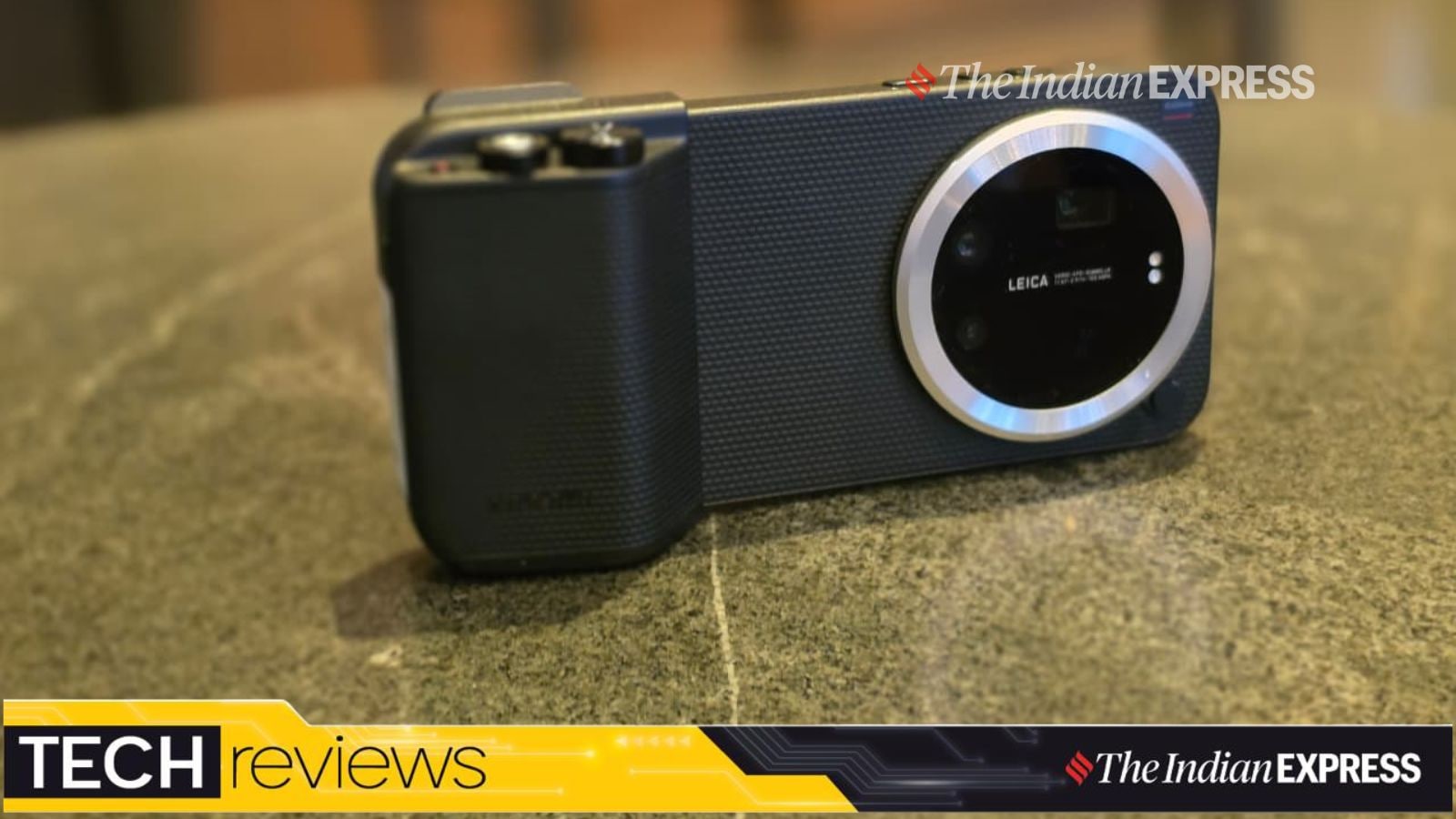
The kit also includes a camera grip with traditional controls, including a shutter button and exposure dial. (Image credit: Anuj Bhatia/Indian Express)
The 17 Ultra looks and feels like a Xiaomi flagship, a design I have seen across high-end phones from Chinese manufacturers. It’s thicker, with an aluminium frame, flat front and back glass panels, and a Nokia Lumia 1020–like circular camera design. There is definitely heft when you hold the device, and at times it feels like you are holding a real camera. Yes, the camera module is huge, as you may have noticed in the pictures by now.
Story continues below this ad
Also Read | Samsung Galaxy S26 Ultra Review: A step toward ‘intelligent’ smartphones
I feel there’s an attempt to make the 17 Ultra resemble a Leica camera–not exactly, but Xiaomi has added physical buttons to the phone. For instance, the volume buttons on the side are round (actually pill shaped) and etched with “+” and “−” markings, reminding me of the circular volume keys on my iPhone 4s. However, the power button is a bit too small, though it’s not an issue for me. Xiaomi could have added a customisable camera button on the side, and since it’s a camera-focused phone, it would have made a lot of sense.
It features a large 50 MP 1.0″-type OV50X50 sensor with 1.6 µm pixels, produced by OmniVision and certified by Leica. (Image credit: Anuj Bhatia/Indian Express)
I must say the 17 Ultra doesn’t feel like a cheap device. While it’s not a small phone, it does feel a bit top-heavy. At 8.25 mm and 224 g, it’s not the thinnest or lightest phone out there, but I didn’t expect it to be like the iPhone Air or any other standard smartphone on the market. Thankfully, it has IP68/IP69 water and dust resistance, which adds to its durability against the elements.
The 17 Ultra has a single 200 MP telephoto camera with a vario 75-100 mm equivalent range. (Image credit: Anuj Bhatia/Indian Express)
One thing I would like to highlight is the optional photography accessory kit, which adds a camera grip and a filter mount. In addition, it comes with a two-stage shutter, a customisable dial to adjust EV, filters, ISO, shutter speed, or white balance, a zoom leveler, and a video button. Connected via Type-C, the grip can also serve as a power bank, housing a 2,000mAh battery. With the kit attached, the Xiaomi 17 Ultra can be held and used much like a compact camera. I loved it. Not only does it add character to the phone, but with the camera kit on, you feel the urge to take the 17 Ultra out for a spin in a new city, at least in my case, and capture whatever catches your eye.
A camera hardware show
The main reason you’re reading this review (if I were in your place, I would do the same) is because of the 17 Ultra’s camera. It features a large 50 MP 1.0″-type OV50X50 sensor with 1.6 µm pixels, produced by OmniVision and certified by Leica. It also comes with LOFIC HDR technology, which helps prevent overexposure in high-contrast scenes such as sunsets and fireworks.
Story continues below this ad
Inside, you will find Qualcomm’s flagship Snapdragon 8 Elite Gen 5 chipset. (Image credit: Anuj Bhatia/Indian Express)
There’s a new telephoto lens as well, featuring a world-first 200 MP 75–100mm mechanical optical zoom, allowing for lossless, zero-crop imaging across the entire focal range. To be clear, there’s only one telephoto lens this year that slides between 3.2X (75 mm) and 4.3X (100 mm) optical zoom. In addition, there’s a 50 MP ultra-wide camera with a 115° field of view and a Samsung JN5 sensor, which also supports 5 cm macro photography for close-ups.
But how does the camera perform?
The 1-inch sensor works like a dream and delivers superb results in a variety of situations, especially in low light. The camera captures sharp, detailed, and accurate photos. However, don’t expect the photos to be pitch-perfect. Because the renowned German camera maker is heavily involved here (I visited Leica headquarters a few years ago, and you can read about how Xiaomi and Leica collaborate on camera phones), the 17 Ultra’s shots have a style of their own, sometimes dramatic, sometimes slightly oversharpened.
The 17 Ultra offers two Leica modes: Authentic, which is slightly more contrasty, and Vibrant, which enhances colour saturation. (Image credit: Anuj Bhatia/Indian Express)
This is what makes the camera special and very different from iPhones and Samsung Galaxy phones. It’s a fun camera to use, and with the Leica name attached, I was expecting a versatile camera, which it certainly is. For instance, the 17 Ultra ships with two colour profiles: Leica Vibrant and Leica Authentic. Vibrant is the default mode, and I have used it for all my photos, but I prefer Leica Authentic. You also get a range of filter options to stylise your pictures after pressing the shutter.
The main camera features a 50MP 1-inch Light Fusion 1050L sensor with LOFIC HDR technology. (Image credit: Anuj Bhatia/Indian Express)
Let me say that the 17 Ultra’s camera heavily leans on its hardware. As a photographer, there’s a larger scope for trial and error, unlike when using an iPhone camera or any phone camera these days where software and AI often handle most of the image corrections.
Story continues below this ad
I can see that the 17 Ultra’s camera has massively improved at taking portrait shots, and the larger image sensor definitely helps. Skin tones and textures are accurate and realistic, something Xiaomi cameras have struggled with a lot in the past.Like a real camera, the 17 Ultra takes pictures that are slightly softer and don’t have perfect details–exactly how an actual camera works.
I noticed that at times the 17 Ultra overdoes colour saturation and leans towards underexposure in bright backlighting, resulting in pictures with lack shadows and overly high contrast. It also lacks a long zoom range, which other flagships offer. Video tops out at 8K/30fps, and I noticed that the 17 Ultra produces great-looking 4K footage. The front-facing lens, which has jumped from 32 MP to 50 MP, has also been upgraded.
Also Read | Want to upgrade to the iPhone 17 Pro Max? Read this review before you do
As I mentioned in the beginning, I took the 17 Ultra to four different cities and spent a lot of time with the camera. These camera samples you will see are straight out of the camera.
Xiaomi 17 Ultra camera sample. Image resized for webXiaomi 17 Ultra camera sample. Image resized for webXiaomi 17 Ultra camera sample. Image resized for webXiaomi 17 Ultra camera sample. Image resized for webXiaomi 17 Ultra camera sample. Image resized for webXiaomi 17 Ultra camera sample. Image resized for webXiaomi 17 Ultra camera sample. Image resized for webXiaomi 17 Ultra camera sample. Image resized for webXiaomi 17 Ultra camera sample. Image resized for web
Top-notch performance and battery life
The 17 Ultra has a 6.9-inch OLED display, and it’s a great panel, though not quite as excellent as the Samsung Galaxy S26 Ultra’s display. You still get a variable refresh rate (1 to 120 Hz), high peak brightness to keep it legible in direct sunlight, and eye-care dimming that makes it equally comfortable to use in a dark room.
Story continues below this ad
Inside, you will find Qualcomm’s flagship Snapdragon 8 Elite Gen 5 chipset, paired with 16 GB of LPDDR5X RAM and 512 GB or 1 TB of UFS 4.1 storage. Performance upgrades over Xiaomi’s previous flagship phones are evident, but the improvements aren’t game-changing, and most average users won’t even notice. The CPU is 20 per cent faster, and graphics performance is 23 per cent better. From running apps and taking photographs to gaming and watching movies, my experience with the 17 Ultra was completely smooth and error-free.
Connected via Type-C, the grip can also serve as a power bank. (Image credit: Anuj Bhatia/Indian Express)
The 17 Ultra packs a 6,000mAh battery made with silicon carbon, containing 16 per cent silicon, which helps with longevity and efficiency, now common in many newer Android smartphones. The battery life is great, but what really impressed me is how the phone supports fast charging. In fact, it can draw up to 100W through both Xiaomi’s proprietary charger and universal USB Power Delivery PPS chargers. Unfortunately, the phone still lacks Qi2 support.
The 17 Ultra has a large camera bump in the middle of the upper portion of the rear casing. (Image credit: Anuj Bhatia/Indian Express)
For me, Xiaomi’s custom HyperOS isn’t on par with iOS or the experience Google offers on Pixel phones, but it isn’t bad either. Sure, HyperOS sometimes mimics iOS, and I find the interface a bit too cartoonish. Oh, add bloatware on top. On the positive side, you can customise it to your taste. And generative AI features, though I doubt they’re as useful as some tech companies claim, are baked right into HyperOS 3.
Is the pricey Xiaomi 17 Ultra worth it?
So, is the Xiaomi 17 Ultra actually worth it–in terms of both money and what you get with a Leica-camera phone? In terms of value, there’s an argument to be made that it is. This device is designed to be a camera first and a smartphone second. The Xiaomi 17 Ultra is an expensive smartphone, and if you add the photography kit, the total cost increases.
Story continues below this ad
That said, the Xiaomi 17 Ultra genuinely intrigued me for what it can do right now–that is, being a terrific camera without venturing into the territory of promising features that aren’t there. Xiaomi has done a good job of bringing a taste of a Leica camera to those of us who can’t afford one, and the Leica collaboration doesn’t feel like it’s just in name. If you have the money for a photography-first phone, I would say go for it and at least give it a try. For average consumers, even those flush with cash, the 17 Ultra isn’t for you. It’s an enthusiast phone, and it should remain that way.
