
Number in a roll call, rank on a marksheet, biometric in a database, fine print in a ‘special Intensiverevision’. The system is designed to make you feel like a cockroach, scurrying around, fighting, surviving, one in 1.25 billion. Till you are one in 1.25 billion.
Saturday I became that – part of a mass thought to be as inconsequential as dust, as unnoticed as air that, to paraphrase Maya Angelou, rose; that, to paraphrase Faiz Ahmad Faiz, sent a throne up in the air like cotton.
When you live in Delhi, Jantar Mantar becomes a place you often hear about, most commonly in news reports, or notice while driving past, but seldom visit. Vaguely you know that it is an observatory, tracing the movement of the sun, moon, and planets. A generation that has the universe in the palm of its hands has even less time for it.
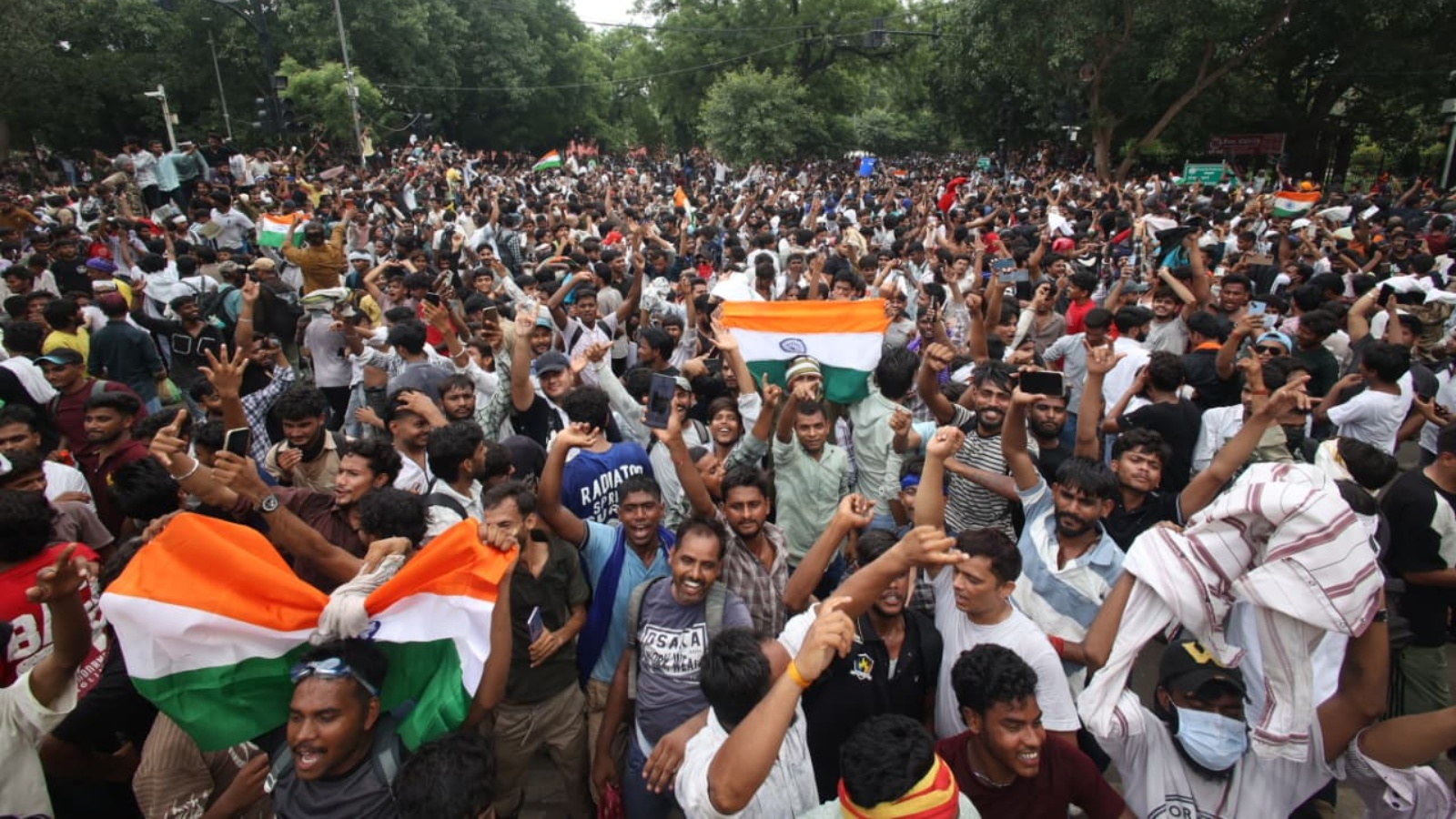
This past week changed that, as all roads in Delhi and from beyond led to Jantar Mantar, to mark presence at a protest that was launched by the Cockroach Janta Party but soon became, as one participant told me Saturday, “what you wanted it to be.” A protest for a fairer system, for a better life, for a responsive government, for the right not to play nice, for the chance to be good. And to do it together, across caste, class, religion, and gender — all the ways they told you it could not be done.
So I drop in too, after days of planning, a lot skeptical and not a little sheepish about my “protest tourism.” Hitching an autorickshaw to the Jantar Mantar road, past the teeming masses in Connaught Place heading the same way, it is hard not to feel there is something in the air.
I reach, and am overwhelmed: Who are these people clambering atop trees and barricades, raising slogans, holding up posters, making reels, and above all just laughing? Who are these girls holding their own – and alone – and standing out, not reflexively shrinking? Who are these youngsters not afraid to sweat out on the streets, or take on a few lathis? Where are those screens we thought they could not take their eyes away from? And who are these people just keen to help, with water, fans, food, even as sentiments swell and threaten to sweep away everything this protest has built?
A wave does come, and another, as next to the stage, a commotion seems to start from the other end of the lane. Scared people scamper, the word stampede crossing our collective minds. My panicked thoughts go to my daughter, with friends, on the other side of the protest. Then, suddenly, my husband and I are swamped by gas that fills our eyes, our nostrils, our throats, sucking the air around us, doubling us over.
This is it, I think. All the things that one should do when hit by tear gas slip away. Again come those helping hands, quickly ushering us and others into an alley, holding out water bottles to wash eyes and faces, telling us not to rub them. Seconds later, come other offers. Across a gate, volunteers hand out more bottles of water, along with masks to wear and to pass along.
Another round of tear gas goes off just then, and the gates open to let in those of us huddling around it. We are told to move quietly and swiftly; it is a church building. “You should not hang outside on the grounds… it’s too dangerous.” We stumble into the dark, collapse into pews, shifting to accommodate as more of us come in.
The sounds of the chaos outside drift in every time the doors open. The walls reverberate as another round of tear gas is fired. One, two, three…10, it is hard to understand what is happening. My husband and I look at one another, and the same thought is on our minds — this is too much like a bad story, where people hiding out in a building are easy targets for any group with violence on its mind.
We dial our phones furiously. We shout at our daughter to head home. “No, just because that side is calm does not mean it will stay that way. Leave, just go.” We next call up the son headed to the protest site, his third visit, this time to volunteer with the cleaning squad. “Scaring us is just what they want,” he argues. “No, just turn around, come another day,” I plead.
The volunteers, most of them the same age as the young protesters outside, tell us not to panic. To wait it out. “We have more water, snacks if you need.” A doctor steps up in case someone wants medical attention, four nurses are called from a building nearby, a youth who comes in breathless has his blood pressure taken.
Wait a few more minutes, just 30, just 20, just 10, the volunteers keep saying. Looking on, dazed still at having come closer to the might of the government than we ever have, gathered from across the country – Muzaffarnagar to Jamia Nagar – we are not going anywhere.
Then comes out a keyboard. “Who wants to sing?” asks a volunteer. One girl steps forward, then two. They start with “Hum honge kaamyab (We shall overcome),” and all join in, clapping. They build up to “Teri he zameen (Hey God, you are all there is),” and the line “Khudame re tu bakhsheesh kar” gets the loudest chorus in this house of Jesus.
One whisper suddenly breaks through the sound: “Has the resignation come?” A query if anyone from the media is around stops with me. I place a call, the person doesn’t know. Then I get a reply from another: yes, it has happened. As I turn around to deliver the news, there is a cry of joy, spontaneous slogans of “Inquilab Zindabad!”
The volunteers urge us to maintain the sanctity of the place, and no one questions it. The walls are again reverberating, this time with cheers and music. As we stream out finally, from the back door, into a day that is suddenly sunny, we hear what they are saying: “Krantiaa gayi (The revolution is here)!”