

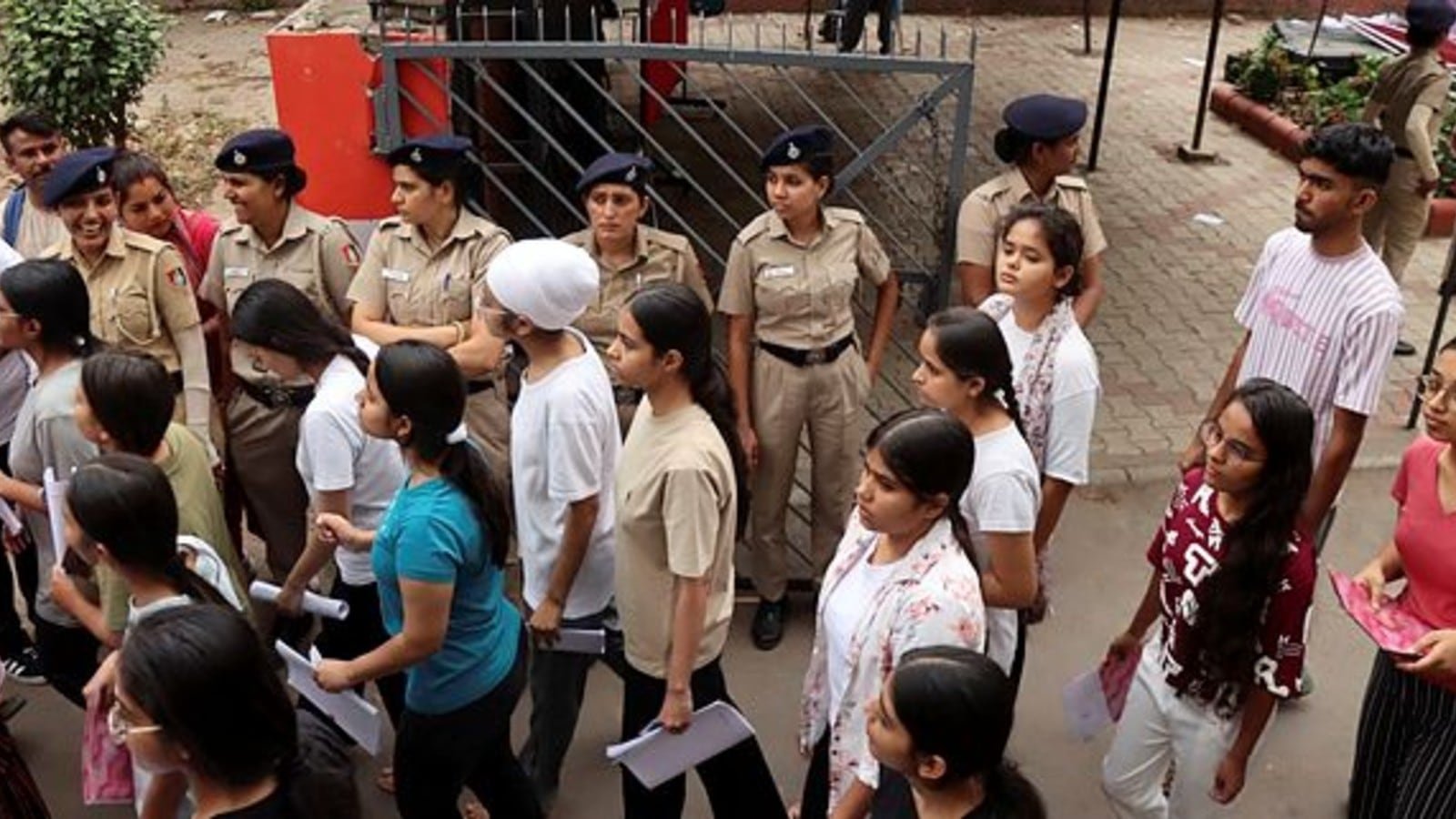
JEE Main, NEET UG and CUET dates released (Express Photo by Kamleshwar Singh/ representative))
Rajasthan’s Special Operations Group (SOG) has said that it is investigating the National Eligibility-cum-Entrance Test (NEET-UG) 2026, for an alleged leak after it found a ‘guess paper’ with as many as 120 questions, which appeared in the actual examination.
Addressing journalists in Jaipur, Vishal Bansal, ADGP, SOG, said, “There are various misconceptions regarding the NEET exam. There is a ‘guess paper’ with 410 questions. Of those 410 questions, it is said that about 120 questions appeared in chemistry. And this guess paper was with students weeks before the examination, as far back as a month.”
He said that the inquiry so far hasn’t revealed where the question paper originated from, and added that it has been found on WhatsApp on the phones of students appearing for the examination. “It is a PDF file of about 150 pages with over 400 questions. We are moving step by step – it is a laborious and painful process. All (SOG) officials are involved in this.”
ALSO READ | Rajasthan NEET UG 2026 irregularities: NTA says exam held under strict security, probe underway
He said that since it was in the public domain, it isn’t easy to zero in on the source. “For example, if someone got it photocopied at an e-mitra, then the e-mitra owner shared it with someone else, and so on. So, our investigation is centered on whether there was cheating or if a crime was committed,” Bansal said, adding that questioning includes a person from Dehradun.
Bansal said that typically, a paper leak is secretive in nature, unlike the present case. “If I share the question paper in public domain (as a paper leak mastermind), then I personally won’t stand to benefit,” he said, adding that paper leak mafia, “which works hard”, would have obtained the question paper before the examination and made the students read it the night before the exam, or on the morning of the exam, without actually sharing it with any students.
He said that if there was indeed cheating involved in the case, then it would be investigated to prevent a repeat in the future.
Story continues below this ad
The National Testing Agency, meanwhile, said that it “remains committed to fair, secure, and credible examinations and to working closely with all investigating agencies in support of the integrity of the examination system”.
“NTA is conscious of the anxiety reports of this nature can cause, and we ask candidates to allow the agencies the space to complete their work. Any necessary steps will be taken in consultation with the Ministry of Education at the appropriate stage. To the candidates of NEET (UG) 2026 and their families: the effort and integrity of the very large majority of bona-fide aspirants is not in question, and will not be devalued,” it said.
“The matter is presently under investigation, and the agencies will establish the facts in due course. NTA will not pre-judge the inquiry, nor characterise its likely outcome. Whatever the agencies determine — including findings that may require further action — will be examined transparently and disclosed in keeping with established procedure,” the NTA said in a statement.
It said that on the late evening of May 7, 2026, four days after the examination, it received inputs concerning alleged malpractice activity around the examination. “These inputs were escalated by NTA to central agencies on the morning of May 8 for independent verification and necessary action. The action subsequently undertaken by the law enforcement agencies, including the detentions reported in the media over recent days, is the result of their professional and timely work,” it said.
Story continues below this ad
Reassuring aspirants and their families about its stringent security measures, the NTA said that the May 3 examination was conducted “under a full security protocol”. “Question papers were transported in GPS-tracked vehicles bearing unique, traceable watermark identifiers. Examination halls operated under AI-assisted CCTV monitoring from a central control room, with biometric verification of every candidate and 5G jammers in operation. The examination process itself proceeded as planned across all centres on the day,” it said.
