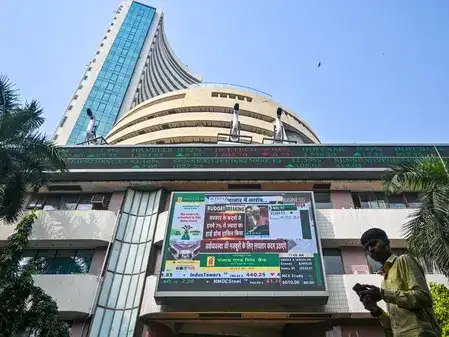


After a wild, multi-year round trip that saw the Nifty 50 peak near 26,277 in late September 2024, tumble on global tariff shocks, recover to 26,373 in January 2026, and slide back to 24,000 zone amid US-Israel-Iran conflict fears, long-term investors find themselves sitting on flat-to-negative returns over a two-year horizon. After a round trip of two years, Nifty is back to where it was in June-end 2024.
But before panic sets in, let’s check the history books. Every comparable episode in which Nifty delivered near-zero returns over a two-year stretch was followed by meaningful recovery. Across eleven such periods since 2001, one-year post-stagnation returns ranged from 5% to 50%, shows data by Edelweiss Mutual Fund.
After a similar stagnation from June 2001–June 2003, the next one-year return was 33%, three-year CAGR hit 40%. The July 2018–July 2020 stagnation delivered 42% in the following year. The August 2018–August 2020 period, which overlapped with Covid, saw 50% in the subsequent twelve months.
There is not a single instance in this dataset where a two-year flat period was followed by further prolonged stagnation.
Also Read |Missed the FII U-turn? 6 stocks turned multibagger after foreign investors corrected their mistake
The best days come in the worst times
The data on individual trading days makes the timing risk of sitting out even more stark. Approximately 96% of the Nifty's top 30 best single trading days across the past two decades occurred during periods of acute crisis — the 2006 FII and DII selloff (30% fall), the 2008 global financial crisis (60% fall), and the 2020 Covid pandemic (40% fall). Twenty-two of the top 30 best days came during the 2008 collapse alone.
In 2020, the Nifty bottomed in March, even as India's Covid case count was still climbing sharply. By the time the outbreak peaked and sentiment felt safe, the recovery was already well underway. This cycle may follow the same script: by the time geopolitical tensions fully ease, oil stabilises and the macro feels comfortable again, markets may have already found their floor.
Also Read | Rs 1,100 crore a day nightmare: Why FIIs are ruthlessly selling bank stocks
Valuations attractive?
The two-year stagnation has done what it was supposed to do: compress valuations back toward reason. Large caps on a one-year forward P/E now trade at 17x, below their seven-year average of 18.8x. The index sits at roughly a 16% discount to its own history, the widest gap across market-cap segments. Nearly 44% of large-cap stocks trade below their 10-year median valuation; in small caps, that figure rises to 53%.
Globally, the relative story has also shifted. The MSCI India premium to emerging markets stands at approximately 24%, against a 15-year average of roughly 56%. Against MSCI World, India now trades at a 5% discount, compared to a historical average premium of 17%. For foreign institutional investors scanning for re-entry points, India's relative attractiveness has arguably not looked this compelling in years.
Entry valuation, the historical data confirms, matters most in the short run. Nifty data going back to 2000 shows that starting PEs in the 15-18x band, where largecaps now sit, have generated average one-year returns of 18.6% and average three-year CAGRs of 14.8%. Across ten-year holding periods, returns from every starting valuation band converge to roughly 10-15% CAGR regardless of entry point.
Earnings downgrade cycle appears to have bottomed
The earnings picture has also inflected. Nifty 50 median EPS growth was stuck at roughly 9-10% through FY25 and FY26. Forward estimates now pencil in 14.3% for FY27 and 16.5% for FY28. Midcap and smallcap estimates are even more aggressive — 21.6% and 24.8% respectively for FY27.
The quarter-by-quarter data confirms the turn. Positive earnings surprises across Nifty companies rose to approximately 48% in Q4 FY26, up from just 32% in Q3 FY26, with the recovery broadening across Energy, Financials, IT, Materials and Consumer Discretionary. Consumer Discretionary went from -23% earnings growth in Q4 FY25 to +18% by Q4 FY26. IT swung from 2% to 13% over the same span.
Comparisons to the 2013 taper tantrum, the last time India markets took a prolonged beating amid currency pressure and foreign outflows, do not hold up on the fundamentals. In FY13-14, India was contending with near-double-digit inflation, a current account deficit of roughly 5% of GDP, deeply negative real rates, bank NPAs of around 9% and heavily leveraged corporates.
Today the picture is materially different. Headline inflation in FY26 came in at 1.9%. The current account deficit is a contained 0.8% of GDP. Real rates are firmly positive. Bank NPAs have compressed to approximately 2.5%. Corporate debt-to-GDP has fallen to roughly 52% from 75% in the pre-crisis FY13 year. FX reserves cover approximately 10.6 months of imports, up from 7 months in FY13.
The rupee's drawdown has also been relatively contained at about 7%, from approximately Rs 89.9 to Rs 96.8 per dollar against depreciations of 15-23% in the 2008, 2011, 2013 and 2018 episodes. Following prior currency-weakness lows, the Nifty 50 TRI rebounded with one-year gains ranging from 11% to 96%.
New pressure points do exist and warrant monitoring: public debt has risen to approximately 85% of GDP, household debt has climbed to about 46%, the capital-account surplus is thinner, and the net forward FX position is larger. But these represent a different and milder risk profile than the twin-deficit-plus-inflation fragility that defined 2013.
It is against this backdrop that market opinion has split.
"Valuations in the large cap space have come down quite a bit and now we believe it could be a good entry point for investors with a medium-term horizon as earnings outlook is improving and investor concerns subside," said Sandeep Bagla, CEO of TRUST Mutual Fund.
Vinod Karki of ICICI Securities frames the oil-price dynamic as an additional tailwind. "Oil prices and Nifty 50 have an inverse correlation above the $90-100 per barrel mark, and the current slump in prices is a potential positive for Indian equities given that the external sector situation will likely improve as the oil import bill recedes," he said.
Karki adds that with valuations having pulled back from peak levels and nominal profit growth showing vigour alongside an improving capex cycle, the current setup offers a high-probability scenario of stock prices tracking accelerating nominal growth of 14-15% — even without any valuation re-rating.
Not all strategists are ready to turn constructive. Nuvama is notably more guarded, arguing that while the supply-side oil shock is fading, demand risks are now building. The GST cut tailwind is fading on a year-on-year basis. El Niño threatens farm output and rural consumption. Income and credit multipliers remain weak across households, corporates and government. "As tax cut effect fades, El Niño has emerged while incomes and credit multipliers are weak," the brokerage noted, expecting further consensus earnings downgrades against what it views as an optimistic 19% FY27 PAT growth forecast for BSE500 companies.
Nuvama also flags that India's valuations, while compressed relative to history, remain elevated in absolute terms — market cap to GDP at approximately 130% versus a 10-year average of 100%, and median trailing P/E at 30x versus a 10-year average of 25x. The brokerage expects markets to remain range-bound and advocates overweighting defensives like IT, private banks, consumer staples along with cement and chemicals, while underweighting cyclicals and autos where rich valuations meet growing demand uncertainty.