
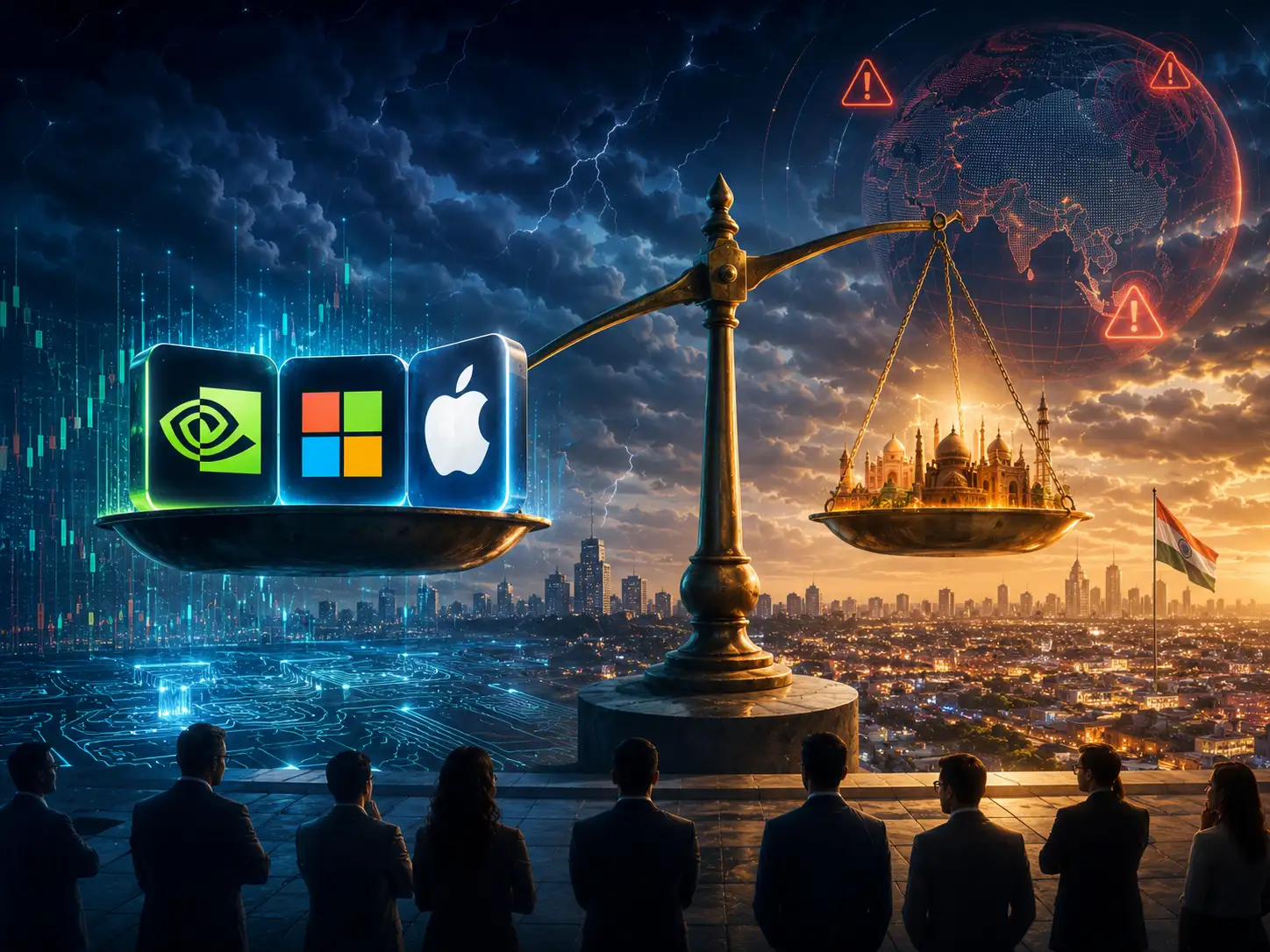
Two of Asia's biggest stock markets are now hostage to a single bet: that the AI chip boom doesn't stumble. Three companies — TSMC, Samsung Electronics, and SK Hynix — have absorbed approximately 28% of the entire MSCI Emerging Markets index between them, more than 2.6 times India's total 10.87% country weight in the same benchmark.
For emerging market (EM) investors, it is a concentration level with no historical precedent, parked in two countries, where an entire regional allocation now lives and dies by one order book, one export curb, one US trade policy pivot.
In Korea, the top 10 stocks now make up roughly 65% of the KOSPI, with electronics alone at 60.2% of the index. In Taiwan, the top 10 stocks exceed 65% of the TAIEX, with semiconductors at roughly 56%. TSMC alone accounts for 14.2% of the MSCI EM benchmark, Samsung Electronics for 7.8%, and SK Hynix for 6.6%. The question now consuming allocators isn't the gap itself — it's what comes next: whether a single layer of the AI supply chain, advanced fabrication and high-bandwidth memory, has made two of Asia's largest markets dangerously exposed to one input, NVIDIA's order book, and whether India's absence from that trade is finally being repriced as an advantage rather than a penalty.
Also Read | $320 billion danger: Jefferies warns 70 large EM funds are underweight India
India's Nifty 500, by contrast, shows zero fabrication or memory exposure in its top 10 holdings. Its largest sector weight is BFSI at an estimated 32–35%, with the index's top 10 stocks comprising about 26% of the total. Japan sits in between, with the Nikkei 225's top 10 stocks at 42–45% of the index and tech/semiconductor equipment names at roughly 30%, the highest concentration since 1989. China's CSI 300 is at roughly 25%, with technology at about 22% and "rising rapidly."
"India doesn't carry that single-point-of-failure risk," Parvati Rai, Fund Manager at Equentis PMS told ET Markets. "Taiwan and Korea have built phenomenal businesses, but their indices now live and die by a handful of semiconductor names — in both markets, one or two stocks alone account for approximate 40-50% of the index weight, so one export curb or demand wobble and the whole market feels it." Rai added that India's market cap is spread across banks, consumption, industrials, and increasingly power and infrastructure, which she said "could translate into more resilient and superior risk-adjusted returns over the full cycle," even without a domestic semiconductor champion.
Rishabh Nahar, Co-founder, Partner and Fund Manager at Qode Advisors, framed the risk in even sharper terms. "Markets like Taiwan and Korea are hostage to a single point in the AI value chain — chip fabrication — which makes their indices extraordinarily sensitive to one variable: NVIDIA's order book and US export policy," he said. "India's AI exposure is spread across power, data centres, telecom infrastructure, software services, and domestic consumption of AI tools. That diversification means lower volatility of outcomes, even if it also means you won't get the explosive upside of a pure semiconductor play."
Not everyone frames India's absence from chipmaking as a pure safety trade. Ajay Modi, Director at Piper Serica, pushed back on the idea that India is simply a "safer" substitute. "I would not characterize India simply as a safer alternative to Taiwan or Korea. Those economies remain critical to the global AI semiconductor value chain and India is not a substitute for them," he said.
Instead, Modi argued India's strength lies in breadth: the country is building capabilities "across semiconductor design, data centres, power infrastructure, cloud, networking, enterprise software, and AI applications," he said, pointing to policy support including the ₹76,000 crore Semicon India Programme, a Design-Linked Incentive scheme backing 23 companies across AI devices, drones, IoT, satellite communications and telecom equipment, and an 83% increase in FY26 semiconductor allocations to ₹7,000 crore.
Also Read | Behind India's Rs 5.5 lakh crore FII selloff lies a hidden list of 84 multibagger winners
The rotation into "hard assets" is already underway, fund managers say.
Nahar said global funds that have been underweight India on valuation grounds are finding it difficult to justify that stance when the underlying earnings growth story remains intact. “What's changed is where the incremental money is going within India — away from expensive consumer discretionary and IT names, and toward hard asset plays that are structurally linked to the AI buildout."
He singled out power as the most interesting theme: "Every data centre conversation eventually becomes a power conversation," he said, calling power, cooling and grid infrastructure plays "picks-and-shovels" bets with strong domestic policy support, even as valuations in some names have already moved.
Modi pointed to the scale of the capital now flowing into India's data-centre buildout. The country's data centre capacity stood at approximately 1.5 GW in 2025 and is expected to reach 1.7–2.0 GW by the end of 2026, with ambitions of scaling to 5 GW by 2030, he said. Backing that expansion: Microsoft has announced $17.5 billion in investment over four years, Google is expected to invest roughly $15 billion through 2030, AWS has committed more than $8 billion, and Reliance and Meta are collaborating on one of India's largest AI-ready data-centre projects, in Jamnagar.
"Rather than a tactical rotation into 'hard assets,'" Modi said, "what we are witnessing is a structural reallocation toward the physical foundations that will enable AI adoption at scale over the next decade."
Rai sees a similar dynamic in capital flows. "As allocators move away from crowded sectors, they are looking for ways to participate in the AI build-out without paying chip-stock valuations — and capacity-starved sectors like power, transmission and data centres fit that need quite well," she said, describing what was once a niche real-estate story as having "turned into a multi-decade capex cycle, backed by hyperscaler commitments and strong policy tailwinds."
The entry point matters too. According to Lighthouse Canton, MSCI India currently trades at a substantial discount to the all-time-high valuation premium it commanded two years ago, while foreign institutional ownership is hovering at a six-year low — a combination the report says has historically acted as "a springboard preceding India's strong period of regional and global outperformance." The report's framing is direct: Korea and Taiwan "own" the semiconductor-fabrication trade; India, it argues, is positioned for the next one — AI infrastructure minus the semiconductor and memory risk.
Whether that absence translates into outperformance remains to be tested. What is clear from the index math is the scale of the imbalance it is being measured against: three chip and memory makers, worth more on a single emerging-markets benchmark than an entire national equity market of 1.4 billion people.